Wednesday, August 23, 2006

Maine Report Part Four: The Goats

The place we rented was a cottage owned by, and located on, Painted Pepper Farm, a maple syrup and goat farm in Steuben, Maine. The farm is owned by a lovely couple who raise chickens and goats (and daughters), as well as tapping maple syrup, growing some vegetables, making maple-syrup nuts and granola, and picking berries. They sell their products on the honor system from a farm stand attached to their house. The maple syrup items are inside, and outdoors there's a refrigerated case for the eggs, goat's milk yogurt and an odd watermelon or pint of blackberries.

We were surprised to learn that they do not make goat cheese. All their milk is used either fresh or in yogurt - amazing, rich, sweet yogurt. Their herd is made up exclusively of Nigerian dwarf goats, which produce a lovely milk, but not much of it. The milk makes great, but prohibitively expensive, goat cheese, so they focus on the yogurt. Actually, the yogurt was pretty pricey, too - I don't know if that was entirely due to the price of the milk, or if the elegant glass containers pushed the price up significantly. In any case, the quality of the yogurt justifies the price, and apparently their herd has quite a following. People drive several hours up the coast to stock up.
Posted by Picasa


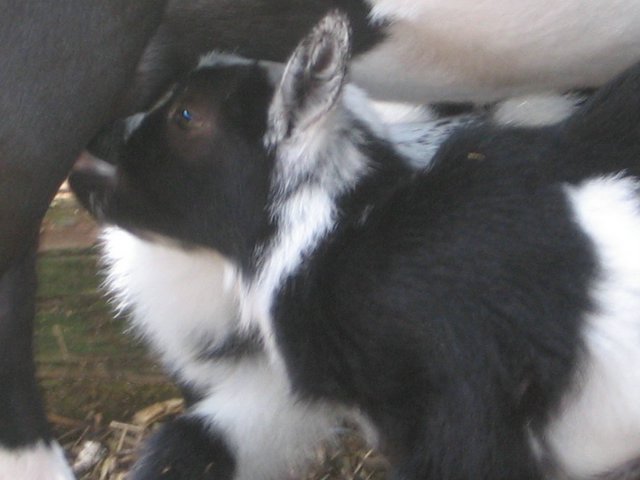
The goats were charming animals, very interested in our comings and goings. They loved to have their heads scratched, and one would respond to attentions by making a noise deep in his throat very much like a purr. There were one-week-old babies that left us weak-kneed. (Okay, they left ME weak-kneed).
Posted by Picasa


We city-slickers also learned a few things about goat-raising. First important lesson: the billy goats will start to smell - the stinkiest goat-cheese smell - just before breeding time, and if you pet them at that point, your hands will smell for days. We avoided the petting, but we can verify the stink. Also, the vigorous headbutting that was going on in the new mothers' pen occurs every time a new goat is added to the group. The structure of dominance needs to be determined. Sadly, Peppermint Patty, the new goat to the group the first night of our vacation, ended up clearly at the bottom of the herd. She failed to headbutt with proper vehemence.

So far, none of these goats have ended up in goat stew. The farm is expanding its herd, so females kids are welcome to stay. The boys are sold as pets - apparently, their size make them popular for 4H club members, and some people like to keep them as company for horses. Learn something new every day.

Posted by Picasa

Tuesday, August 22, 2006

Soda - An interruption

I interrupt the ongoing Maine report (oh, yes, there is more!) to bring you this article about soda making people fat. Okay, so this is hardly news. But my favorite part is this line, which seems to have been the pull-quote for almost every media outlet:

An extra can of soda a day can pile on 15 pounds in a single year.

I love that "extra." Don't worry, it's not your normal allotment of soda that's the problem, it's extra soda. Somebody should have spent a little more time working up the press release.

Maine Report Part Three: Roadside Stands

I lost my copy of the Jane and Michael Stern's Roadfood in my divorce, and it still makes me bitter. I have the new version, but I was attached to that copy that had travelled with me to so many drive-ins and clam shacks, diners and hot dog stands. I love road food, love the simple, strong flavors, the sense of joy and freedom of eating with your hands at a picnic table next to your car. Lobster fettucine has its place, but so do clam rolls. Particularly clam rolls made with fresh, big-belly clams.

Here's a plate of fried seafood to make you weep. Scallops, clams, shrimp, and under all that, a big slab of haddock. All fresh and local. All amazing.
Posted by Picasa

All that fried deliciousness was bought here:

Posted by Picasa

Notice the locally-made blueberry pies and cakes on the table in front of the menu. I dare any foodnik to drive by without stopping.

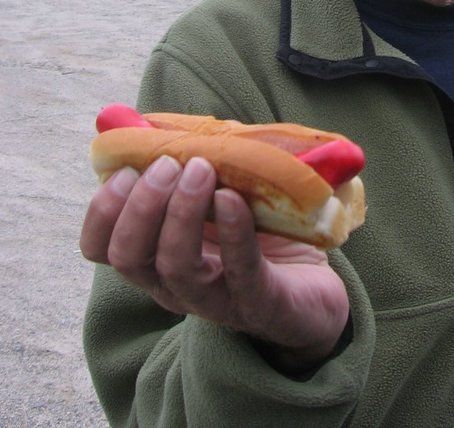
Sometimes, though, you just want a hot dog. This one, from a different stand, was rather alarmingly red:
Posted by Picasa

I saw the same hot dogs for sale at the fish shop later in the trip. J. asked the woman behind the counter what made them so red. In her heavy Maine accent, speaking very slowly, she replied, "They just come in that way." The mystery remains...

Maine Report Part Two: Seafood

"That don't have this in Austin." That was the review of a Texan in our vacationing group.

The blueberry may mean Maine to Mainers, but to out-of-states, lobster means Maine and Maine means lobster. And it's true that if you've only eaten frozen or pre-cooked lobster, or even lobster from a tank at a supermarket, the lively, just-out-of-the-ocean seabugs you can get in Maine are a revelation.

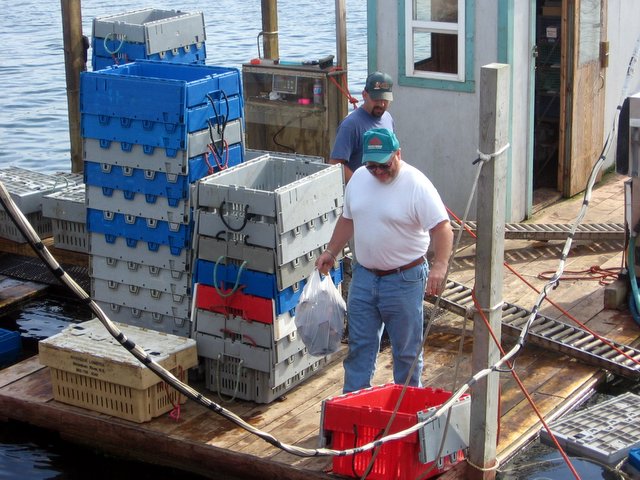
We took a lobster-fetching trip to Jonesport, about a half-hour ride up Route 1 from where we were staying in Steuben. Jonesport is a working fishing town, small and picturesque. To buy lobsters, you go down to the fisherman's co-op dock at about 5 at night when the boat comes in. You call down your request to the lobsterman, soft or hard shell and the number of pounds or number of lobsters. Then he takes the lobsters out of the underwater holding crates, weighs them up, puts them in a bag, and drags himself with his delicious bundle across to the stairs on a float. We paid $7/pound for hard-shell.


Posted by Picasa


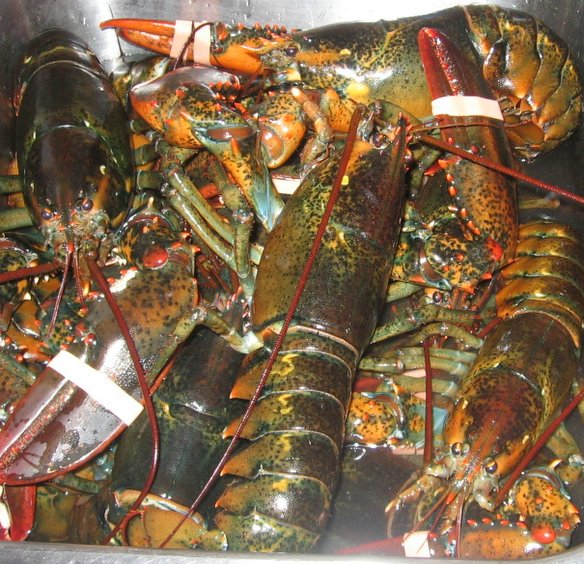
Once home, the water should be put on the moment you walk in the door. Once you have a full boil, you're just six minutes away from seafood perfection.

Before:

Posted by Picasa

After:

Posted by Picasa

We bought more lobsters than necessary for that first dinner, because nothing feels better than knowing you have leftover lobster in the fridge. All the carcasses, minus the liver, were put back in the pot to make stock. I simmered the shells for over an hour, then put the stock in the fridge and went to bed. The next day I removed the shells and simmered the stock down a bit more, until it was rich and condensed. We had enough shells to get two quarts of very flavorful stock.

For the second lobster dinner, I made sausage and lobster fettucine, a surefire winner. I'll try to give a recipe here, but really, I winged it, so this is not very precise:

Lobster-Sausage Fettucine
1.5 boxes fettucine (cook usual way)
Three lobsters-worth of meat, in large chunks
About a quart of rich lobster stock (if you don't have tons of extra shells from an earlier lobster dinner, you could use some shrimp shells to increase the flavor of your stock)
About eight sweet Italian pork sausages
1 tsp thyme
A shallot (I didn't have this, but have used in the past)
1 pint light cream
1 Tb. butter
1 Tb. flour
A little white wine or sherry
Pepper, salt, a pinch of sweet paprika

Crumble the sausage and brown in a little oil (or do as I did and use the butter in which the lobster had been dipped). Remove and drain. Pour off fat. Melt butter, add thyme, (add minced shallot briefly if using), then add the flour and cook roux to remove raw flavor of flour, about 30 seconds. Whisk in stock and cook until slightly thickened. Add cream and cook a few minutes more. Add lobster and sausage and heat until warmed through. Add wine, salt and pepper to taste, and paprika if the color needs improvement. Taste, make adjustments, pour over fettucine and serve.

Lobster is of course not the only seafood available in Maine. The last night of vacation, I used the last of the lobster stock in a chowder - J.'s favorite chowder, in fact, beating out clam.

Crab and Corn Chowder, roughly (all measurement are estimates)

1 pound crab meat (can use body meat)
6 ears corn
1 quart lobster stock
2 bay leaves
1 tsp celery seed
3 strips bacon
1 1/2 very large white onions
About a dozen smallish potatoes
1 pint light cream
1 tsp smoked paprika
Lots of black pepper, a little salt

Remove the kernels from the ears of corn. Put the cobs into a pot with the lobster stock and simmer at least 1/2 hour.
Brown the bacon, remove. Use the fat from the bacon to cook the onions. Add the potatoes and give them a few turns in the fat as well, maybe two minutes. Add the celery seed and smoked paprika and cook about thirty seconds more. Then add the stock and bay leaves and simmer on low until the potatoes are cooked. Add the crabmeat and corn kernels, plus the cream and allow to heat through. Taste and season with salt, pepper.


Both recipes serve about eight normal people, or six who have spent all day hiking up a mountain.

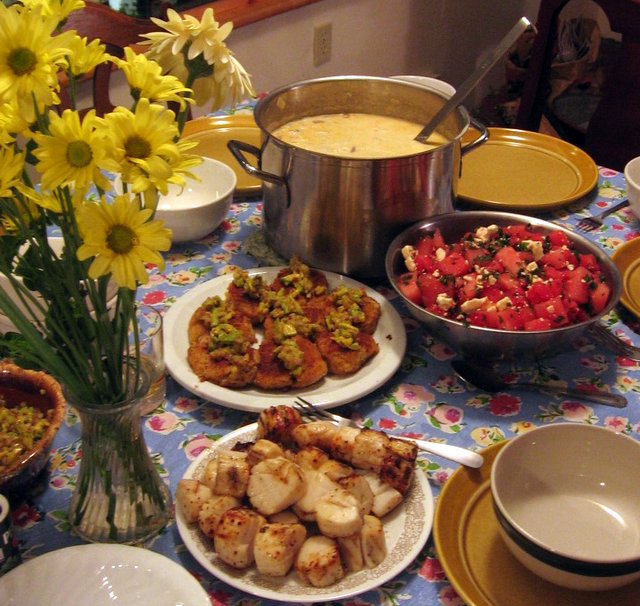
I served the chowder with Nigella Lawson's watermelon-feat-mint salad, some grilled vegetables, grilled scallops simply prepared with olive oil and pepper, and crabcakes. The crabcakes were pretty straightforward, just leg and claw meat bound together with a little egg and bread crumbs, spiced with Penzey's Northwoods seasoning, browned in butter, then topped with avocado, lime and red onion. The scallops were from Nova Scotia, not far away in those parts and the best source of scallops in the world. They were marvelously sweet.

Posted by Picasa


One member of the group had a piece of swordfish, but it's worth noting that in Maine, seafood mostly means shellfish and haddock. Other fish are caught in the local waters, including salmon, but scallops, lobster, shrimp, crab and even mussels, quahogs, and winkles seem to dominate over finfish, except for the ubiquitous haddock and the occasional cod.

That's fine by me. Despite the efforts of Beyond Salmon, I'm still a shellfish girl at heart.

Maine Report Part One: Blueberry Land

Posted by Picasa
Washington County, Maine produces something like 90% of the world's wild blueberries. If you hit the season just right (we were off by a few days this year), the fields along the road shimmer blue. In the fall, the berry bushes turn vibrant red. It's a lovely place.

Wild blueberries, in case you're unlucky enough only to have had the big, cultivated type, are tiny, a pain to pick (though they can be raked with a special device that catches the berries in a pan) and incredibly flavorful. They are also really good for you. They're high in antioxidants, I assume in part because they have such a high skin-to-flesh ratio. The good people at Wyman's, the major player in wild blueberries and a big employer in Washington County, have realized health benefits make for a good marketing opportunity. In recent years their wild blueberries have been made available frozen in the supermarket year-round, as well as in the form of juice, and of course the canned pie filling they have always sold retail. This is altogether a good thing, but, given the ease of acquiring wild blueberries in the last few years, I thought I would be less excited than I used to be about being in the wild blueberry capital during the peak season.

I was wrong.

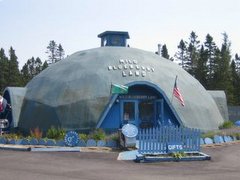
The people of Washington County have embraced the blueberry. The blueberry represents Maine as much as the moose or the lobster - maybe not to people "from away", but within Maine, there is no question. Blueberry pancake breakfasts are offered at every church and lodge. There's the big wild blueberry festival in Machias, with pie-eating contests, the blueberry musical, a blueberry run, and the annual raffle of a blueberry-themed quilt made by the women of the town. And then there's Wild Blueberry Land, a fantastic piece of roadside kitsch selling all things blueberry.

What I found particularly charming about Wild Blueberry Land (besides the building itself, of course) was that the blueberry items were all pretty good. Sure, there were some nationally sold brands that just happened to have offerings in blueberry flavors, like a blueberry iced tea. But there were locally-made blueberry pies (excellent), scones (also very good), muffins (average), truffles (the chocolate was high-quality and the blueberry fondant filling was bright and fresh in flavor), as well as very good blueberry ice cream from Giffords, a Maine brand.

In case you think that's all the blueberry products anyone should expect to find in Washington county - well, think again. Our group of vacationers decided to have a contest the last night to determine who had consumed the most blueberry items. I blush to declare myself the winner, the blueberry queen, as it were. In order to achieve such heights, I had to consume (or at least taste) raw blueberries, a blueberry scone, a blueberry muffin, French toast with blueberry compote, blueberry wine, blueberry ale, blueberry milkshake, a blueberry truffle, blueberry jam, blueberry soda, blueberry ice cream, blueberry banana bread, and blueberry coffee cake. But I did not even get a chance to try chocolate-covered dried blueberries, blueberry pancakes, blueberry tea, blueberry liqueur, blueberry sorbet, blueberry whoopie pies (!), blueberry mimosas and blueberry cheesecake. Clearly, I have goals to reach in my next visit.

Thursday, August 10, 2006

Party food

This weekend my siblings and I hosted a 45th wedding anniversary/70th birthdays party for my parents. I catered, so that meant all the cooking I’ve done since the end of the Eat Local challenge has been party-related.

For financial and logistical reasons, I knew I was not going to be able to buy locally for this event, but I found that I was mostly unable to bring myself to purchase regular supermarket meat or eggs. So the produce was Haymarket (not a farmers’ market, for you non-Bostonians, but a big open-air market of regular commercial produce of mixed quality but rock-bottom prices), but most everything else came from local Italian markets or Whole Foods. Strangely, though I wanted to use organic pork, I still couldn’t bear to use my great heritage, pastured pork on people who were unlikely to appreciate it. (“I am large, I contain multitudes.”)

I’ll give ya’ll the menu, because it was actually one of my best-planned parties. I fed about 45 people at a reasonable price; everyone ate a lot and seemed to really enjoy the food; the food wasn’t too scary for a conservative crowd, but was not so cliché-ridden as to bore me; and everything was done and in place when the first guest arrived without any last-minute craziness. I think the mix of purchased and homemade items was just about right - enough homemade to give flair and warmth, enough purchased to make things easy.

Cheese plate: Generously provided as far, far below wholesale price by my friend A., the cheese salesman. There were about a dozen lovely cheeses.
Crackers.
A basket of breads, including a large whole wheat Tuscan loaf, a long crusty white, some soft rolls, a ring loaf, and a multigrain.
A tray of cold, sliced roasted meats: a boneless pork rib roast, a pair of beef eye or round, and a half-turkey. I rubbed the pork simply with black pepper and salt, the beef with black pepper, salt, and celery seed, and the turkey with Penzey’s fabulous Northwoods Fire Seasoning.
An assortment of condiments, including (semi) homemade artichoke/caper spread, fig/caramelized onion spread, and horseradish spread, plus purchased tapenade, mustards, and mayo.
A vegetable platter made up of steamed green beans in basil oil, steamed asparagus, roasted tomatoes, roasted peppers, and a ruffle of prosciutto slices.
Purchased olives and pickled onions and homemade marinated mushrooms.
A fresh fruit tray with grapes in three colors, cherries in two colors, cantaloupe and honeydew slices, and some fresh figs, sliced in half and hit with the torch,
Devilled eggs. (Why do people love these so much? They were the first item gone.)
Two 12 inch cakes: one raspberry-almond, the other chocolate.
Purchased ice cream and homemade berry compote.

People ate pretty much everything. The spreads, which I hoped would elevate the simple cold-cuts-and-bread arrangement, probably were used the least. I think part of this was logistic: people circled in the opposite direction from what I had expected, so they hit the spreads before the meats. The fig and onion, which was simply a matter of caramelizing onions and folding them into purchased Dalmatia fig spread, was the most popular, and with good reason. It was delicious. But I think overall, people are more afraid of mixing together flavors than I expected. They weren’t sure what meat went with what spread, or if they were supposed to use the spreads with the meats at all, or just on the bread, so they skipped over the spreads entirely. Lesson learned. Next time I do something along these lines, I’ll either make the sandwiches myself or include suggestions on the labels for the spreads.

People ate less fruit that I would have expected, too. But they ate more vegetables – the roasted tomatoes were gone in a flash, and the asparagus and peppers soon after. There were beans left over, but I had made an awful lot of beans. The three meats seemed to go over equally; no distinct preferences were shown. Everyone ate the meat, but not with the excitement I think they would have had the crowd been younger. For the under-forty set, home-roasted meat is a comparative rarity, but for these folks it was nothing particularly special, though still a definite step up from deli cold cuts. The cheese was a big deal, though. Some people just stood there and noshed.

The raspberry almond cake was a huge hit. I used the Martha Stewart wedding cake recipe from Baking with Julia, brushed with amaretto syrup, then filled with raspberry jam, raspberries, and a plain traditional buttercream. People went back for seconds and thirds, which was gratifying. The chocolate cake was not ignored, but in the end, about a third was left – the raspberry-almond had been annihilated. The ladies loved the marzipan flowers and bees, a comparatively simple decoration that always goes over well. I like it because I do the marzipan work ahead and just place the flowers on the cake that morning.

My sister took pictures, but I forgot my camera, so I’ll post when she forwards hers along. That probably won’t be for another week – I’m off on vacation to Maine, where I expect to eat local vegetables and seafood and all sorts of good stuff. I’ll be renting a cottage from a goat/maple syrup farm, so I intend to take lots of pictures and come back with all sorts of food tales. See you then.

Friday, August 04, 2006

Reinventing the pig

This story is a little frustrating. I mean, I'm glad they want to breed some fat back into pigs. That's great. But Tamworth, Berkshire, and other heritage breeds already have enough fat. Of course, some of them won't thrive in a 2 foot by 4 foot cage, so we better rely on technology to avoid having to change our system...

Wednesday, August 02, 2006

Organic at the bodega

There's a really interesting article in today's Salon (you have to do the day pass thing to read it) about programs designed to bring fresh produce into inner cities. It's a hard battle, but there's some progress showing.

The farmers' market I go to with the most regularity is the tiny, two-stall one in Mission Hill, just down the block from my office. Although most of the people that use the market seem to be employees of the hospitals around the corner, many shoppers do seem to be local residents, some of whom pay with food stamps. Although some of the items (tomatoes, fruit) are more expensive than their grocery-store equivalents, the big bunches of greens, beets, squash and so on are very reasonably priced and provide a lot of nutrition to the dollar.

My mother works for a food pantry at her church that receives donated fresh produce from a local farm. Unfortunately, a lot of it goes to waste. It's not that people won't take fresh vegetables; it's that they won't take fresh vegetables they don't know how to cook. Many of the people who use the pantry are from South America or the Carribean. The farmer is Italian. The fashionable arugula and fennel he grows for his upscale clientele are completely foreign to the people at the pantry (and to my Irish mother for that matter, who calls me with questions: I've got this thing that has long frilly leave attached to a white stalk that kind of bulges at the bottom like a garlic, but flat - what do I do with it?). The cultural disconnects are as problematic as the logistics. But both can be overcome.

Tuesday, August 01, 2006

Eat Local Challenge: The Finale

Well, it's over. I actually gave up a little early, because my brother arrived in town and we had both breakfast and dinner out on Sunday, so I let things slide. Having a fridge full of local ingredients means that even a let-your-hair-down, non-local-eating day will include lots of local vegetables and fruits, though. Today's lunch is nearly completely local just because local has become standard for me. The exception is the bread and peanut butter I packed to go with my local salad, fruit and yogurt. I missed bread. It was far too hot to consider baking bread, and of course there are no available breads made from locally-grown wheat, although of course there are many locally-made breads.

Bread, lemons, pasta, coffee, gin, and nuts: if we could just find a way to ensure easy access to locally-grown versions of those items, I could do the eat-local challenge forever. And maybe some white flour and sugar to make the occasional cookie. And some chocolate.

Okay, so maybe I'm not really that interested in pursuing a fully-local diet for the long-term. But I realized there were definitely places where I could increase my local sourcing. I will continue to buy my cornmeal from Gray's Grist Mill, which is fantastic, and my dried mushrooms from Maine. I intend to be more stringent in choosing local dairy, which are widely available even at my big, mainstream supermarket. I hope to use honey and maple syrup more and sugar less. And, with the exception of the cooking essentials parsley and lemons, the first of which was rarely available at the farmers' markets and the second of which will not grow in New England, I think I can stick to all local vegetables in season without much trouble. I already sourced nearly all of my meat locally.

I think that I can move my in-season local eating from something like 50% to closer to 75% without much effort. Winter is another story, and one I fear is unlikely to change without a change in my living situation. With a cellar, more storage space, I could store, freeze and can more local food for the winter, but otherwise I'm stuck.

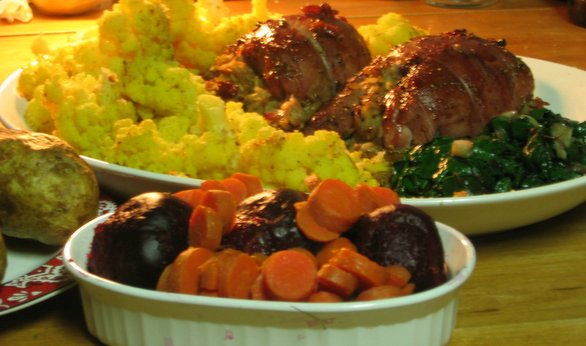
For a final big send-off meal on Saturday, I made a ground beef dish with zucchini, garlic, corn, onions, mushrooms, and peppers. It was supposed to be stuffed zucchini, but two of my zukes had gone soft on me, so I just sort of threw everything into the oven and baked it off (after browning the meat and sautéing the onions, of course). Only the oil and black pepper were non-local. I made cole slaw from cabbage and carrots, sour cream, and mayo made from an egg yolk, olive oil, mustard powder, and a teaspoon of vinegar (non-local items: vinegar, oil, mustard, black pepper, celery seed). I tried to make a cornbread using whole wheat flour, which came out terribly. I think the whole wheat flour absorbed more of the liquid than white would have, and so there wasn't enough moisture for the (non-local) baking powder to react with. As a result, the bread didn't rise well, and there was that unfortunate distinctive metallic-salty flavor of baking powder. (The whole wheat flavor also overpowered the corn flavor.) The guys ate it, though, and didn't think it was nearly as bad as I did. Everything in it was local, save the baking powder, and it might have been okay had I increased the milk. For dessert, we had a honey-peach-sour cream ice cream, and that was really good.
Here's a rough recipe:

Honey-Peach-Sour Cream Ice Cream
1/2 cup honey
1 cup milk
2 egg yolks
1 1/2 cups fresh peach chunks, pureed
1 cup sour cream

Make a custard with the honey, milk and egg yolks. Chill. Fold in sour cream and peach; freeze in ice-cream freezer.

Unlike the other honey-sweetened ice creams I've made, the honey flavor did not dominate. The peach came through strong and clear, with a nice sour tang in the finish. I'll make this again.

Wednesday, July 26, 2006

Media flotsam and jetsam

There's a nice article in today's Globe about local eating. Good to see so much attention given to movement.

I know everyone's already seen this story about CBS advertising its new shows on egg shells, but I just wanted to express my general disgust. There's this weird tendency in the mainstream food world to make food something other than food. Have you seen the Cheerios games on the back of the boxes? The whole business is creepy, particularly for those of us who try to avoid advertising as best we can.

According to the All Things Maine blog, this farm is the only place in New England growing hops commercially, which is interesting, because, as I understand it, hops will pretty much grow like gangbusters here. Good news for local brewers, which J. is supposed to start becoming as soon as the hot weather is over.

Finally, I'm thinking about writing an article about Boston food bloggers, with an emphasis on those who are interested in seasonal eating. Probably won't get started on this for a few weeks, because I have a lot going on just at the moment. But if you're a Boston-area blogger who might want to talk about blogging. let me know.

Tuesday, July 25, 2006

Week Three Summary

(Something went wrong with the photo this time - apologies.)

I was better this week about sticking to the system, only breaking once* for dinner out with the two friends I have from work (one of whom has left us, damn her, and the other is leaving in a few weeks. Sigh.) Lunches remained some variant on salad and potatoes or eggs or cheese, and breakfasts were mostly yogurt and fruit. I haven't felt much like eating dinner in the heat, but one day I was very clever and used the crock pot to cook a fine dish overnight. The farmers' market finally had some peppers, so I bought jalapenos, Italian sweet and green bell, sautéed them with some onions, browned some stew beef, and let the whole thing cook on low for about nine hours. If I had use of my usual ingredients, I probably would have thrown a little beer in there or crushed tomatoes, but I think it turned out better with the only liquid being the juices from the meat and peppers. The flavor was richly meaty and the different peppers gave a complexity I wouldn't have expected. Score one for limitations.

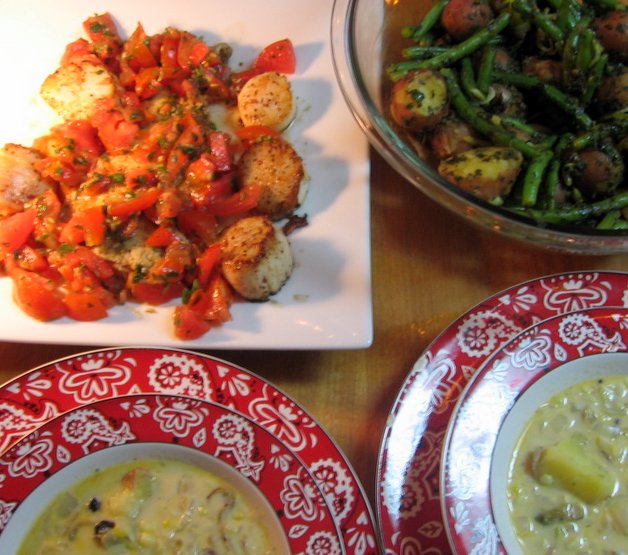
The meal in the picture was Saturday night dinner. Scallops and haddock ("local catch" at Whole Foods), pan-fried in butter, with tomatoes and fennel and parsley, green beans and potatoes in Parmesanless pesto, and clam-mussel chowder. The chowder was another case of broken habits leading to something good. Usually, I start chowders with bacon. (Actually, I start a lot of things with bacon. It is, as my friend M. used to say, the food of joy.) But, although I can find local bacons, they are all made with decidedly non-local sugar, so that was out. This chowder was based on a broth made from simmering corn cobs, to which I added the liquid from the canned mussels. Yep, I used canned mussels from Maine, which I had picked up at the end of June to have around for a quick local meal. Surprisingly, they were really good - not quite the same as fresh, of course, but more delicate and tender than one would expect from a can. Not a bad thing to have on hand. Anyway, to this base I added potatoes, then corn and the mussels, cream and a little salt, paprika and pepper and that was that. And again, really good. The mingled sweetness of the corn and the mussels was more prominent than it would have been if it had to compete with the smokiness of bacon.

This is my last week. The ingredients I have been missing most? White flour, lemons, Parmesan and wine. And chocolate, coffee and sugar, of course, but those haven't put any sort of cramp in my cooking, just in my habits.

*At least as far as meals go. I've also indulged in one or two iced coffees while out and about, and had a little chocolate a co-worker had brought back from a trip, because it would have been rude to refuse. Shut up, it would have! Posted by Picasa

Wednesday, July 19, 2006

Breakfast: It's what's for dinner


I generally make a nice meal on Saturday and Sunday, but during the week I eat simply - salad, a fried egg, some potatoes, yogurt and fruit. It just doesn't seem quite worth it to make a full meal just for myself. But of course before the Eat Local project, I would sometimes get a hot meal at work or pick up sushi on the way home. So I've been feeling the need for real meal. Of course, my favorite real meal is breakfast, so that's what I made for dinner.

I thought I might be able to convert cheese blintzes to my whole wheat-honey ingredient list. I used 1/3 cup water, 1/3 cup apple cider, 2/3 cup milk, and 1 cup whole wheat flour from Maine, plus a pinch of salt. These proportions are from Julia Child, but I replaced some of her water with cider, because I thought the acidity might help keep the crepes tender. So many whole wheat things are rubbery. I let the batter sit for two hours; a good idea with any crepe batter, but essential here, because whole wheat takes longer to absorb moisture than white flour does. When I returned to my batter, it was far too thick, and I had to add another 1/4 cup of water. That made it thin enough, but note! if you try this, stir the batter before pouring each crepe. The batter tend to separate just a little. But the crepes came out fine, very tasty even on their own.

So crepes were done, and then I needed a filling. I mixed cottage cheese with honey in the blender, since I had it out to mix the crepe batter anyway. This was a mistake, but not a big one. The batter became too thin, and filling the crepes was a bitch. They didn't come out pretty and plump, but somewhat flattened. Didn't matter, though; they were delicious. I drizzled some maple syrup, topped with blueberries, and enjoyed my dinner thoroughly. Posted by Picasa

Sunday, July 16, 2006

Week Two Summary


So I was much less strict on week two, mostly for reasons beyond my control, as I've mentioned. The two staff lunches, the trip to New York, and an outing yesterday to pick up a half-cow's worth of beef in Groton meant quite a few meals were not local. But overall, I stuck to the program. And it's getting easier, partly because I'm getting into the habit of bringing enough food to work, partly because the farmers' markets have exploded with produce. We seemed to have crossed rather suddenly into summer. At the beginning of July, summer may have technically begun, but the markets were still full of peas, baby greens, radishes and strawberries, the same foods Gourmet will feature in its Easter issue. But this week we have corn, tomatoes, basil and, thank ye gods, tiny "spring" potatoes.

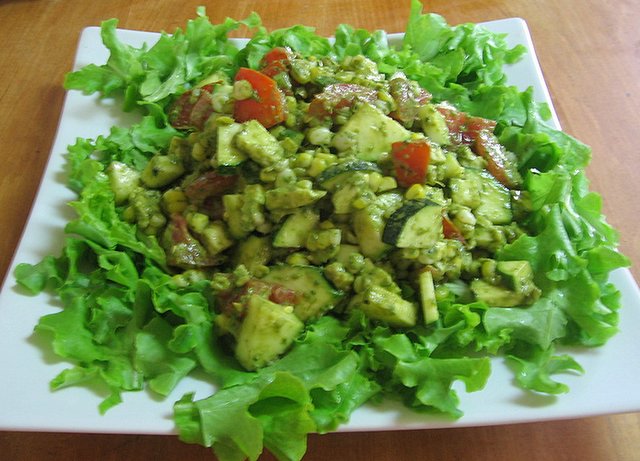
The salad above utilizes all the new bounty: tomatoes, zucchini, corn, mozzarella (from Maplebrook Farms in Vermont), and a dressing of basil, Maine sea salt and olive oil. Last night's dinner was a summertime classic - tomato, mozzarella and basil salad, followed by New York strip steak (from River Rock Farm in Westport), with corn on the cob and potatoes in Kate's butter (Maine) and parsley. I've noticed that small changes in preparation of what are essentially the same ingredients provides enough variety to keep eating interesting when the ingredients themselves are top-notch. Greens sautéed and served with a fried egg on top one day is sufficiently different from a ramekin of greens baked in a custard with cheese the next. I don't need the level of variety I tend to think I do.

Walter Jeffries mentioned in the comments that he would like to know what I'm paying for my ingredients. So would I, for that matter. I'm terrible about tracking my spending, but I'll try to pay closer attention this week. I can say that Walter's pork is cheaper than what I get: I spend $5.50/lb for pretty much all my meat, lamb, pork and beef. Both the pork and beef farmers tend to be generous with the extras, though - fatback, trotters, hocks, beef soup bones, and so forth are thrown in for free. And we really made out this weekend; the woman at the slaughterhouse told us that the people who had picked up their cows before us hadn't wanted the offal, so we reaped the bounty of their unwanted heart, tongue, and liver.

River Rock Farm is using a new slaughterhouse, Blood Farm in Groton. Blood Farm processes its own meat, as well as the meat of other farms, and they have a small retail shop with freezers of rabbit, turkey, chicken, veal, pork and beef. I got another lesson in buyer beware, though. The chickens they sell are not only not their own, but not locally produced. They get their chicken from a distributor. The woman who was helping us explained that the USDA doesn't allow poultry to be slaughtered at the same facility that processes beef. Just another example of how the government seems hellbent on putting small producers out of business. Posted by Picasa

Thursday, July 13, 2006

New York has changed (or, when I fall off the wagon, I really fall off the wagon)

This was my week for breaking the eat local rules. Monday and Wednesday I had staff lunches to attend, but ate local breakfasts and dinners. But Tuesday - well, Tuesday I hauled down from Boston to New York for a job interview, and as far as I was concerned, all bets were off.

What's ironic about that is that the job was a position at an (unnamed) organization devoted to the promotion of sustainable agriculture. So I was taking a break from my commitment to sustainable agriculture to try to get a job in the field. Of course.

The short story on the job is that I don't think it's going to work out. The long story I'm not going to put online. Let's just make a suggestion to anyone doing hiring out there - if someone takes a day off from work at a busy time, lies to her trusting boss, and comes all the way from another state at great expense and inconvenience, it might be helpful if you've actually 1) looked at her resume or 2) bothered to free up the schedule of the person she needs to meet with so that the interview process can be more than ten minutes long. I'm just sayin'. Also, if you're the person who HAS the job your company is recruiting to fill because you're leaving? Don't use the words "burnt out" or "monotonous." Really not very appealing.

At the airport I had a bagel and blessed, blessed coffee. Blissful coffee. I arrived in the city a good three hours before I needed to be there, and so I walked. I walked for almost the whole three hours, with only a short break to eat a cinnamon-walnut swirl at the City Bakery. (Which was rather disappointing, by the way. I have Maury Rubin's tart book, and I worship him, but that was a pretty dull cinnamon swirl.) In some ways, New York has not changed. The smell of barely-burnt pretzel wafts from street corners. The bodegas still offer the most amazing selection of flowers. I was pretty high on being in New York for those first few hours, while I was imagining a life there, back in the big city, with a fabulous job doing something important for the world, attending conferences with intelligent, concerned people, eating amazing food.

But then I went to the interview. And when I came out, I was a bit, well, demoralized. And it was nearing one-hundred degrees. Didn't I mention that? So I walked some more, and went into Grand Central, which I hadn't seen since the ceiling had been cleaned, and I admired the market there (comparing a train station with its own Penzey's to the Dunkin Donut and McDonald's wasteland that is North Station in Boston), and then I decided that what I really needed was a drink. It was terribly, terribly hot, I was taking a day off of local eating, I was in the city, and I wanted a gin and tonic, damnit.

And this is why I say New York has changed.

I walked from Grand Central vaguely in the direction of the bus terminal, where I would be getting my luxury ride home. (Yup, plane down, bus back - because I'm half cosmopolitan, half poor.) I wandered a bit up and down the streets. I saw about five thousand places to get a cup of coffee, nearly as many places to buy freshly squeezed juice, and a few hundred sushi restaurants. What I did not see was a bar. Really, for blocks and blocks, just cafes and juice bars and pizza places and a few fancy restaurants that probably had bars, but were not open or were far too intimidating. I wanted a sandwich and a G&T. In the New York I remember from only a few years ago, that would not have been a problem. What had happened? I was outraged. Also, sweaty.

I finally found a terrible, overpriced, tourist-trap of a deli with a bar, and while waiting for my drink, I had to shoo a cockroach off the table. So maybe New York hasn't changed all that much after all.

New York has changed

Sunday, July 09, 2006

Eat Local Challenge: First Week in Review

The easiest and most exciting thing in the last week has been limiting my cooking to local foods. With a fridge full of local dairy, fruits and vegetables, and a freezerful of local meat, plus a handful of nice local specialty items (maple syrup, dried tomatoes), I've been able to put together some pretty damned fine meals. I've made a lovely whole-wheat (from Maine) crust pizza with pesto and the first available local (hothouse) tomatoes, plus mozzarella from Vermont (Maplebrook Farms, Bennington, VT, 145 miles). I've made Gray's Gristmill cornbread, a weird recipe that uses only beaten eggs for lift and makes a dense, moist bread that I disliked at first, but came to appreciate. I made crockpot pulled pork (I know, and yes, some bits can be a little mushy, but I have no grill) with Vermont apple cider. I ate a lot of simple salads of lettuce, radishes, scallions and sprouts. some enhanced with leftover slices of roast beef. Strawberries were consumed in every possible dairy product - with yogurt, with whipped cream, and in smoothies with milk. I've eaten more vegetables than usual, which is saying something. I've felt an altogether unlikely level of excitement about finding something new at the farmers' market - "hey, carrots! Wow! You have carrots! That's great!!!!" And, amazingly enough, I've spent less on food than usual, because I have not been buying two coffees each day, or an afternoon cookie, or breakfast out. This is all good, and I intend to keep it up.

But I'm lessening the restrictions somewhat. I've found that not allowing for some time spent sitting in cafes or bars is limiting my social life. I have to keep saying "no" in a way that I found frustrating - not just to myself, which is hard enough, but to my guy and my friends, which feels terrible. I remembered how liberating it was to stop being a vegetarian, to be able to go to any restaurant at all and have eating options, not to be such a drag, always fussing over what I couldn't eat. The one things I disliked this week was not having the freedom to go stop while out and about in the city to have a glass of wine or lemonade with J.

So, for the rest of the month, I am allowing for "off-site beverages." All food, all meals are still to be consumed at home (with my original "people over projects provision" - I'm going to eat at M.'s barbecue). But I can have a drink when I'm out if I want to.

It's strange how powerful the idea of purity is for me. I think it's the Catholic upbringing. It was hard for me to decide to relax my standards; it felt like quitting or cheating or something. Clearly, I'm not the only one; at the Eat Local Challenge site, several articles discuss the important questions like "are spices okay?" But this week I had an interesting talk on another topic that touched on this idea with my friend A., a lovely, wise Hungarian gentleman of my acquaintance who is in his seventies. We were discussing a friend who can be a bit of a perfectionist, and I was explaining that he wouldn't see himself as a perfectionist, but only as trying to be "good enough." To which A. replied, "Ah, what is good enough in this world? There's so many terrible things. Just to try is enough." A. has lived through more than I hope I will ever see of the horrors of the world. I think when he speaks, I should listen.

I'll have to be far from perfect this week anyway. I have two staff lunches at work I have to attend, and I have a surprise trip I have to take, for a special secret reason to be possibly revealed later, depending on outcome.

Tuesday, July 04, 2006

What I've learned so far

What I've learned so far...

1) Starch makes you feel full. I don't know how the Atkins crowd can claim they are never hungry. I've been on a near-Atkins diet for four days, heavy on the meat, dairy and vegetables, and I'm pretty much always hungry. I would pay through the teeth for some local potatoes. Soon?

2) And, speaking of paying through the teeth, local fruit is expensive. Local vegetables are about the same as supermarket, my local meat is cheaper than comparable organic meat, but local fruit is really expensive. And, apparently, I can hoover up a quart of strawberries in no time. Which brings me to ....

3) I eat a lot. Really, I must eat all the time. Now I understand why I'm chubby, because I eat all day long. This is much harder to do when you can't just buy stuff. Planning out my eating ahead is making me painfully aware of how much I usually eat between meals. The meals are about the same, but the between-meal munching is much more problematic. Which reminds me..

4) Stopping to get a bite or a drink is a big part of my life. By far the hardest part of this experiment is not giving up my favorite foods or having to cook all my meals. It's not being able to stop while walking around in the city to sit and have a coffee or a drink. Urban folk buy the right to sit down in public with the purchase of food or drink. And restaurants do not have all-local options.

Actually, this is a pretty big problem. I don't drive, so summer in the city is hard enough as it is. No running off to the pond or the ocean for me. I don't even have a yard, so no barbecue or gardening. That pretty much leaves walking around, puttering in used book or cd shops, going to the marvelously empty museums, and, most of all, sitting in cafes or bars, watching the world walk by. I don't know if I'm going to be able to give that up for whole month. I don't know that I want to. But giving it up so far has shown me how much I take it for granted.

5) Jonnycakes are hard to make. Here's John Thorne on the subject:

Let's be honest: unless you come from Rhode Island, a true jonnycake isn't
worth make for anyone but yourself. They're tricky to make and no one will thank
you for the effort - at least until they've acquired the taste. Why make them?
Well, they taste like that crisp crust that forms of the bottom of the mush pot,
a mouthful of hot crunchy corn. If that and the pleasure of working a delicacy
out of unpromising and reluctant material is the sort of thing to appeal to you,
the effort pays for itself.


Well, maybe. But I wasn't able to achieve sufficient success to really speak to
jonnycakes with any authority. I will say that Gray's Grist Mill produces an
amazing cornmeal, full of bright flavor, a revelation of how good cornmeal can
be. But my jonnycakes were a disaster, the lovely crust coming away from the
cake every time, leaving a sticky footprint on my cast-iron skillet. I gave up
on cast iron and switched to my tiny, rarely-used Teflon pan. Two miniature
jonnycakes cooked slowly, slowly, and I was finally rewarded with the promised
flavor and crunch - two whole bites-worth. I gave up for the time being and
had a couple eggs instead. I think the secret might be a real griddle, not
a skillet, and a very thin spatula. I will try again, but in the meantime..

6) I can make a silk purse of a sow's ear. Or rather, I can make a very
nice dinner out of leftover jonnycake batter, which is essentially polenta. I
put it in the fridge until dinnertime, then dotted the top with butter and
broiled it to get that lovely crunchy crust. I then served it topped with
sauteed mushrooms, re-hydrated dried mushrooms and sun-dried tomatoes (Sangha
Farm, Ashfield, MA, 109 miles), fresh oregano, pepper and paprika, plus a
spoonful of smoked goat's cheese, and a side of beet greens and early garlic.

7) I've learned I could live happily on goat's cheese.

8) Oh, and about those mushrooms? I've learned to doublecheck labels. There's a mushroom grower in Connecticut that used to provide mushrooms for the Harvest Coop. The store carried two types of mushrooms, the ones from California and the ones from Connecticut, and I bought the Connecticut ones all winter. So yesterday I picked up the California mushrooms, read the label, put them down, picked up the other mushrooms, and bought them, only to notice while cleaning up AFTER dinner that they came from Pennsylvania. Not the same mushrooms. So I've fallen off the wagon, inadvertently. Bugger all.

Monday, July 03, 2006

Day Two


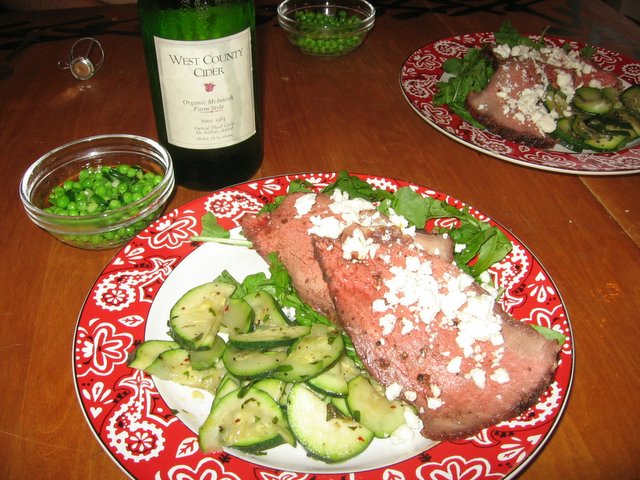
This was dinner: cold beef with Great Hill Blue (Marion, MA, 62 miles) over arugula with just a drizzle of olive oil; zuchinni sauteed in olive oil with fresh oregano (Coy Brook Farm, West Brookfield, MA, 68 miles); peas and scallions just turned in butter (Cabot's, from farms all over the state of Vermont, let's just say 200 miles) , and sparkling apple cider from West County Cider of Colrain, MA, 100 miles (a gift from my guy to start off the month). We had maple ice cream for dessert. I did NOT feel deprived, though I miss starch. The only non-local items were black and red peppers and olive oil. Posted by Picasa

Sunday, July 02, 2006

Eat Local Challenge: Day One

Saturday I experienced once again something I had not known since my days as a vegetarian: near-constant hunger. Clearly, I should have done some more prep, because a freezerful of local meat will not feed a person in its frozen state. Still, I managed to eat decently.

For breakfast, I had Butterworks Farms yogurt (223 miles) with a spoonful of raw honey from Reseska Apiaries in Holliston (25 miles) and farmers' market strawberries. By 10:30, I was ready to eat anything in sight (I'm a big breakfast person - yogurt is NOT going to cut it). J. and I had gone in town to walk around by the water, and I was very, very glad I had brought some cherries (42 miles) along with. I tried to use this experience as a chance to meditate on how much I take for granted the ability to just buy food whenever I want it, but my attempts to feel grateful failed in the face of my hunger. We went home.

I had a nice salad:

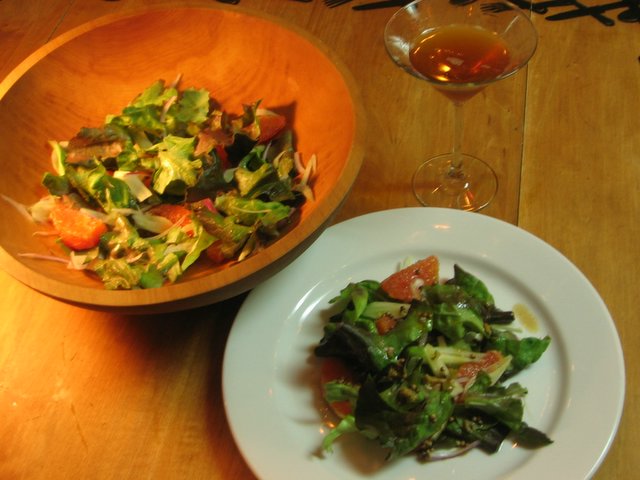
Lettuce (41 miles), radishes (left over from Monday's market - I have to check the name and location tomorrow), pepper goat cheese (59 miles), and California olive oil and vinegar. I followed this with frozen blueberries (293 miles) thrown in the blender with whole milk (Crescent Ridge in Sharon, 28 miles) to make a purple and lightly sweet milkshake. By dinner, the heat had taken the edge off my hunger, so I had scrambled eggs (47 miles) with cheddar cheese (same farm, 47 miles), followed by a big bowl of more strawberries and honey-sweetened whipped cream (Butterworks Farm, Vermont, 223 miles).

Today I got up early and put a top round roast in the oven in the cool of the morning. I started it off on 450 degrees to brown, then lowered the heat for 300. Once the heat was down, I baked off a couple ramekins of egg/cheese/sauteed swiss chard in a bain-marie. I also shelled some peas (which may be the most soothing activity on earth) as prep for dinner tonight, and made the custard for a maple ice cream (grade B dark amber maple syrup from Littleton, NH 151 miles). I had a swiss chard baked omelette for breakfast, along with some maple syrup-sweetened yogurt. I feel full and very pleased with the good food waiting in my kitchen, but I still need to hit the Harvard Square farmers' market for more strawberries. Posted by Picasa

Thursday, June 29, 2006

Local Eating: The Beginning

Saturday begins the extra-long July 4th weekend, and I am declaring my independence from shipped food. That’s right: my own Eat Local Challenge month is at hand.

It seems that people who take up the challenge range from the very strict to the very casual, from those who just try to eat something local in every meal to those who strip their kitchens of everything grown more than 100 miles away. I will be taking the middle road.

Here are my rules:

Everything must be grown in New England. I will try to buy from the closest possible source, but anything within the New England boundaries is fair game. I will also try to buy directly from the farmer whenever possible (farmers’ market eggs, rather than supermarket, even if both are grown in New England).

My exceptions:

Olive oil. I simply can’t bring myself to cook with only animal fat for a whole month, especially during salad season. Despite the fact that soybeans and nut trees and other things that can be made into oil can be grown in New England, there are no commercial sources I can find, and pressing oil is not in home-cooking territory.

Vinegar. I screwed up here. I thoroughly intended to make some vinegar with New England wine, but I didn’t hunt down the wine soon enough. I will most likely be using red wine vinegar I’ve got brewing from a leftover bottle of Californian wine, figuring that at least that brings homemade frugality points. Again, I need vinegar for salads, given that I can’t use lemon juice either. If anyone can think of a substitute, I would love to get rid of this exception. I might just try to live without – lately I’ve been eating some salads sans dressing. But I reserve the right to a bit of vinegar.

Yeast. Depending on how the sourdough starter works out, I might need yeast.

Spices. I would guess I use something like 6 ounces of spice in a month (mostly pepper, cumin, cinnamon, ginger, paprika and nutmeg). The shipping-weight-to-culinary-value ratio makes the spice drawer a reasonable exception for me. I will use only fresh herbs, though.

Eating with friends. I will try to have people to my house for dinners or drinks this month as much as possible. But I believe people come before projects. If my friend M.W. from the Cape has a barbecue in July, I will be there with bells on and will eat with gusto (damn, you bet!)

A few leftovers in my fridge. I have two eggs, a couple carrots, celery and my sauerkraut. I don’t intend to waste good food just because I wasn’t able to eat it up before the project starts.

The blogging plan:

I will give a complete accounting of everything I eat and, to the best of my ability, where it was grown, including the inevitable slips off the wagon (I’m guessing chocolate chip ice cream and Bing cherries). And if I give up before the month is out, I promise a full accounting.

The reasons:

I think anyone who is reading here probably knows why we should eat locally (fuel costs of shipping, the environmental benefits of preservation of farmland in urban and suburban areas, the transparency of agricultural methods that is involved when you can meet the farmer, etc.) But there’s a lot of grey ground. For instance, some have argued for the benefits of supporting organic farming in the developing world. And Wyman’s blueberries may help preserve open land in Maine, but they are probably shipped to a larger distributor before being shipped back to my supermarket. So why bother trying to be (somewhat) strict about local food for a month? What is the point?

I’m not going to give up mangoes or lemons or even those buckwheat noodles from Japan for good. But I want to try this experiment because I want to learn more about how I eat. I want to pay attention to every bite that enters my mouth and be mindful of how it connects to the larger food system. I want to challenge my cooking skills. I want to try new things and to go deeper into the culinary history of New England. And, heck, for health reasons I would probably do well to eliminate white flour and white sugar from my diet. Thoreau said that if there is an experiment you want to try, you should do it. Always listen to Thoreau.

So goodbye (for now) to chocolate, coffee, margaritas, lemons, wine, pizza, popcorn, peanut butter, Petsi’s scones, Toscanini’s ice cream, and those M&Ms the receptionist keeps on her desk.

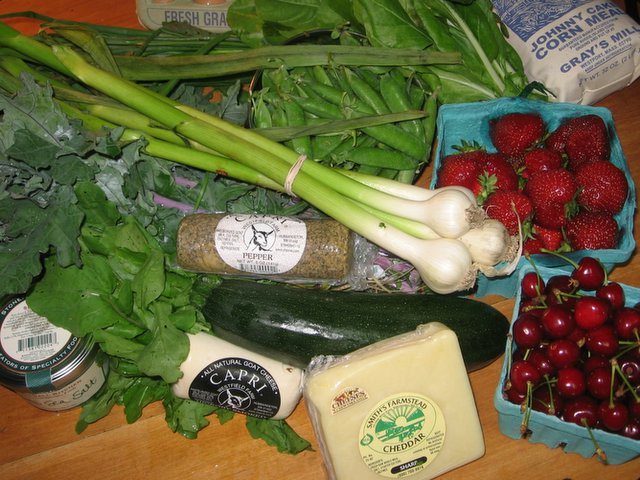
Here’s what I’m starting with in my kitchen:

8 oz. dried mushrooms, Oyster Creek Mushrooms, Damariscotta, ME: 160 miles
2 # cornmeal, Gray’s Grist Mill, Adamsvilles, RI: 67 miles
Pork (trotters, butt, shoulder, hocks, ground, heart, liver, lots of fatback), Mamashoe, Petersham, MA: 70 miles
Beef (ground, liver, short ribs, top round roast) River Rock Farm, South Westport, MA: 65 miles 1 pint soybeans, Grateful Farm, Franklin, MA: 44 miles
Lamb (fore roast, leg, ground), Sojourner Sheep, Northampton, MA: 101 miles
Many bottles carbonated water, Polar Water, Worcester, MA: 45 miles
Pepper and smoked goat cheeses, Westfield Farms, Hubbardston, MA: 59 miles
1 dozen eggs and sharp cheddar cheese, Johnson and Sons, Westminster MA: 47 miles
1 bunch each arugula and kale, Stillman’s Farm, Lunenberg, MA: 41 miles
Cherries and garlic from a farm (uncertain which) in Pepperell, MA: 42 miles
Scallions, strawberries, zucchini and chard from a farm at the Brookline farmers’ market – stand too busy to ask, no signs.
1 can mussels, Look’s Gourmet Foods, Whiting, ME: 340 miles.
8 # whole wheat flour, Wood Prairie Farm, Bridgewater, ME: 372 miles
16 oz. plain yogurt, Butterworks Farm, Westfield, VT: 223 miles
12 oz frozen wild blueberries, Wyman’s, Milbridge, ME: 293 miles Posted by Picasa

Friday, June 23, 2006

Not cooking, but shopping

Julie Powell complained that an obsession with local eating a la Alice Waters leads to shopping replacing cooking. And perhaps she has a point, because in the last few weeks, preparing for my Eat Local Challenge month, I've done very little cooking and quite a bit of shopping.

But, oh, what shopping!


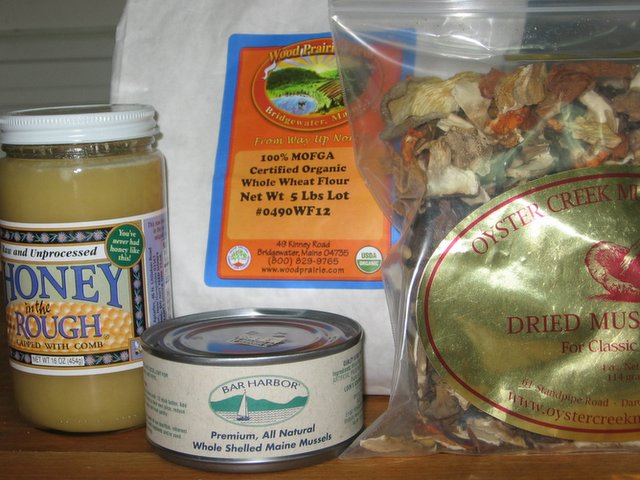
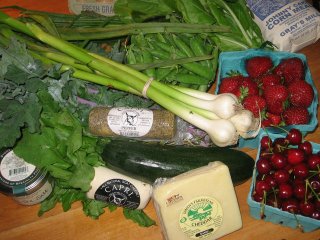
What we have here is a local honey "in the rough," which means filled with bits of honeycomb and pollen and all the stuff I should be eating to toughen my immune system and beat my allergies into submission; a can of Maine mussels, ready for a quick chowder on a weeknight; whole wheat flour from Maine, less a few cups in the lost sourdough starter; and the Maine mix of dried mushrooms from Oyster Creek Mushrooms. I've also got some reeal ground flint corn from Gray's Grist Mill in Rhode Island, but it arrived too late for the group picture. I'm itching to get started with all this good food, but I'm restraining myself, because I'm going to need the backstock in another week.

In the meantime, the farmers' markets are starting to offer some selection. We've already passed the asparagus, amazingly enough. The lettuce is out in full force, and some of the cooking greens are showing up as well. I've had scallions and garlic scapes. Things are looking up.

And of course the strawberries have arrived. So far, I haven't had a really amazing berry. I'm pessimistic about finding anything outstanding in this year's crop. The long rains this spring will give us watery, bland berries; they need the sun to concentrate their sugars. But I keep testing, just in case. Posted by Picasa

Sauerkraut

I've noticed my titles are getting more and more boring. "Sauerkraut." I need to work on that.

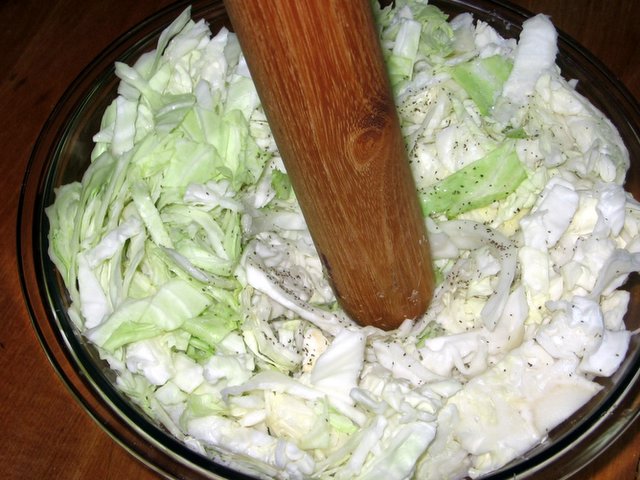
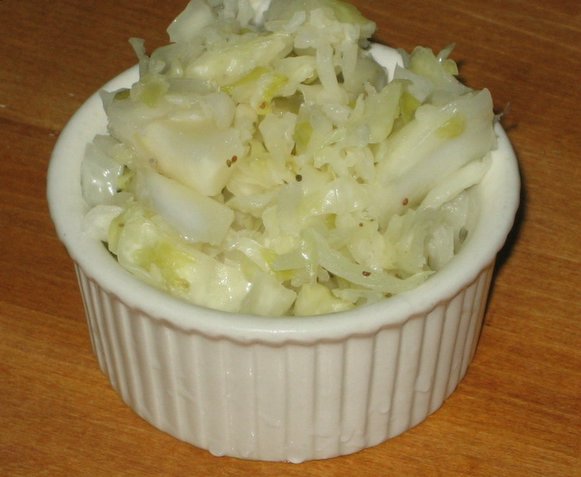
But sauerkraut is pretty straightforward stuff. I shredded a whole cabbage, added salt, celery seeds and juniper berries, pounded the heck out of it until there was enough liquid to nearly cover, added a little whey drained from some local yogurt, and covered with cheesecloth. Over the cheesecloth I placed a plate and then another layer of cheescloth, with a heavy bottle on top to weigh it down. Several days later, I had sauerkraut.

Now, as kitchen alchemy goes, making your first sauerkraut isn't quite on the level of baking your first yeast bread or caramelizing sugar for the first time. But it's still mighty satisfying. This sauerkraut is mildly sour, not too salty, beautifully crunchy; over a success. I'm now emboldened to try variations: a little shredded carrot, some hot pepper. The sauerkraut sky is mine. Posted by Picasa

Posted by Picasa

Tuesday, June 13, 2006

News of the Weird Food

God bless News of the Weird and the work they do to bring to our attention stories that might otherwise have slipped by, like this one:

In a May dispatch from Atlanta on Southerners' notoriously unnutritious, fat-laden cuisine, a Chicago Tribune reporter watered readers' mouths with descriptions of the "hamdog" and the "Luther" (prized dishes of Mulligan's restaurant in Decatur, Ga.), which are, respectively, "a half-pound of hamburger meat wrapped around a hot dog, which is deep-fried and served on a hoagie topped with chili, bacon and a fried egg," and "a half-pound burger served with bacon and cheese on a Krispy Kreme doughnut." The 11 states from Washington, D.C., to Florida, west to Texas, have the nation's highest mortality rate from strokes, but, said a University of Mississippi professor, "Food is a strong emblem of identity for Southerners," uniquely shared across racial lines. [Chicago Tribune, 5-16-06]

Mmm...bacon-donut-burger...

Monday, June 12, 2006

If you haven't cooked in a month...

Robert Beverly Hale, the famous art instructor, used to say, "If you haven't drawn for a week, you'll know it. If you haven't drawn for two weeks, everyone will know it."

It seems the same applies to cooking.

In case you've forgotten, I ruined a batch of sauerkraut by adding twice the required salt, but I was happy nonetheless because my sourdough starter was bubbling on schedule. Well, um, that starter? I went to feed it on Sunday, only to discover a fermenting mass beneath - and a canopy of mold above. And these were interesting molds, not just your garden variety white bread mold. No, these had structures, nobules, spray formations and color patterns.

I think I may have screamed.

I was crazy enough to go online to see if the starter could be salvaged. After all, I had paid shipping on that flour; that was certainly the most expensive flour of my life, and it was hard to accept the inevitable. But I did. There's a running theme through all the advice pages on sourdough: if you find mold, toss it. So my insanely expensive fermented paste got flushed.

I was using no yeast, and I think that's where things went wrong. A little yeast probably does get things going faster, so the mold has less of a chance. According to one person I read, the initial strain of yeast is crowded out by local yeasts after two or three feedings anyway, so my "symbolically local" issue need not suffer too much from a bit of yeast in the starter. I also was following instructions to feed alternate days after the first two days, and most other sourdough recipes seem to indicate daily feedings are required for the first week. So tonight I will start again, a modern-day Sisyphus of the kitchen. I'll let you know how it goes.

Fortunately, I was able to make some actual edible food this weekend, a braised chuck roast with horseradish from Please to the Table, which was excellent, though much milder than expected, and fried potatoes with mushrooms from the same, which was delicious, if absurdly rich. I also threw together a buttermilk sherbet, and I really did throw it together - I don't know how much sugar I added, and when I realized I had no lemon, I added some pineapple juice instead. It was really good, which soothed my rather battered ego.

Good advice

Stupid Blogger. My posts keep disappearing. I have no patience to rewrite the last one, so I will just direct you to the interview in Salon with Marion Nestle, professor of nutrition at NYU with one fab quote, full of good advice:

I have these facetious rules. Always shop the periphery. Don't go into the center aisles. If you do go into the center aisles, don't buy anything with more than five ingredients. If you can't pronounce the ingredients on the package label, don't buy it. Don't buy anything with a cartoon on it. If you don't want your kids eating junk food, don't have it in the home.

Friday, June 09, 2006

Grass-fed beef in Time

When something hits Time Magazine, you know it has officially arrived. I'm not saying your mom and Aunt Sally won't still roll their eyes when you start talking about the importance of pasture or eating locally over Thanksgiving dinner, but they will at least have heard about this stuff. Progress! Here's the Time article on grass-fed beef, and here's their article on the 100-mile diet.

I've started a sourdough with flour from Maine. I used just filtered tap water and flour. No yeast! This is more a symbolic and aesthetic gesture than an indication of real purism. I love the idea of local wild yeast slowly growing and fermenting, ultimately ending in truly local bread.

I haven't made sourdough in a long time, mostly because a commitment to frequent baking is required to make it worthwhile. It may take me a while to get back in the swing. My friend E., who is married to the cheese salesman, keeps a sourdough going that is very much rooted in her kitchen - all her bread tastes just a little like cheese. The sourdough must pick up on certain cultures from some of the cheeses. My kitchen is less fertile with living foods, but I'm working to change that. My sourdough was bubbling a bit last night, so it seems all is well.

All was not well, sadly, with my first attempt at sauerkraut. You see, I am essentially an idiot when it comes to math. I have a somewhat impressionistic relationship to numbers, and, as a results, sometimes I put in twice the necessary salt. Not often, but sometimes. So my sauerkraut, still in its early days, tasted about as salty as a cheap dill pickle. I dumped it. Fortunately, the cost of salt and cabbage is negligible. I can afford to start another batch this weekend.

The sauerkraut project is unnecessary, at least as far as obtaining local ingredients goes. I can't yet get local cabbage, and I can buy excellent local sauerkraut from the good people at RealPickles. But I am feeling a deep need to have a living kitchen, full of fermenting things and growing things and slow-cooking things - the stocks and breads and fermented pickles and fine homemade things that give a kitchen a soul and a sense of place. I want these things to relate to the place around me, the New England fields and woods that I love. This is partly just a growing need for connection to my food source, but also I know a reaction to the death of my friend. Her illness was strange and complicated, but resulted in part from her neglect of her body in many, many ways, including failure to eat genuinely nourishing food.

Our culture tends to split food into two groups - the bad-for-you-and-delicious and the good-for-you-and-awful. It's a match-up between a bacon double-cheeseburger and brown-rice with tofu. One day indulgence wins, the next day guilt wins, and both sides entrench their positions. But fast food really tastes terrible, and a lot of the health food options at your local co-op are highly nutritionally and environmentally suspect, despite their reassuring flavorlessness and green packaging. I don't want to eat like a McDonald's-scarfing American or a Gourmet-obsessed foodie or a hairshirt hippie. I want honest food, sustaining and good, that's all.

(I also don't want to eat like this guy. I love the Onion.)

Wednesday, May 24, 2006

Greenmarkets in the Times

Today's Times has an article about the Greenmarkets in New York that is fairly interesting (though I really, really hate that they refer to organic farmers' concerns about Walmart's organic initiative as "handwringing"). Here's my take: I don't care if a farmer's market includes jams made from imported sugar or pottery or corn husks dolls or bread baked with non-local flour as long as 1) local farmers are not turned away in favor of vendors of non-local products and 2) everything is clearly labelled.

Transparency is the key. Not everyone cares about whether the flour is local, and I would still rather support a local baker using non-local ingredients than a national chain that also uses non-local ingredients. Just let me know what's going on. At least in the Northeast, the easiest way to find out how things have been grown is by asking the vendor. In most cases, they are deeply involved in production and can tell you everything you need to know.

Tuesday, May 16, 2006

Thank you

I wanted to thank everyone who has sent best thoughts, wishes and prayers while my friend has been in the hospital. The outpouring of kindness and sympathy from people I have never even met has just been unbelievable. Unfortunately, I have bad news. My friend died on Saturday morning. Her parents, sister and I were with her. She was a funny, smart, incredibly generous and loving person, who liked seafood, Tom Waits, Jane Austen, cats, Edward Gorey, romantic comedies, dark humor, rainy days, breakfast at diners, and Vermeer. She was thirty-three years old. I will always miss her.

Monday, May 08, 2006

Eating locally and world poverty

An interesting article in Salon today about, among other things, eating locally. (This will bring you to the main page, but you have to watch the commercial to read anything.) The argument against eating locally seems to be that 1) shipping is much more fuel-efficient than trucking; 2) growing stuff in the irrigated California desert is worse than shipping stuff grown in places that have water and arable soil naturally, and 3) if even 2 cents of every dollar you spend on imported food gets to a Kenyan farmer, that's going to make a big difference in world poverty.

Hm. Okay, here's my take: Eating locally shouldn't be any more mindless than eating "organic." Every choice has to be examined on its own merits. But I don't think the only choices are between arid desert forced into work as farmland and natural farmland 10,000 miles away. Eating more foods that can be grown sustainably locally seems to me the goal.

As for the shipping versus trucking issue, I would find this a heartening argument for the purchase of Italian olive oil over Californian olive oil - if I knew that the oil wasn't shipping to Los Angeles and THEN trucked across the country.

And the point about the Kenyan farmers is encouraging for coffee-drinkers. But I can't say that most of my food-dollars-abroad are heading to Kenya. Are the New Zealanders is eqaully desperate need of my money, or am I justified in thinking an apple from the local orchard makes more sense than the supermarket Granny Smiths?

Finally, there are other arguments besides shipping fuel costs for supporting New England farmers, particularly the maintenance of biologically diverse (if the farming methods are sustainable) land in areas under threat of overdevelopment.

Monday, May 01, 2006

Still not cooking

I'm still not cooking. I'm one week and three days away from the end of my classes, which I am looking forward to passionately. My friend is still in the ICU, so I'm pretty much always at work, in class, or at the hospital. Culinary ambition = nil.

Except...

Except that I keep thinking about the Eat Local Challenge. There's just no way to do it in New England in May, but by the end of June, when the strawberries show up, I can. So one-week-and-three-days-from-now, I'm going to start stocking up, gathering a pantry-worth of local foods. I need this sort of project, something to focus on, something that matters to me. And it gives me an excuse to buy all sorts of local foods, just as the season is opening. I also expect that, without white sugar and white flour and cocoa and coffee and hard liquor, I might lose some weight. Which, frankly, I really need to do.

My biggest concern, lack of bread, has just been allayed by the discovery that Wood Prairie Farms*, of the fabulous potatoes, also grows and sell wheat flour. Woo-hoo.


*Yes, these good folks are located 378 miles from Cambridge, which is a good bit further than the 100 miles the Eat Local people recommend. But for godsake, the Eat Local folk are in California! Land of plenty! Not hardscrabble New England. Other than some flint corn from Rhode Island, this is the only grain I can find grown in New England. And if I want to use the Challenge as a chance to change my habits in the long-term, I'm going to need some local grains. Most wheat in the U.S. is grown in North Dakota, Montana, Minnesota and South Dakota. Minnesota is 1500 miles away, Montana 2600. 'nough said.

Saturday, April 15, 2006

Hospital food

I haven't written in so long, I don't know if anyone bothers to check this blog any more. My apologies to any readers still out there. I had mentioned befor that I had a friend in the hospital? Well, her condition worsened, and the situation is very serious. Between that and coming into the end of the semester, I have no been in any shape to think about food in any way.

I haven't been cooking much, just living on cafeteria food and yogurt and fruit and that sort of thing. Annie's Vegetable Pot Pies. I've tried to make reasonably healthful choices (the school caf will often have grilled salmon with vegetables or other decent options), but I've also fallen into some pretty bad habits. Remember scarfing down a bag of M&Ms to stay awake through class as an undergrad? Yeah, ahem. Or realizing you've eaten pizza three days in a row?

After a couple days of eating food that was designed to be cheap and easily prepared, I am craving nutrients. Fortunately, it's easier now to eat well without a lot of effort: there are fairly healthful options in the freezer case at the regular supermarket, fresh fruit is available everywhere, same with salad. It's easy - unless you're in the hospital.

I was visiting my friend yesterday when the dinner arrived. I am angry. This is what they offered a very, very sick woman: breaded chicken cutlets, which appeared to have been fried and then allowed to steam, a tiny bag of carrot sticks, a cup of broth, a slice of angel food cake, and a can of diet ginger ale.

Where to start?

The only vegetable on the plate was the bag of carrots, which, given that she is having a hard time with chewing and swallowing, was completely useless. Oh, and the bag was a little sealed one, which she would never have had the strength to open anyway. (The old woman sharing her room, who did actually eat her dinner, couldn't have opened hers either, and no nurse bothered to check in to help). The chicken looked horribly greasy. Ginger can help settle your stomach, it's true, but the idea of giving diet soda, with all the artificial flavors and colors and fake sweeteners, to a body that is weak and needs real food is just disgusting. And, of course, for our borderline diabetic patient, some angel food cake! Because nothing builds strength like a nice shot of pure white sugar and white flour.

The only intelligently-chosen item they offered was the broth.

I don't know why I was so shocked. I've just never spent time in hospitals, so I didn't know. But I wouldn't eat that stuff when I was well, not because it looked unappetizing (though it did), but because it was so lacking in nutrition. It wasn't much better than McDonald's. Memo to the doctors of America: this crap can make us sick in the first place! We don't want more of the same when we're actually sick.

I don't have the most healthful lifestyle, and therefore my body is not as sensitive as it should be. But if I ate food like that for a few days, I would start to feel gross - heavy, tired. Why do we give this stuff to people whose bodies are weak? This country is so ignorant about food, so divorced from the consequences of our insane eating habits, our bizarre system of growing food and dispersing food.

I hope to the gods that if I ever end up in a hospital, someone will be kind enough to bring me actual food: real beef stock made from the bones of pastured cows (I've got some in the freezer at all times), some pureed squash or pumpkin with a little ginger in it, a nice custard made from real eggs and milk. Honest food, with healing in it. I hope that the hospital will allow it in. And I am furious that my friend has spent a month eating food that feeds neither her body nor her soul.

Wednesday, March 29, 2006

Genuinely organic

We all know that "organic" has become a trendy label, and all sorts of questionable practices are being used by big manufacturers who technically qualify as organic, while ignoring the real spirit of organic farming. Two links on the topic: click here for a very useful rating of organic dairies based on criteria such as control over milk production and percentage of profits that go to family farmers; and click here for the standards of "authentic food," food which reflects the values that organic once implied.

Tuesday, March 28, 2006

A non-post

I'm home sick today, wishing I had some good homemade chicken soup in the freezer. I don't. I should used up some of the bags of salad greens in the fridge for dinner, but I wanted easy comfort, so Annie's Mac N Cheese it was. I pretty much keep a box in the house for sore-throat-stuffed-head-swollen-glands kind of days.

For lack of anything more interesting to tell you about, I've posted a picture of Saturday night's supper.


A pretty straightforward meal, but very satisfying - London broil, balsamic-braised Brussel sprouts and boiler onions, sauteed mushrooms, and buttermilk mashed potatoes with parsley. Prepping the vegetables was the most time-consuming part of the meal; once the onions were peeled and the sprouts trimmed, it was done in less than half an hour.

Time to go back to bed. Posted by Picasa

Thursday, March 23, 2006

And speaking of bread pudding...

I just wanted to share an experiment I tried this weekend that worked out beautifully. I was having an itch for bread pudding (something that happens once every, oh, month or so), and I also had about half a loaaf of stale bread to use up. So far, so good, except the bread was a rather dense part-wheat sourdough. Generally, I like to use brioche, cinnamon bread, plain white - anything soft and a little sweet. I wasn't too worried about the texture, because though the crumb may have been a bit tight, this loaf wasn't terribly chewy. I figured once it dried out, it would work fine. But sourdough? In a moment of inspiration (okay, not really a big one or anything, we're not talking Newton here), I decided to go with the sour flavor rather than fight it. So I used my regular bread pudding ratio, but subbed buttermilk for plain milk.

This was the final recipe:
1/2 loaf wheat sourdough, cut into cubes and dried thoroughly
3/4 cup buttermilk
3/4 cup heavy cream
1/2 cup sugar
2 eggs
raisins - I don't know, maybe 1/2 cup? More? soaked in dark rum
About 1 T butter

Whisk together the buttermilk, cream and eggs. Strain through a sieve. Fold in the cubes of bread and let the mixture sit in the fridge for at least an hour. Fold in the raisins. Put the whole mixture in a buttered dish, then dot some butter on the top. Bake in a waterbath at 300 degrees.

I skipped the vanilla I usually use, because I didn't want that sweet floral note to get in the way of the buttermilk flavor. The result: a lovely, old-fashioned bread pudding, with a nice tang which contrasted well with the dark sweetness of the raisins. Recommended, particularly if you, like me, often end up with ends of sourdough around the house.

Wednesday, March 22, 2006

Comfort

It's been a tough week here at Seasonal Cook. A very good friend is very, very sick, and I've spent the last week just waiting on news. I just called the hospital, and her condition has improved somewhat, so I'm feeling a bit more hopeful about things.

Not surprisingly, I haven't really been thinking about food or blogging, but I did cook this weekend. I made bread pudding, ragu, clam chowder. All comfort food - and not just for the eater. Anyone who cooks, who is at heart a cook, no matter the skill level, takes comfort from preparing food. Certain foods are better for this than others. You don't want something too fussy - no spun caramel or architectural creations - but you don't want anything too easy either, like a steak that's seared and done in minutes. You need something to, for lack of a better word, nurture, to lay care on. A cook needs a ragu that simmers on lowest for a few hours, fed with a tablespoon of milk every once in a while. A cook needs a soup that has to be occasionally stirred and tasted, salt added, the heat adjusted. A cook needs to cut the bread for pudding, let it dry on low in the oven, let it sit in the fridge and slowly absorb the custard, and then bake the whole thing gently, gently in a bath of water.

Sometimes we feed the ones we love. Sometimes we can't, and the food is only a substitute for the person we would like to be able to offer that tenderness and care. But, if we are cooks, we will always be found, whether in joy or in worry or in love, in the kitchen.

Friday, March 17, 2006

Really very funny.

Are you a posh green gourmand (guilty!), a crunchy mummy, or a GenX econ-preneur?
Find out here.

And remember, little man - don't you go to Goa.

Wednesday, March 15, 2006

Feeding my yens

I was talking with some friends the other night, one of whom was reading in Calvin Trillin's Feeding a Yen and loving it, of course. (Although personally, I like American Fried best, with Alice, Let's Eat in second, because I always love the appearances of Alice.) This lead to a discussion of ouy own personal yens, the foods we don't have access to and miss actively, regularly.

Here's my list:

Eli Zabar's country sourdough - the really big loaf.

The pizza with the very thing crust from that joint around the corner from my old apartment in Queens - I think the place was called Sol's? The cheese was different, possibly a blend of fresh and aged mozz. The sauce was spicy. Sol's (if it was called Sol's) represented my Platonic ideal of pizza.

The cheddar/dill scones from the little shop in Bath where Sally Lunn cake originated.

The chocolate rum balls from a bakery in Penzance. I have no idea how they made these so soft and melting and tender, but they did.

The lemon potatoes at Uncle George's in Astoria (preferably late at night, after a few drinks out, maybe a game of pool.)

The montelimar we made at CIA - dried cherries, not candied. Sigh.

The home fries from the breakfast place near the river in Cold Spring, NY. They cooked a lot of red peppers in with the potatoes, and they achieved the perfect level of greasiness - just enough, not too much.

The danish Alfred made at his bakery out in Forest Hills, NY. A little hole-in-the-wall, but the danish dough was all-butter and made by hand. There isn't much in the world better than a homemade danish.

Unless it's a homemade English muffin, toasted, with cream cheese. That's another CIA memory. I could probably make those, though. I'm sure I have the recipe somewhere. But what I really want is for someone else to make them for me, and serve them up hot to go with my morning coffee.

Big, fat blackberries hot from the sun. You don't get those in the city.

Monday, March 13, 2006

Salad


Just a simple salad my guy made on Saturday (from Chris Schlesinger, of course). Red leaf lettuce, orange segments, fennel bulb, red onion and a dressing made of red wine vinegar, olive oil, coriander and chopped green olives. (And lemon juice? Possibly.) This is the sort of combination it's nice to keep in mind for throwing together something that's easy, but tastes very sophisticated. No need for a recipe, and with a nice T-bone and some baked potatoes, you'll feel like you're eating at a nice restaurant, only with cats, leftovers, and your own choice of background music. And cheaper drinks. Posted by Picasa

Look at the size of those thighs!


Turkey thighs, that is. I've never bought just the thighs from a turkey before, but they've always been my favorite part of the bird. The whole stuffing business didn't really work out so well; these were not pretty, neat, little packages with stuffing evenly distributed throughout. More like lopsided lumps with the stuffing all hanging out on one end and falling onto the roasting pan. But tasty!

For the stuffing, I caramelized some onions, then mixed them with rice and orange zest. The caramelized onion flavor didn't come through very clearly, but I think it did give a background of depth and sweetness. The orange zest was very flavorful (I used one of those cara-cara pink navels that have been in the stores lately).

For a glaze, I blended some fig spread (which all the cool bloggers have been using lately, and which I love with all my heart), a bit of orange juice, some balsamic vinegar, and black pepper. I could have eaten that mixture straight from the bowl, so it was a bit disappointing that there wasn't enough glaze to really sauce up the thighs. I will definitely be making that sauce again, but next time I'll make enough to drizzle some on the meat on the plate.

Overall, it needs a little tweaking, but I liked this dish. I might use wild rice in the stuffing next time, for a little savory contrast to the sweet flavors of orange and fig. Turkey thighs are cheap and actually taste like something, unlike turkey breast. Don't know why I haven't made them before.

As you can see, I made a pile of vegetables as side dishes, mostly so that I would have lots of leftover vegetables for this week's lunches. That cauliflower wasn't flavored with turmeric or saffron - it's a yellow cauliflower called "Carnival." It has a nice flavor and a beautiful color, recommended. Posted by Picasa

Tuesday, March 07, 2006

LA Urban Organic Gardens to Close

If you have a moment, write a note to the mayor of LA to let him know that you think an urban organic garden area that provides food for 350 poor families, improves a blighted neighborhood, and acts as a community center is a valid use of public land. Let him know that you don't think the city should sell this land to a developer for the creation of a Walmart's warehouse. Click here for info, here to send a letter.

Monday, March 06, 2006

Unphotogenic food

Okay, I'm not going to win any food photography awards for this one. But the meal was good. What I should done was take a photo of the main dish while it was still sitting in its cast iron skillet - two big, beautifully browned pork chops, nestled in a bed of kasha flavored with bacon, wild mushrooms and onions. I served it up with wedges of cabbage cooked in some chicken broth with caraway seeds, some slices of boiled beets, and a spoonful of Cabot sour cream. Very simple to pull together (cook the bacon, then brown the chops in the fat, remove, cook onion in fat, add kasha, some rehydrated dried mushrooms, cook a couple minutes, throw in the bacon, the mushroom cooking liquid, a little chicken stock, put the chops on top and toss in the oven) and very tasty. Of course, the sour cream and bacon don't exactly make this the lightest dish on earth, but we've discredited low-fat diets now, right? Bacon for everyone! Walter Willett, eat your heart out. So to speak.

On a topic not culinary, but at least food-chain related, I watched a hawk scoop up a pidgeon today right in the heart of Porter Square. He sat on the top of a telephone pole with the pidgeon in his grasp, eyeing the commuters warily as if he expected one of them to try to climb the pole and take his prize away. I find it incredibly heartening to see hawks in the city. Posted by Picasa

Wednesday, March 01, 2006

Lobster dreams and blueberry reveries

It's cold out today - not quite the unbearable bitter cold that hurts your face and teeth, but cold enough to make the wait for the bus seem very, very long. I'm daydreaming about my summer vacation. I've rented a cottage in Maine with a group of friends. You can see it here, if you're curious.

The cottage is owned by an organic farm that sells goat milk, yogurt, cheese and maple syrup. I'm looking forward to sampling their wares and visting with the goats. Since booking this place, I've noticed that quite a few farms use rental cottages as an extra source of income. So, if you're planning a vacation this year, consider supporting a small farm.

And if you've never been to the Northern coast of Maine, I highly recommend it. If you drive past Acadia, the tourists disappear, leaving behind lobster boats, rocky shoreline, blueberry barrens, pine trees, a few artists, some organic farms, puffins, a surprisingly good fruit winery, and the freshest air you'll ever breathe. And did I mention the lobster? Because, my god, the lobster. And the scallops. And the crab. It's shellfish heaven. And in August the blueberries are ripe - the tiny, spicy, wild ones, not the flavorless, oversized supermarket ones.

Just six months....