Thursday, June 29, 2006

Local Eating: The Beginning

Saturday begins the extra-long July 4th weekend, and I am declaring my independence from shipped food. That’s right: my own Eat Local Challenge month is at hand.

It seems that people who take up the challenge range from the very strict to the very casual, from those who just try to eat something local in every meal to those who strip their kitchens of everything grown more than 100 miles away. I will be taking the middle road.

Here are my rules:

Everything must be grown in New England. I will try to buy from the closest possible source, but anything within the New England boundaries is fair game. I will also try to buy directly from the farmer whenever possible (farmers’ market eggs, rather than supermarket, even if both are grown in New England).

My exceptions:

Olive oil. I simply can’t bring myself to cook with only animal fat for a whole month, especially during salad season. Despite the fact that soybeans and nut trees and other things that can be made into oil can be grown in New England, there are no commercial sources I can find, and pressing oil is not in home-cooking territory.

Vinegar. I screwed up here. I thoroughly intended to make some vinegar with New England wine, but I didn’t hunt down the wine soon enough. I will most likely be using red wine vinegar I’ve got brewing from a leftover bottle of Californian wine, figuring that at least that brings homemade frugality points. Again, I need vinegar for salads, given that I can’t use lemon juice either. If anyone can think of a substitute, I would love to get rid of this exception. I might just try to live without – lately I’ve been eating some salads sans dressing. But I reserve the right to a bit of vinegar.

Yeast. Depending on how the sourdough starter works out, I might need yeast.

Spices. I would guess I use something like 6 ounces of spice in a month (mostly pepper, cumin, cinnamon, ginger, paprika and nutmeg). The shipping-weight-to-culinary-value ratio makes the spice drawer a reasonable exception for me. I will use only fresh herbs, though.

Eating with friends. I will try to have people to my house for dinners or drinks this month as much as possible. But I believe people come before projects. If my friend M.W. from the Cape has a barbecue in July, I will be there with bells on and will eat with gusto (damn, you bet!)

A few leftovers in my fridge. I have two eggs, a couple carrots, celery and my sauerkraut. I don’t intend to waste good food just because I wasn’t able to eat it up before the project starts.

The blogging plan:

I will give a complete accounting of everything I eat and, to the best of my ability, where it was grown, including the inevitable slips off the wagon (I’m guessing chocolate chip ice cream and Bing cherries). And if I give up before the month is out, I promise a full accounting.

The reasons:

I think anyone who is reading here probably knows why we should eat locally (fuel costs of shipping, the environmental benefits of preservation of farmland in urban and suburban areas, the transparency of agricultural methods that is involved when you can meet the farmer, etc.) But there’s a lot of grey ground. For instance, some have argued for the benefits of supporting organic farming in the developing world. And Wyman’s blueberries may help preserve open land in Maine, but they are probably shipped to a larger distributor before being shipped back to my supermarket. So why bother trying to be (somewhat) strict about local food for a month? What is the point?

I’m not going to give up mangoes or lemons or even those buckwheat noodles from Japan for good. But I want to try this experiment because I want to learn more about how I eat. I want to pay attention to every bite that enters my mouth and be mindful of how it connects to the larger food system. I want to challenge my cooking skills. I want to try new things and to go deeper into the culinary history of New England. And, heck, for health reasons I would probably do well to eliminate white flour and white sugar from my diet. Thoreau said that if there is an experiment you want to try, you should do it. Always listen to Thoreau.

So goodbye (for now) to chocolate, coffee, margaritas, lemons, wine, pizza, popcorn, peanut butter, Petsi’s scones, Toscanini’s ice cream, and those M&Ms the receptionist keeps on her desk.

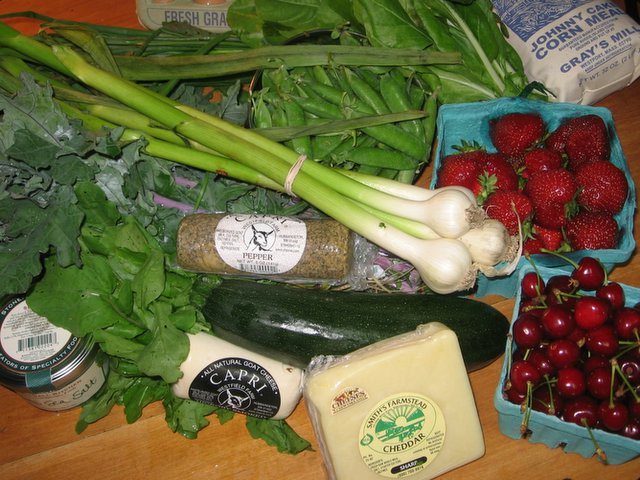
Here’s what I’m starting with in my kitchen:

8 oz. dried mushrooms, Oyster Creek Mushrooms, Damariscotta, ME: 160 miles
2 # cornmeal, Gray’s Grist Mill, Adamsvilles, RI: 67 miles
Pork (trotters, butt, shoulder, hocks, ground, heart, liver, lots of fatback), Mamashoe, Petersham, MA: 70 miles
Beef (ground, liver, short ribs, top round roast) River Rock Farm, South Westport, MA: 65 miles 1 pint soybeans, Grateful Farm, Franklin, MA: 44 miles
Lamb (fore roast, leg, ground), Sojourner Sheep, Northampton, MA: 101 miles
Many bottles carbonated water, Polar Water, Worcester, MA: 45 miles
Pepper and smoked goat cheeses, Westfield Farms, Hubbardston, MA: 59 miles
1 dozen eggs and sharp cheddar cheese, Johnson and Sons, Westminster MA: 47 miles
1 bunch each arugula and kale, Stillman’s Farm, Lunenberg, MA: 41 miles
Cherries and garlic from a farm (uncertain which) in Pepperell, MA: 42 miles
Scallions, strawberries, zucchini and chard from a farm at the Brookline farmers’ market – stand too busy to ask, no signs.
1 can mussels, Look’s Gourmet Foods, Whiting, ME: 340 miles.
8 # whole wheat flour, Wood Prairie Farm, Bridgewater, ME: 372 miles
16 oz. plain yogurt, Butterworks Farm, Westfield, VT: 223 miles
12 oz frozen wild blueberries, Wyman’s, Milbridge, ME: 293 miles Posted by Picasa

Friday, June 23, 2006

Not cooking, but shopping

Julie Powell complained that an obsession with local eating a la Alice Waters leads to shopping replacing cooking. And perhaps she has a point, because in the last few weeks, preparing for my Eat Local Challenge month, I've done very little cooking and quite a bit of shopping.

But, oh, what shopping!


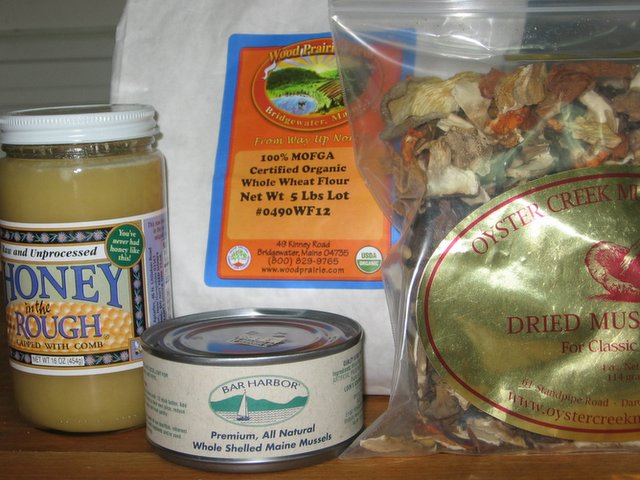
What we have here is a local honey "in the rough," which means filled with bits of honeycomb and pollen and all the stuff I should be eating to toughen my immune system and beat my allergies into submission; a can of Maine mussels, ready for a quick chowder on a weeknight; whole wheat flour from Maine, less a few cups in the lost sourdough starter; and the Maine mix of dried mushrooms from Oyster Creek Mushrooms. I've also got some reeal ground flint corn from Gray's Grist Mill in Rhode Island, but it arrived too late for the group picture. I'm itching to get started with all this good food, but I'm restraining myself, because I'm going to need the backstock in another week.

In the meantime, the farmers' markets are starting to offer some selection. We've already passed the asparagus, amazingly enough. The lettuce is out in full force, and some of the cooking greens are showing up as well. I've had scallions and garlic scapes. Things are looking up.

And of course the strawberries have arrived. So far, I haven't had a really amazing berry. I'm pessimistic about finding anything outstanding in this year's crop. The long rains this spring will give us watery, bland berries; they need the sun to concentrate their sugars. But I keep testing, just in case. Posted by Picasa

Sauerkraut

I've noticed my titles are getting more and more boring. "Sauerkraut." I need to work on that.

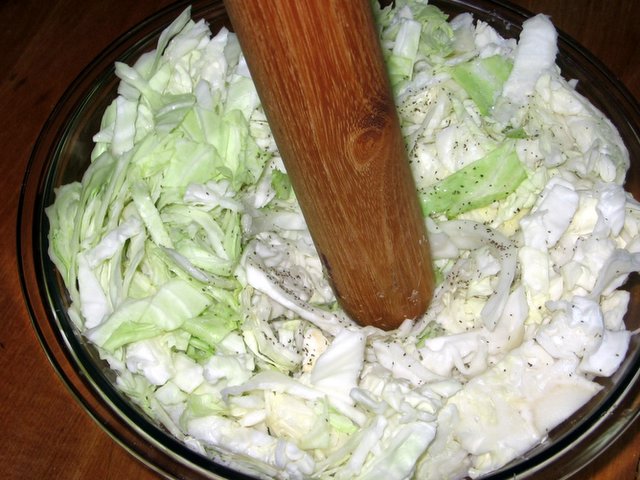
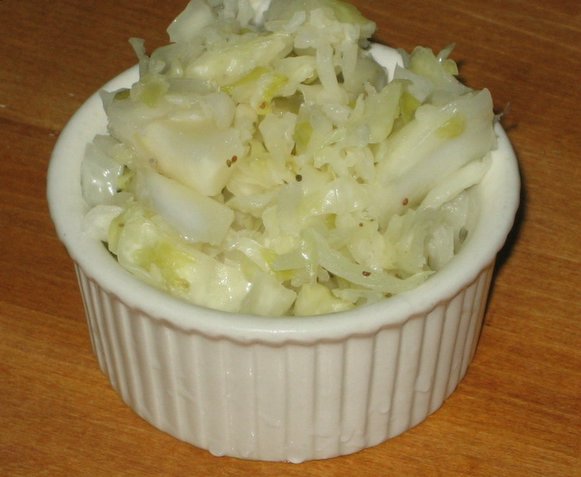
But sauerkraut is pretty straightforward stuff. I shredded a whole cabbage, added salt, celery seeds and juniper berries, pounded the heck out of it until there was enough liquid to nearly cover, added a little whey drained from some local yogurt, and covered with cheesecloth. Over the cheesecloth I placed a plate and then another layer of cheescloth, with a heavy bottle on top to weigh it down. Several days later, I had sauerkraut.

Now, as kitchen alchemy goes, making your first sauerkraut isn't quite on the level of baking your first yeast bread or caramelizing sugar for the first time. But it's still mighty satisfying. This sauerkraut is mildly sour, not too salty, beautifully crunchy; over a success. I'm now emboldened to try variations: a little shredded carrot, some hot pepper. The sauerkraut sky is mine. Posted by Picasa

Posted by Picasa

Tuesday, June 13, 2006

News of the Weird Food

God bless News of the Weird and the work they do to bring to our attention stories that might otherwise have slipped by, like this one:

In a May dispatch from Atlanta on Southerners' notoriously unnutritious, fat-laden cuisine, a Chicago Tribune reporter watered readers' mouths with descriptions of the "hamdog" and the "Luther" (prized dishes of Mulligan's restaurant in Decatur, Ga.), which are, respectively, "a half-pound of hamburger meat wrapped around a hot dog, which is deep-fried and served on a hoagie topped with chili, bacon and a fried egg," and "a half-pound burger served with bacon and cheese on a Krispy Kreme doughnut." The 11 states from Washington, D.C., to Florida, west to Texas, have the nation's highest mortality rate from strokes, but, said a University of Mississippi professor, "Food is a strong emblem of identity for Southerners," uniquely shared across racial lines. [Chicago Tribune, 5-16-06]

Mmm...bacon-donut-burger...

Monday, June 12, 2006

If you haven't cooked in a month...

Robert Beverly Hale, the famous art instructor, used to say, "If you haven't drawn for a week, you'll know it. If you haven't drawn for two weeks, everyone will know it."

It seems the same applies to cooking.

In case you've forgotten, I ruined a batch of sauerkraut by adding twice the required salt, but I was happy nonetheless because my sourdough starter was bubbling on schedule. Well, um, that starter? I went to feed it on Sunday, only to discover a fermenting mass beneath - and a canopy of mold above. And these were interesting molds, not just your garden variety white bread mold. No, these had structures, nobules, spray formations and color patterns.

I think I may have screamed.

I was crazy enough to go online to see if the starter could be salvaged. After all, I had paid shipping on that flour; that was certainly the most expensive flour of my life, and it was hard to accept the inevitable. But I did. There's a running theme through all the advice pages on sourdough: if you find mold, toss it. So my insanely expensive fermented paste got flushed.

I was using no yeast, and I think that's where things went wrong. A little yeast probably does get things going faster, so the mold has less of a chance. According to one person I read, the initial strain of yeast is crowded out by local yeasts after two or three feedings anyway, so my "symbolically local" issue need not suffer too much from a bit of yeast in the starter. I also was following instructions to feed alternate days after the first two days, and most other sourdough recipes seem to indicate daily feedings are required for the first week. So tonight I will start again, a modern-day Sisyphus of the kitchen. I'll let you know how it goes.

Fortunately, I was able to make some actual edible food this weekend, a braised chuck roast with horseradish from Please to the Table, which was excellent, though much milder than expected, and fried potatoes with mushrooms from the same, which was delicious, if absurdly rich. I also threw together a buttermilk sherbet, and I really did throw it together - I don't know how much sugar I added, and when I realized I had no lemon, I added some pineapple juice instead. It was really good, which soothed my rather battered ego.

Good advice

Stupid Blogger. My posts keep disappearing. I have no patience to rewrite the last one, so I will just direct you to the interview in Salon with Marion Nestle, professor of nutrition at NYU with one fab quote, full of good advice:

I have these facetious rules. Always shop the periphery. Don't go into the center aisles. If you do go into the center aisles, don't buy anything with more than five ingredients. If you can't pronounce the ingredients on the package label, don't buy it. Don't buy anything with a cartoon on it. If you don't want your kids eating junk food, don't have it in the home.

Friday, June 09, 2006

Grass-fed beef in Time

When something hits Time Magazine, you know it has officially arrived. I'm not saying your mom and Aunt Sally won't still roll their eyes when you start talking about the importance of pasture or eating locally over Thanksgiving dinner, but they will at least have heard about this stuff. Progress! Here's the Time article on grass-fed beef, and here's their article on the 100-mile diet.

I've started a sourdough with flour from Maine. I used just filtered tap water and flour. No yeast! This is more a symbolic and aesthetic gesture than an indication of real purism. I love the idea of local wild yeast slowly growing and fermenting, ultimately ending in truly local bread.

I haven't made sourdough in a long time, mostly because a commitment to frequent baking is required to make it worthwhile. It may take me a while to get back in the swing. My friend E., who is married to the cheese salesman, keeps a sourdough going that is very much rooted in her kitchen - all her bread tastes just a little like cheese. The sourdough must pick up on certain cultures from some of the cheeses. My kitchen is less fertile with living foods, but I'm working to change that. My sourdough was bubbling a bit last night, so it seems all is well.

All was not well, sadly, with my first attempt at sauerkraut. You see, I am essentially an idiot when it comes to math. I have a somewhat impressionistic relationship to numbers, and, as a results, sometimes I put in twice the necessary salt. Not often, but sometimes. So my sauerkraut, still in its early days, tasted about as salty as a cheap dill pickle. I dumped it. Fortunately, the cost of salt and cabbage is negligible. I can afford to start another batch this weekend.

The sauerkraut project is unnecessary, at least as far as obtaining local ingredients goes. I can't yet get local cabbage, and I can buy excellent local sauerkraut from the good people at RealPickles. But I am feeling a deep need to have a living kitchen, full of fermenting things and growing things and slow-cooking things - the stocks and breads and fermented pickles and fine homemade things that give a kitchen a soul and a sense of place. I want these things to relate to the place around me, the New England fields and woods that I love. This is partly just a growing need for connection to my food source, but also I know a reaction to the death of my friend. Her illness was strange and complicated, but resulted in part from her neglect of her body in many, many ways, including failure to eat genuinely nourishing food.

Our culture tends to split food into two groups - the bad-for-you-and-delicious and the good-for-you-and-awful. It's a match-up between a bacon double-cheeseburger and brown-rice with tofu. One day indulgence wins, the next day guilt wins, and both sides entrench their positions. But fast food really tastes terrible, and a lot of the health food options at your local co-op are highly nutritionally and environmentally suspect, despite their reassuring flavorlessness and green packaging. I don't want to eat like a McDonald's-scarfing American or a Gourmet-obsessed foodie or a hairshirt hippie. I want honest food, sustaining and good, that's all.

(I also don't want to eat like this guy. I love the Onion.)

Wednesday, May 24, 2006

Greenmarkets in the Times

Today's Times has an article about the Greenmarkets in New York that is fairly interesting (though I really, really hate that they refer to organic farmers' concerns about Walmart's organic initiative as "handwringing"). Here's my take: I don't care if a farmer's market includes jams made from imported sugar or pottery or corn husks dolls or bread baked with non-local flour as long as 1) local farmers are not turned away in favor of vendors of non-local products and 2) everything is clearly labelled.

Transparency is the key. Not everyone cares about whether the flour is local, and I would still rather support a local baker using non-local ingredients than a national chain that also uses non-local ingredients. Just let me know what's going on. At least in the Northeast, the easiest way to find out how things have been grown is by asking the vendor. In most cases, they are deeply involved in production and can tell you everything you need to know.

Tuesday, May 16, 2006

Thank you

I wanted to thank everyone who has sent best thoughts, wishes and prayers while my friend has been in the hospital. The outpouring of kindness and sympathy from people I have never even met has just been unbelievable. Unfortunately, I have bad news. My friend died on Saturday morning. Her parents, sister and I were with her. She was a funny, smart, incredibly generous and loving person, who liked seafood, Tom Waits, Jane Austen, cats, Edward Gorey, romantic comedies, dark humor, rainy days, breakfast at diners, and Vermeer. She was thirty-three years old. I will always miss her.

Monday, May 08, 2006

Eating locally and world poverty

An interesting article in Salon today about, among other things, eating locally. (This will bring you to the main page, but you have to watch the commercial to read anything.) The argument against eating locally seems to be that 1) shipping is much more fuel-efficient than trucking; 2) growing stuff in the irrigated California desert is worse than shipping stuff grown in places that have water and arable soil naturally, and 3) if even 2 cents of every dollar you spend on imported food gets to a Kenyan farmer, that's going to make a big difference in world poverty.

Hm. Okay, here's my take: Eating locally shouldn't be any more mindless than eating "organic." Every choice has to be examined on its own merits. But I don't think the only choices are between arid desert forced into work as farmland and natural farmland 10,000 miles away. Eating more foods that can be grown sustainably locally seems to me the goal.

As for the shipping versus trucking issue, I would find this a heartening argument for the purchase of Italian olive oil over Californian olive oil - if I knew that the oil wasn't shipping to Los Angeles and THEN trucked across the country.

And the point about the Kenyan farmers is encouraging for coffee-drinkers. But I can't say that most of my food-dollars-abroad are heading to Kenya. Are the New Zealanders is eqaully desperate need of my money, or am I justified in thinking an apple from the local orchard makes more sense than the supermarket Granny Smiths?

Finally, there are other arguments besides shipping fuel costs for supporting New England farmers, particularly the maintenance of biologically diverse (if the farming methods are sustainable) land in areas under threat of overdevelopment.

Monday, May 01, 2006

Still not cooking

I'm still not cooking. I'm one week and three days away from the end of my classes, which I am looking forward to passionately. My friend is still in the ICU, so I'm pretty much always at work, in class, or at the hospital. Culinary ambition = nil.

Except...

Except that I keep thinking about the Eat Local Challenge. There's just no way to do it in New England in May, but by the end of June, when the strawberries show up, I can. So one-week-and-three-days-from-now, I'm going to start stocking up, gathering a pantry-worth of local foods. I need this sort of project, something to focus on, something that matters to me. And it gives me an excuse to buy all sorts of local foods, just as the season is opening. I also expect that, without white sugar and white flour and cocoa and coffee and hard liquor, I might lose some weight. Which, frankly, I really need to do.

My biggest concern, lack of bread, has just been allayed by the discovery that Wood Prairie Farms*, of the fabulous potatoes, also grows and sell wheat flour. Woo-hoo.


*Yes, these good folks are located 378 miles from Cambridge, which is a good bit further than the 100 miles the Eat Local people recommend. But for godsake, the Eat Local folk are in California! Land of plenty! Not hardscrabble New England. Other than some flint corn from Rhode Island, this is the only grain I can find grown in New England. And if I want to use the Challenge as a chance to change my habits in the long-term, I'm going to need some local grains. Most wheat in the U.S. is grown in North Dakota, Montana, Minnesota and South Dakota. Minnesota is 1500 miles away, Montana 2600. 'nough said.

Saturday, April 15, 2006

Hospital food

I haven't written in so long, I don't know if anyone bothers to check this blog any more. My apologies to any readers still out there. I had mentioned befor that I had a friend in the hospital? Well, her condition worsened, and the situation is very serious. Between that and coming into the end of the semester, I have no been in any shape to think about food in any way.

I haven't been cooking much, just living on cafeteria food and yogurt and fruit and that sort of thing. Annie's Vegetable Pot Pies. I've tried to make reasonably healthful choices (the school caf will often have grilled salmon with vegetables or other decent options), but I've also fallen into some pretty bad habits. Remember scarfing down a bag of M&Ms to stay awake through class as an undergrad? Yeah, ahem. Or realizing you've eaten pizza three days in a row?

After a couple days of eating food that was designed to be cheap and easily prepared, I am craving nutrients. Fortunately, it's easier now to eat well without a lot of effort: there are fairly healthful options in the freezer case at the regular supermarket, fresh fruit is available everywhere, same with salad. It's easy - unless you're in the hospital.

I was visiting my friend yesterday when the dinner arrived. I am angry. This is what they offered a very, very sick woman: breaded chicken cutlets, which appeared to have been fried and then allowed to steam, a tiny bag of carrot sticks, a cup of broth, a slice of angel food cake, and a can of diet ginger ale.

Where to start?

The only vegetable on the plate was the bag of carrots, which, given that she is having a hard time with chewing and swallowing, was completely useless. Oh, and the bag was a little sealed one, which she would never have had the strength to open anyway. (The old woman sharing her room, who did actually eat her dinner, couldn't have opened hers either, and no nurse bothered to check in to help). The chicken looked horribly greasy. Ginger can help settle your stomach, it's true, but the idea of giving diet soda, with all the artificial flavors and colors and fake sweeteners, to a body that is weak and needs real food is just disgusting. And, of course, for our borderline diabetic patient, some angel food cake! Because nothing builds strength like a nice shot of pure white sugar and white flour.

The only intelligently-chosen item they offered was the broth.

I don't know why I was so shocked. I've just never spent time in hospitals, so I didn't know. But I wouldn't eat that stuff when I was well, not because it looked unappetizing (though it did), but because it was so lacking in nutrition. It wasn't much better than McDonald's. Memo to the doctors of America: this crap can make us sick in the first place! We don't want more of the same when we're actually sick.

I don't have the most healthful lifestyle, and therefore my body is not as sensitive as it should be. But if I ate food like that for a few days, I would start to feel gross - heavy, tired. Why do we give this stuff to people whose bodies are weak? This country is so ignorant about food, so divorced from the consequences of our insane eating habits, our bizarre system of growing food and dispersing food.

I hope to the gods that if I ever end up in a hospital, someone will be kind enough to bring me actual food: real beef stock made from the bones of pastured cows (I've got some in the freezer at all times), some pureed squash or pumpkin with a little ginger in it, a nice custard made from real eggs and milk. Honest food, with healing in it. I hope that the hospital will allow it in. And I am furious that my friend has spent a month eating food that feeds neither her body nor her soul.

Wednesday, March 29, 2006

Genuinely organic

We all know that "organic" has become a trendy label, and all sorts of questionable practices are being used by big manufacturers who technically qualify as organic, while ignoring the real spirit of organic farming. Two links on the topic: click here for a very useful rating of organic dairies based on criteria such as control over milk production and percentage of profits that go to family farmers; and click here for the standards of "authentic food," food which reflects the values that organic once implied.

Tuesday, March 28, 2006

A non-post

I'm home sick today, wishing I had some good homemade chicken soup in the freezer. I don't. I should used up some of the bags of salad greens in the fridge for dinner, but I wanted easy comfort, so Annie's Mac N Cheese it was. I pretty much keep a box in the house for sore-throat-stuffed-head-swollen-glands kind of days.

For lack of anything more interesting to tell you about, I've posted a picture of Saturday night's supper.


A pretty straightforward meal, but very satisfying - London broil, balsamic-braised Brussel sprouts and boiler onions, sauteed mushrooms, and buttermilk mashed potatoes with parsley. Prepping the vegetables was the most time-consuming part of the meal; once the onions were peeled and the sprouts trimmed, it was done in less than half an hour.

Time to go back to bed. Posted by Picasa

Thursday, March 23, 2006

And speaking of bread pudding...

I just wanted to share an experiment I tried this weekend that worked out beautifully. I was having an itch for bread pudding (something that happens once every, oh, month or so), and I also had about half a loaaf of stale bread to use up. So far, so good, except the bread was a rather dense part-wheat sourdough. Generally, I like to use brioche, cinnamon bread, plain white - anything soft and a little sweet. I wasn't too worried about the texture, because though the crumb may have been a bit tight, this loaf wasn't terribly chewy. I figured once it dried out, it would work fine. But sourdough? In a moment of inspiration (okay, not really a big one or anything, we're not talking Newton here), I decided to go with the sour flavor rather than fight it. So I used my regular bread pudding ratio, but subbed buttermilk for plain milk.

This was the final recipe:
1/2 loaf wheat sourdough, cut into cubes and dried thoroughly
3/4 cup buttermilk
3/4 cup heavy cream
1/2 cup sugar
2 eggs
raisins - I don't know, maybe 1/2 cup? More? soaked in dark rum
About 1 T butter

Whisk together the buttermilk, cream and eggs. Strain through a sieve. Fold in the cubes of bread and let the mixture sit in the fridge for at least an hour. Fold in the raisins. Put the whole mixture in a buttered dish, then dot some butter on the top. Bake in a waterbath at 300 degrees.

I skipped the vanilla I usually use, because I didn't want that sweet floral note to get in the way of the buttermilk flavor. The result: a lovely, old-fashioned bread pudding, with a nice tang which contrasted well with the dark sweetness of the raisins. Recommended, particularly if you, like me, often end up with ends of sourdough around the house.

Wednesday, March 22, 2006

Comfort

It's been a tough week here at Seasonal Cook. A very good friend is very, very sick, and I've spent the last week just waiting on news. I just called the hospital, and her condition has improved somewhat, so I'm feeling a bit more hopeful about things.

Not surprisingly, I haven't really been thinking about food or blogging, but I did cook this weekend. I made bread pudding, ragu, clam chowder. All comfort food - and not just for the eater. Anyone who cooks, who is at heart a cook, no matter the skill level, takes comfort from preparing food. Certain foods are better for this than others. You don't want something too fussy - no spun caramel or architectural creations - but you don't want anything too easy either, like a steak that's seared and done in minutes. You need something to, for lack of a better word, nurture, to lay care on. A cook needs a ragu that simmers on lowest for a few hours, fed with a tablespoon of milk every once in a while. A cook needs a soup that has to be occasionally stirred and tasted, salt added, the heat adjusted. A cook needs to cut the bread for pudding, let it dry on low in the oven, let it sit in the fridge and slowly absorb the custard, and then bake the whole thing gently, gently in a bath of water.

Sometimes we feed the ones we love. Sometimes we can't, and the food is only a substitute for the person we would like to be able to offer that tenderness and care. But, if we are cooks, we will always be found, whether in joy or in worry or in love, in the kitchen.

Friday, March 17, 2006

Really very funny.

Are you a posh green gourmand (guilty!), a crunchy mummy, or a GenX econ-preneur?
Find out here.

And remember, little man - don't you go to Goa.

Wednesday, March 15, 2006

Feeding my yens

I was talking with some friends the other night, one of whom was reading in Calvin Trillin's Feeding a Yen and loving it, of course. (Although personally, I like American Fried best, with Alice, Let's Eat in second, because I always love the appearances of Alice.) This lead to a discussion of ouy own personal yens, the foods we don't have access to and miss actively, regularly.

Here's my list:

Eli Zabar's country sourdough - the really big loaf.

The pizza with the very thing crust from that joint around the corner from my old apartment in Queens - I think the place was called Sol's? The cheese was different, possibly a blend of fresh and aged mozz. The sauce was spicy. Sol's (if it was called Sol's) represented my Platonic ideal of pizza.

The cheddar/dill scones from the little shop in Bath where Sally Lunn cake originated.

The chocolate rum balls from a bakery in Penzance. I have no idea how they made these so soft and melting and tender, but they did.

The lemon potatoes at Uncle George's in Astoria (preferably late at night, after a few drinks out, maybe a game of pool.)

The montelimar we made at CIA - dried cherries, not candied. Sigh.

The home fries from the breakfast place near the river in Cold Spring, NY. They cooked a lot of red peppers in with the potatoes, and they achieved the perfect level of greasiness - just enough, not too much.

The danish Alfred made at his bakery out in Forest Hills, NY. A little hole-in-the-wall, but the danish dough was all-butter and made by hand. There isn't much in the world better than a homemade danish.

Unless it's a homemade English muffin, toasted, with cream cheese. That's another CIA memory. I could probably make those, though. I'm sure I have the recipe somewhere. But what I really want is for someone else to make them for me, and serve them up hot to go with my morning coffee.

Big, fat blackberries hot from the sun. You don't get those in the city.

Monday, March 13, 2006

Salad


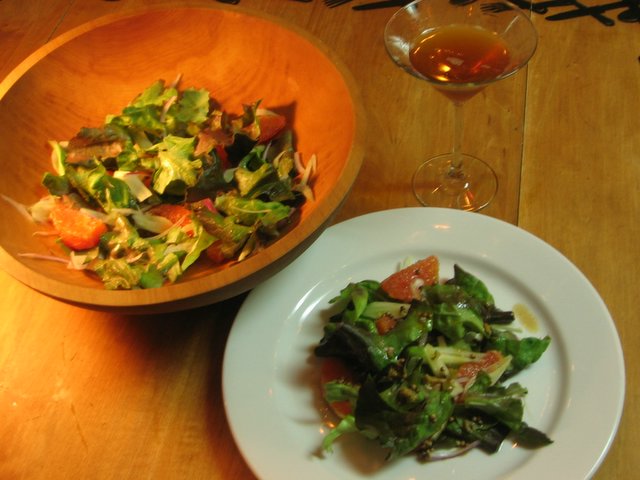
Just a simple salad my guy made on Saturday (from Chris Schlesinger, of course). Red leaf lettuce, orange segments, fennel bulb, red onion and a dressing made of red wine vinegar, olive oil, coriander and chopped green olives. (And lemon juice? Possibly.) This is the sort of combination it's nice to keep in mind for throwing together something that's easy, but tastes very sophisticated. No need for a recipe, and with a nice T-bone and some baked potatoes, you'll feel like you're eating at a nice restaurant, only with cats, leftovers, and your own choice of background music. And cheaper drinks. Posted by Picasa

Look at the size of those thighs!


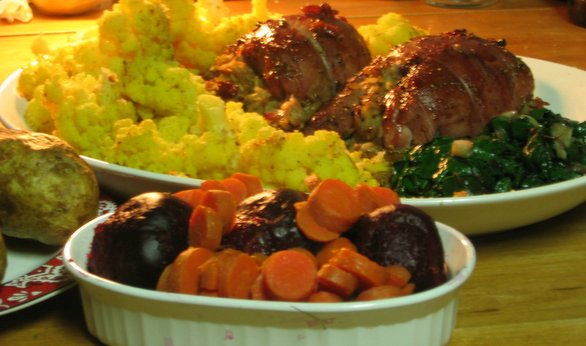
Turkey thighs, that is. I've never bought just the thighs from a turkey before, but they've always been my favorite part of the bird. The whole stuffing business didn't really work out so well; these were not pretty, neat, little packages with stuffing evenly distributed throughout. More like lopsided lumps with the stuffing all hanging out on one end and falling onto the roasting pan. But tasty!

For the stuffing, I caramelized some onions, then mixed them with rice and orange zest. The caramelized onion flavor didn't come through very clearly, but I think it did give a background of depth and sweetness. The orange zest was very flavorful (I used one of those cara-cara pink navels that have been in the stores lately).

For a glaze, I blended some fig spread (which all the cool bloggers have been using lately, and which I love with all my heart), a bit of orange juice, some balsamic vinegar, and black pepper. I could have eaten that mixture straight from the bowl, so it was a bit disappointing that there wasn't enough glaze to really sauce up the thighs. I will definitely be making that sauce again, but next time I'll make enough to drizzle some on the meat on the plate.

Overall, it needs a little tweaking, but I liked this dish. I might use wild rice in the stuffing next time, for a little savory contrast to the sweet flavors of orange and fig. Turkey thighs are cheap and actually taste like something, unlike turkey breast. Don't know why I haven't made them before.

As you can see, I made a pile of vegetables as side dishes, mostly so that I would have lots of leftover vegetables for this week's lunches. That cauliflower wasn't flavored with turmeric or saffron - it's a yellow cauliflower called "Carnival." It has a nice flavor and a beautiful color, recommended. Posted by Picasa