Saturday, May 26, 2007
Assorted pictures 2
Here's my brother, enjoying breakfast in Montreal. Note how lovely the presentation is. In general, I find restaurants in Montreal, even the relatively low-end ones, put a lot more effort into presentation.
Tuesday, May 22, 2007
Usually
That said, I liked the interview with Marco Pierre White today in Salon:
What do you think of the American food scene right now?
I think America is very exciting. I've never seen anyone who obsesses about produce more than the Americans. Their love for produce is extraordinary. And that's where it all begins. Mother Nature is the true artist. Even when I was in Seattle, walking the markets there, just the pride with which people present their food, just the way they stack it and present it and show it off, it's fantastic. I think America, the future of America, is fantastic.
It's interesting, what you're saying about the produce. Because it seems like when I go to France, even in the lowliest shop or restaurant, everything is good, but here you have to seek it out.
Well, [the French] take it for granted because it's all around them. It doesn't ignite their imagination. In America, the produce ignites the imagination. I'm sure when you go to France, it fucking blows your brains.Sunday, April 15, 2007
What's the official ethical blogger stance
The Eight Types of Food Snob
1) The Four-Star Snob (Or Classical Form)
No meal which costs less than $50 is worthwhile. They like to drop the names of fabulous places they've eaten. They have no idea where to get decent pizza. And don't get started with the wine.
2) The Exotic Food Snob
More commonly male than female, the exotic food snob will mention frequently how good the street food is in Thailand or Malaysian, but will snub mac and cheese, classical French cuisine or a good roast. The fewer Americans who have tasted a particular cuisine, the more status it holds. Scorns home-cooked food. Closely related to, and overlapping with the
3) Spicy Food Snob
Exotic is better, but chili and barbecue are okay, too, as long as the food is HOT!HOT!HOT! Heat is directly related to "authenticity," so the spicier the food, the more authentic (even if the dish is traditionally not that spicy), and people who have a problem with heat are to be mocked.
And speaking of authenticity...
4) The Authentic Food Snob
No substitutions accepted! The authentic food snob doesn't care what s/he eats, as long as it represents in the purest form a dish once eaten by a peasant somewhere. Is certain that there is ONE authentic version of every dish. If the authentic food snob cooks as well as eats, will worship Paula Wolfert.
5) The Reverse Food Snob
Believes that anyone who prefers "fancy" food is just putting on airs and needs to be put in place. Gets pissed off by unfamiliar foods. Insists that everyone really likes like Hellman's and Jif better than homemade mayo or natural peanut butter, but won't admit it.
6) The Fresh And Local Snob (Guilty!)
"I only eat food grown within 100 miles of home, except for spices and olive oil." "Oh, I do only 50 miles and I've given up olive oil - I only cook in local lard now." "I only eat food grown within one mile of my front yard. I've lost eighty-five pounds."
7) The Healthy Food Snob
"No meat, and you know what? I don't even miss it. No rich sauces for me - I really like things light. Only fruit for dessert. Maybe a single square of dark chocolate once a week or so, but generally, I don't have much taste for sugar any more. No, not fat either. You know, once you break your addiction to unhealthy food, you just don't want that stuff any more. You should try it."
8) The Trendy Food Snob
Genuinely thinks that someone's knowledge or interest in food can be gauged by their level of devotion to the NYTimes food section. Often cooks as well as eats; if so, owns very expensive kitchenware. Thinks that has something to do with one's abilities as a cook. I'm sorry, "chef." Thinks that formerly trendy foods like sundried tomatoes are kind of, well, funny.
Farming the City Conference
I exaggerate, but only a little. There were probably twenty people there older than I am, and SEVERAL of these were attendees, rather than presenters. And I saw one other person in a skirt (no hose, though). (I carry the remnants of my Catholic upbringing with me even when I think I've rooted them out. After ten years of having to wear a skirt to school every day, and of course a dress to church on Sundays, I still am convinced on a deep level that jeans are suitable only for hanging around the house and doing grocery shopping - anything that involves meeting people calls for a proper outfit. Yeah, somehow I managed to attend high school in both the 1980s and the 1950s simultaneously. ) Anyway, to co-opt Elvis Costello - I used to be embarassed, now I try to be amused. And the sight of all those earnest college students, in their fleece and denim, devoted to the ideals of sustainable agriculture and food justice, eager to change the world in really positive, concrete ways - well, it warms the cockles of your heart, you know?
The day opened with Sandor Katz and Mark Smith (campaign director from Farm Aid). Now, here's the disappointing story about Sandor Katz - I was supposed to get to hang out with him, and I was pretty excited. I know - that's pushing the geek-o-meter to eleven. But I love his books. Wild Fermentation got me started making my own sauerkraut, and I read The Revolution Will Not Be Microwaved through practically in one sitting. He's obviously a complete kook, and I mean that in the best of ways. So when I find out a co-worker knew him and would be attending his talk with plans to hang out afterwards, I was eager to tag along. Alas, my co-worker was a no-show, so I just got to hear the talk.
Which was very good, if a bit short (the same complaint I had about Mark Smith's presentation - the organizers really should have planned more time for both of these guys, who had a lot to say). Here was Katz's big message (stolen from someone else, though I've forgotten whom, because I never remember to take notes): Sustainability is participation.
I'm still mulling it over, because I think there's a lot there. His general point is that the role of consumer is a limited one. If we're going to stop the tide of destructive materialism, we need to be creators and nurturers and growers, each of us, and not just consumers. Not exactly a new concept, but still an important message, one that needs to be repeated over and over to be heard for even a moment in the din of the overall culture and its constant insistence that we buy!buy!buy!
I think that my grandfather was a relatively happy man. In no way did he live off-the-grid. His life was not exceptional for his time. He and my grandmother had a chicken farm for a while, and he worked in a lumber yard. After he had advanced in the company, they sold the farm and move to the "streetcar suburbs" of Boston (Roslindale). Then they retired to a truly suburban home in Wakefield, MA.
Sounds like a not-uncommon American life and hardly some sort of model for sustainability. After all, he sold the farm - it's probably a condo complex now. And he moved to the suburbs, where he became very attached to, of all things, Days of Our Lives.
But that suburban house had an apple tree in the yard and some blackberry bushes. My grandparents planted two big gardens and grew lettuce, spinach, zuchinni, summer squash, carrots, rhubarb, peas, green beans, yellow beans, radishes, tomatoes, and probably some other things I don't remember. My grandmother made jam from the blackberries and froze beans, peas, rhubarb and carrots for the winter. Of course, she made their meals, simple good food, nothing fancy, but all from scratch. In the basement, my grandfather had a workshop where he fixed things and built things from wood: shelves and small things for the house, dollhouse furniture for his granddaughter. I don't ever remember my grandparents playing a record, but my grandfather pulled out his guitar or his harmonica on most visits. My grandmother made quilts. And every morning they walked around the lake that sits in the middle of the town, visiting the neighbors along the way, stopping to pick up a newspaper, their mail at the post office.
In other words, their lives were defined more by what they made or what they did than what they bought. They made important contributions to their household through the work of their own hands. They had a community with whom they interacted on a regular basis. And I think their lives were so much more in balance than most people's lives are today, when spend-watch-listen has largely replaced make-play-do.
Cooking is the primary way that I participate, though I also make woodcuts and paintings. I wish I could grow things. I used to, I had a garden in my last apartment. But I made a strategic error. In my desperation to find an apartment in Cambridge that was affordable and not terribly depressing, I gave up on access to a yard. I knew that I had loved my garden, but I didn't think it was essential. I also thought that this apartment was a short-term, temporary thing, for a year or so, until I was able to find a job outside the city. Well, I was wrong. It's been three years, and I'm still here. And the loss of the garden has been very difficult. Rather than moving forward, into a life of greater participation, I have moved back, into a greater reliance on being a consumer.
It's okay. I won't make that mistake again. And I've used this time to learn some other skills - I've learned how to knit (at least a little), I've improved my jam-making and canning, I've learned how to make fermented pickles (thanks, Sandor), I've assisted in beer-making, I make my own vinegar. Since I still don't know when I'm going to leave this place, I've decided this summer I'm going to focus on pickling, drying, and freezing local produce. And I'm going to learn the harmonica, because, as Maude said, "Everyone should know how to make a little music."
Hmm, I seem to have wandered from the Farming the City conference. What else to say about that? A lot of great projects are going on. I was particularly impressed by the projects described in the morning session that were aimed at getting farm produce to food-insecure communities. The problems seem insurmountable, but these projects seemed to have great success by starting very, very small and growing slowly until they are helping a lot of people. Which is its own lesson - small steps matter.
Okay, Sunday morning sermon is over. The Mass is over, go in peace to participate as fully as you can in your own life.
Wednesday, April 11, 2007
You're going to have to imagine
I used Maury Rubin's tart crust recipe, because, as I believe Jeffrey Steingarten pointed out, it's perfect and there's no need for any other recipe for tart shells. I didn't use his recipe for passionfruit filling, though. It looked a little lacking in eggy goodness. So I found a recipe online for passionfruit curd, then looked at Helen Witty's lemon curd recipe, which is my standard go-to recipe for lemon curd. I determined that the Witty recipe would work, as long as I decreased the sugar (tart though passionfruit is, it's sweeter than lemon juice). I also wanted to use Rubin's idea of including vanilla bean to add another layer of flavor. So this is what I came up with:
3 egg yolks, plus one whole egg
1 cup sugar (or 3/4 cup - I'll explain in just a minute)
1/2 cup passionfruit pulp/juice (I didn't use fresh, though that would have been great. Goya*, god bless 'em, sells frozen pure pulp. It's excellent in cocktails, smoothies and this recipe.)
1 stick plus two T butter, cut into pieces (whoo-hoo! eggs and butter! bring it on!)
2-inch piece vanilla bean
Beat the eggs and sugar together thoroughly. Add the juice, butter and vanilla bean (scrape the seeds into the mix, then throw the pod in while you're at it), and put your bowl over some simmering water. Cook and whisk seemingly endlessly, but really only for about 10-15 minutes (I recommend you put on NPR before you start) until it's nice and thick, then put through a strainer into a bowl and refrigerate.
Blind bake your tart shell, let it cool, then brush it thinly with a bit of melted white chocolate. This will seal the shell from the moisture of the filling and keep it from getting soggy. Fill the tart - you should have exactly enough for a standard tart shell.
Now, here's the question: meringue or whipped cream? For eating purposes, I prefer whipped cream, but for the baker, meringue has two advantages. One, it uses up those perfectly good egg whites. Two, you get to use the blowtorch. For me, the joy of playing with fire trumps the pleasure of butterfat (just barely), so I went with meringue. And therein lies the error I made with the recipe. It was just a little too sweet. With lightly sweetened whipped cream, the curd would have been perfect, but it wasn't quite tart enough to stand up to meringue. Therefore, I would suggest that if you want to serve the curd plain, or with raspberries (which would look and taste great) or with cream, you use 1 cup of sugar, but if you want to to cover the curd with meringue, drop the sugar down to 3/4 cup.
The sauce was my way of dealing with the overly-sweet tart. Passionfruit pulp, a little sugar, heated together, a little cornstarch to thicken (my arrowroot had something blue in it - I have NO idea), then a glug of rum. Fine, nothing exciting, but brought the sweetness back into balance. Unnecessary if you follow the sugar guidelines above, I think.
I will definitely make this tart again; it's pretty easy, the components could be made ahead, and it's a little unexpected. Plus, I think it will be fun to play around with fruit pairings. Raspberries are obvious, because raspberries and passionfruit have a special synergy, but kiwi might be nice as well, or strawberries or even possibly peaches. We shall see.
*If there's one big brand I love with a pure and untarnished love, it is Goya, maker of the only canned beans that are neither chalky nor mushy, purveyor of otherwise unattainable ingredients, my one true Goya.
Wednesday, April 04, 2007
Wednesday, February 28, 2007
Buttermilk sherbet warning
And then there's buttermilk sherbet.
I make buttermilk sherbet more than any other dessert. I often have buttermilk left over in the fridge, and the sherbet comes together in minutes. I just add enough sugar (sometimes honey) to make the buttermilk sweet-tart, then add a little something, and in the ice cream maker it goes. Ten minutes later I have a nice little dessert, low in fat, not too high in sugar, with a little protein and calcium to keep it from being totally nutritionally reprehensible. This is one of the only desserts I ever make just for myself; usually, dessert is a company phenomenon.
Now, that "little something" I add is fruit-based, but it changes with what I have in the house, from a tiny dash of lemon juice to a mess of pureed fruit. I have successfully made blackberry-buttermilk sherbet, lemon-buttermilk sherbet, lime-buttermilk sherbet, raspberry-buttermilk sherbet, peach-buttermilk sherbet and blueberry-buttermilk sherbet. Last night I made pink grapefruit-buttermilk sherbet, and I just want to share this advice with you: don't. Grapefruit-buttermilk sherbet is bad and weird. Just. Don't.
This has been a public service announcement.
Friday, February 16, 2007
I love this
Tuesday, February 13, 2007
Overheard in Cambridge
"It was pretty good. The basic idea was that nutrition is really complex and we don't know as much as we can, so you shouldeat based on humanity's accumulated knowledge about food you find in traditional cuisines, instead of just eating whatever nutritionists say you should this week. So, eat real food, like what your grandparents ate. You know, don't eat anything your great-grandmother wouldn't recognize as food, like Powerbars or Oreos or yogurt."
Yogurt. Cracked me up.
Tuesday, February 06, 2007
A little something
Well, I do. At least, I do when I'm reading other peoples' blogs. I love to hear what people really eat, day to day. What did you have for lunch, for dinner? I want to know. I want to know where you get your groceries, what you splurge on, and where you pinch pennies, what your fall-back meals are and what's in your pantry and what big-brand foods do you still eat all the time even though you're not really a big-brand-eatin' kind of person (Grape-Nuts). But I never feel like I have enough to say unless I can offer up something different. Isn't it always that way? We want greatness from ourselves, but love other people if they just smile at us.
So, here's what I had for lunch: lentil salad. This is a good salad, simple and tasty enough to eat three days in a row. I used to make it all the time, but then I stopped because the boyfriend doesn't like feta, and feta is key to this salad. Then I realized that feta is only key for me - he likes really plain food. So I made a batch and removed his portion before I added the feta.
I don't measure for this. I don't even know how many cupes of lentils I used, because I made the lentils for a side dish on Saturday night, just boiled firm-tender with some mushrooms over. The next day I mixed the leftover lentils with chopped red pepper, parsley and feta cheese, and dressed it all with a combination of lemon juice, olive oil, pepper, salt and a spoonful of tomato paste. Of course, you can skip the red pepper, or use green, or add red onion or chopped sundried tomatoes,or cucumbers or regular tomatoes or scallions. The basic requirements are lentils (not overcooked), parsley (the salad will taste dull without it), feta, and enough salt and pepper in the dressing to really give it some flavor. Though you could substitute vinegar for the lemon juice, I wouldn't recommend it - the bright citrus serves as a good counterpoint to the earthy lentils. But you can skip the tomato paste if you wish, particularly if you do add some tomatoes, dried or not, to the salad.
Friday, January 26, 2007
BUZZBUZZBUZZ
Tuesday, January 16, 2007
If I knew then what I know now....
1) Throw away ceramic pie plates, no matter how cute they may be or how many you might receive as gifts. They are useless.
2) Oven-roasted potatoes take at least twice as long as it seems like they should. Short of actual burning, it's almost impossible to overcook a roasted potato.
3) You will never, ever use frozen spicy chicken broth. If there's a chicken carcass with lots of spice on it, just pick it bare and toss it out.
4) Always buy two bottles of glass cleaner, two cans of scrubbing cleanser, two rolls of paper towels. Keep one each in the kitchen and the bathroom. See how much cleaner your rooms stay.
5) Put all the bits and pieces for stock in ONE freezer bag, dummy.
6) Don't waste your vote on a third party candidate.
7) Refrigerate your apples.
8) Those weird "produce storage" bags with the tiny holes? They work.
9) Buttermilk freezes perfectly.
10) A small food processor is a waste of space. Buy a big one or skip it.
11) You will not grind meat as often as you thought you would.
12) If you like a cookbook writer, buy everything s/he ever wrote. You'll probably use those books twice as often as any other additions to the library - unless you luck on another favorite. At which point, repeat.
13) On a similar note, you will never regret buying another Tom Waits album.
14) A kitchen drawer needs scissors, binder clips, paper clips, rubber bands, and note paper. Having to run to the desk for these items is annoying.
15) Every home needs a cat.
16) White pepper is freakin' delicious.
17) Celery seed helps out a lot of dishes - anything with mayo, anything with beef.
18) Really good dried pasta (bronze-die) is actually worth the money.
Thursday, January 11, 2007
New Issue Up
Anyway, the January issue of NewEnglandGrown is up. We're focusing this month on game and exotic meat - deer and bison farming, etc. Check it out.

Bison on a farm in Rutland, MA, during the only snowfall we've had this year.
Monday, January 01, 2007
Ring in the New Year!
Thursday, December 21, 2006
Hey there, sugar!
I sent cookies to my aunt and uncles. I brought packages of cookies to work. I left plates of cookies for the neighbors. I spent the entire weekend baking and singing Christmas carols. I discovered that Christmas cookies have healing powers; I really felt much better after my baking extravaganza than I have in ages.
Okay, I’ll put the personal stuff aside now and talk about cookies.
I’ve noticed that people who improvise wildly when cooking are nervous about making even the slightest adjustments in a baking recipe. They shouldn’t be; there are lots of things you can do to change cookies without the slightest risk.
It’s important to think about flavor and texture separately. Flavor is easy to play around with; texture is more problematic. Texture defines a cookie – shortbread is shortbread whether the flavor is vanilla or ginger or even chocolate, as long as the texture is crumbly. The texture of a cookie depends largely on the following factors: ratios of major ingredients (eggs, flour, sugar, butter), method of combining (is the butter melted, are the eggs separated and whipped, is the flour sifted), temperature of dough (chilled or not), temperature of oven and baking time, and even a little on temperature of the cookies sheets. In some cases, ingredients affect texture if they are structural, intrinsic to the dough – cake flour versus a.p. flour can matter quite a bit, and ingredients like molasses or peanut butter make a big difference.
But flavor is a whole other story. For one thing, you can add things to cookies with abandon; unlike cakes, which can fall under the weight of too many extras, cookies will pretty much bake up just fine as long as there’s enough dough to bind all the bits you’ve added. So you can add nuts, coconut, all kinds of dried or candied fruit, or chocolate chips to almost any cookie. You can also swap out extracts – use a little less lemon, almond, or orange extract than you do vanilla. You can add spices or grated citrus peel. Before baking, you can sprinkle cookies with sanding sugar or pearl sugar or cinnamon sugar. After baking, you can glaze cookies or dip them in chocolate. You can also swap dark brown sugar for light to deepen the molasses flavor or swap light for dark to lighten it. (Don’t swap white and brown sugars, though, unless you want to change the texture).
This year I made a few cookies straight from the recipe: the lime meltaways and chocolate crackles from Martha Stewart’s holiday cookie supplement last year. The chocolate cookies were good, but the lime were a bit dull. Not bad, but I won’t make them again. I made butter cookies from the Cook’s Illustrated Best Recipe Cookbook recipe, with only a minor adjustment. I added a little orange oil, because I like a hint of orange in my sugar cookies. I also decorated them with royal icing. I made the Russian tea cakes from Stars Desserts straight, and they were good, as always.
I used The Best Recipe cookbook for several starter recipes. My chewy walnut cookies are a variation on the chewy chocolate chip cookies. I use dark brown sugar, add natural walnut flavoring, and replace the chips with toasted walnut halves. I made their spice cookie, but replaced their cinnamon-heavy mix of spices with a hearty teaspoon of clove and ¾ teaspoon of allspice, used light brown sugar so the clove flavor would come through, included ½ teaspoon of lemon extract, then glazed the baked cookies with a lemon/powdered sugar glaze and topped each one with a little candied lemon peel. These were winners, tart and spicy and sweet all at once. I turned the anise biscotti recipe into orange-cardamom-fig biscotti with the addition of ½ tsp each dried orange peel and orange oil, 1 teaspoon of cardamom, and chopped figs soaked in Triple Sec (dropped the anise and vanilla). I liked these very much as well.
Less successful were the oatmeal cookies from the Best Recipe. Clearly, not the best recipe after all. I made no changes except substituting dried cherries for the raisins, but these just weren’t very good oatmeal cookies. Oh, well, live and learn.
I don’t like the Best Recipe peanut butter cookie recipe, so I used the one from the Wooden Spoon Dessert Cookbook, another good source for dependable American-style baking recipes. Again, I replaced the light brown sugar with dark to increase the molasses flavor, then I added 2 teaspoons of ginger, and garnished the top with a piece of candied ginger. My favorite saltwater taffy was always the peanut-molasses; I think a lot of people are surprised as how comforting and familiar the peanut-ginger-molasses combination is. And, yes, I used natural peanut butter; the idea that only preservative-laden peanut butters can be used in cookies is a myth, and a silly one at that.
I wanted to make some meringues, but I seem to have lost my big star tip, and Verna’s Cake Supply on Mass Ave has tragically closed its doors. Still, a solid selection of cookies, which made for nice plates. I was wiped out by the end of weekend, though, what with the baking and the glazing and the decorating and the packing and the tying of the bows. I’m all rested up now, so it’s time to start thinking about Christmas dinner.
Here's hoping you make some great cookies this year. Don't be afraid to improvise - oh, and be sure to write down your changes, just in case someone falls in love with your cookie and you have to make the same recipe every Christmas forever and ever.
Sunday, December 10, 2006
Announcement
I've not been posting a lot in the last month or two, because I've been involved in a project now ready for unveiling. It's a website called NewEnglandGrown, devoted to New England agriculture and food. Each month, we will be publishing new articles on some theme, some aspect of NE farming, as well as directories of resources related to that theme. We're hoping to build up a useful resource, as well as providing some interesting reading. We intend to focus on some of the less-explored aspects of the food/farm world, not just the apple orchards and the CSAs, but the farm summer camps and the llama breeders and the heirlooom seed growers and the farm inns and the people who sell Maine seaweed and the people who grow and dry herbal teas. We've also got an extensive events listing, because as far as I can tell, there's no one place to go to find information on all the maple festivals, open farm days, country fairs, cheesemaking workshops, and other great stuff going on.
Anyway, the first issue is up, and I would be thrilled if you took a look. Unfortunately, the first issue is a little light on writing - we're hoping to up both the quantity and the depth of the reading content next month. We spent a lot of time getting some of the resource material ready and didn't focus as heavily on the writing as I would like, but that will change. In the meantime, we've got a local food guide and a farmers' internet guide, directories of farm B&Bs, Christmas tree farms, and wineries, a holiday gift guide, some book recommendations, recipes, and the events listing, so there's plenty to check out.
If you have any recommendations about thing you think the site could use, do let me know. I'll read your messages between batches of sugar cookies and research on bison farms in New England for the January issue.
Thanks!
Sunday, November 26, 2006
France, Part II (Or, No One Will Ever Make a Mini-Series About This)
The cheapest flight we could get went from Logan to JFK, then JFK to Paris. Except we had been waiting at Logan for hours. Snow. We were going to miss our NY flight. We waited. And waited.
When we got to JFK, we found that, yes, indeed, we had missed our flight. We waited some more, for instructions. The airline was going to put us up for the night, and then we were going to take another flight the next afternoon. I called Josh, who was supposed to meet us at the airport.
“What do you mean? I need you here. You shouldn’t have left so little time between flights [As if I and not the airline had determined the length of time between the legs of the journey, which was a generous two hours anyway]. At least if you’re going to be late, you can do me a favor. Buy me some mineral oil.”
It was very, very late at night in the hotel at JFK. Where the hell was I supposed to get mineral oil? Why did he need mineral oil?
I promised to try.
The next day we spent a long, long time waiting around the airport. We looked in every shop for mineral oil. Nothing. We flew to France and arrived exhausted to find no one waiting for us. We tried to call, but no answer. We waited for over an hour. Finally, Josh appeared and the first words out of his mouth were: “Did you find the mineral oil?”
He was angry that we had failed. He seemed to have decided to take his anger out on his vehicle, an early-type SUV that was about five times the size of every other car on the road. He flew, going easily 90 miles an hour, and driving erratically, swerving and jerking the car around the road. Even my ex, who was generally a fast driver, was a bit alarmed. The whole trip out of Paris was a blur of words from Josh on the usual themes – France is beautiful, the French are annoying, can you do the job – with a few new additions. For example, he told us his wife came out on Friday nights and stayed “until we fight, usually on Sunday morning.” In New York he had claimed she came out Thursday and stayed until Monday. He asked if we remembered the sheets, because that’s all we’ll need. He pointed out an open-air market.
“What do you think of that? Americans think it’s quaint! That’s one of your New England words, “quaint!” But, really, it’s filthy! Why would you want to eat food that sits out like that?”
He was practically spitting.
We got to the villa, and from the outside, it was everything he promised. The factory is in one wing, his home in another, our apartment in the third; there’s a courtyard and huge windows with shutters. He took us into the apartment.
It was empty.
He was right about the sheets; there were no sheets on the bed. Also, no blankets. Or pillows. Or any other furniture. Or pans, pots, utensils. No fridge. No anything really, just a bare bed, and a few coathangers in the closet. The closet which, by the way, had those folding mirrored doors. To match the gold wall-to-wall carpet. He had a 15th century French villa, and he was remodeling it to look like a Holiday Inn in Jersey.
He made me go to work that afternoon, making brownies. He informed me that he wanted chewy brownies. Then he informed me that there was no mechanism for melting the butter. Also, the butter couldn’t be warmed in any way. The factory was in a stone building with limited heat; I would say the room temperature was about 55 degrees.
As anyone with the slightest knowledge of baking will understand, this was a problem.
I was told to work with the French head baker, who doesn’t speak any English. We muddled through and made a few batches of brownies. It was clear the cook thought that Josh was crazy. It was also clear he was a little afraid of Josh. Meanwhile, Josh was cooking lamb in a pit in the courtyard, occasionally throwing his arm to the sky and yelling, “We’re the only people from Spain to Belgium barbecuing!”
After the brownies were baked, Josh invited me and my husband to have dinner with him and his wife. The kitchen was vast, like a storybook kitchen, with an old hearth. Dinner was the lamb, plus a strange fish soup made from a powder; that was all. The room was freezing cold; his wife, still silent, wore a hat, coat and mittens indoors. Josh explained some of his business decisions. For example, instead of buying cloths for cleaning the factory, he stole towels from expensive hotels. Then, he offered these towels to his employees in exchange for their old home towels. That way, he got both free rags and improved employee relations. He had become disenchanted with this method, however, because the employees’ towels weren’t, to his mind, of high enough quality.
I got the next day off to settle in. We needed food, badly – the lamb and broth were all we had eaten since New York, except of course for some brownies. We decided to go into the neighboring village, since my husband had taken a walk around our tiny village the day before while I baked and found only a drugstore and a sausage shop. Josh warned us that it was too far to walk, and offered to let us borrow his car. We declined. At this point, all we want is to be away from him. He insisted that we couldn’t walk. Unfortunately, a car appeared in the road at this point. Josh ran into the road, waving his arms madly. The car stopped, and Josh told the terrified driver that he had to take us to the next town, opening the back doors and pushing us in as he did so.
The driver took off with panic in his eyes, and once he was safely out of view, I used my limited French to end his misery. “Arretez, s’il vous plait! Ici, c’est bien! Merci, merci!” He let us out, and we started walking.
Josh was right, it was too far. We walked and walked and walked. Finally, a car pulled over to pick us up – one of the workman who was rebuilding the wall in front of Josh’s property. We spent the afternoon in a nice little French town, and that was the high point of our trip to France. We had to take a taxi back. It was very, very expensive.
The rest of the week is a bit of a blur. Among the things I remember:
Finding out that the local children throw rocks at Josh’s windows – and at my ex-husband, presumably because he was Josh’s guest
Finding out that the American electricians left in the dead of night after wrecking the apartment
Josh mentioning how he likes to go to Amsterdam to get cocaine (that made some things make lots more sense)
Josh mentioning how nice it will be for him to be able to go away now that we’re going to be there to protect the house from the angry neighbors
Josh setting us up with furniture: dirty old pillows from some lost couch and a small exercise trampoline as a “table”
Josh admitting his wife rarely stayed even one night at the villa (forget that Paris apartment)
Eating sausage and brownies and wondering how we would ever find real food
Catching Josh looking in our windows first thing in the morning (no shades, of course, and he complained if we closed the shutters, which we did anyway)
And, most of all, trying to make brownie batter that didn’t break with cold butter in a cold factory while Josh stood right behind me saying over and over, “but what I want to know is, can you do the job?”
I broke after one week. I don’t get angry with people very often, and I rarely lose my temper. But, my god, did I lose my temper.
The French baker was back, the first time in a week. I had tried every chance I could to explain to Josh that we needed to at least warm the butter, or the batter would keep breaking. The brownies came out just fine, but there was a crusty top that didn’t cut cleanly, and that was the inevitable result of the cold butter. Needless to say, I never got that many words out at a time. He never seemed to notice that I was talking, let alone what I was saying. But now, with the French baker standing next to me as I mixed the batter, he suddenly noticed the broken batter.
“What is this crap? I’ve never seen batter look like that, have you?” He turned to the French baker, pulling him into his disgust with me.
That did it. I remember literally throwing in ths towel – flinging the rag I was holding across the room and turning on Josh with fury. I remember saying something like this: “Everyone hates you! Your employees hate you, the neighbors hate you, the village children hate you, even your wife hates you, and I certainly hate you!” I know it’s not nice, I know. But that’s what I said.
I told my husband we were leaving. He was happy. As I repacked my bags, Josh offered to drive us to Paris, an offer we unfortunately had to accept. A taxi, the train, would have been too complicated and expensive, and he was going there anyway. Something to do with his wife.
The ride back to Paris was very unpleasant, to say the least. Josh tried to convince me to stay, tried to convince my husband to make me stay, and still kept asking (you know what’s coming) “but what I want to know is, can you do the job?” and I will confess, part of me thought that if perhaps I just had a night or two away, I could go back with a clear head, draw some necessary boundaries=, and get to stay in France.
But then he was interrupted by a phone call on his cell. He said hello, then okay, I’ll be there soon, then he hung up. Then he said to us, in the exasperated tone of voice a man might use to say that his wife says she has nothing to wear, and with that closet of hers!: “My wife just had a miscarriage.” He actually rolled his eyes.
That was the point at which I actually thought I was going to throw up. The exhaustion, the madhouse ride at 90 miles/hour, the diet of sausage and brownies, and more than anything the utter disgust at this strange and horrible life I had just spent a week looking in on. I remember thinking that all I had to do was get to Paris without throwing up, and then everything would be fine.
Everything was fine, of course, and yet not fine at the same time. We went home to the worst Christmas I can remember. I was demoralized on my return; I felt like I carried the stench of bad luck and bad decisions. I knew I should have trusted my instincts and stayed home. But I was afraid of my instincts – my instincts were also saying: don’t become a cook, despite all the time and money you just dropped on your education. My instincts were saying: leave your husband.
It took time to pay off the costs of the tickets, of course. I did get a job in a bakery and worked there for a while, but ultimately I left the culinary world. I also left my husband. And life has been better since. I have not often looked back at that week in France, which wasn’t even the bottoming-out point, which came two years later, in another questionable job I should have known better than to take - one that lacked even an entertaining story. But there’s only one real regret I have.
I wish I still had that brownie recipe. By the end of the week, it was really good. So, yeah, I think I could have done the job.
The France Story, or, Why My Life Isn't Like Peter Mayle's, Part I
But it was funny, really. And vaguely culinary. And it took place around Thanksgiving.
I was in my last month of culinary school, the 1 year baking and pastry arts program at the CIA. I had figured out one thing after about the second month – I didn’t like professional kitchens. I had done an internship at a bakery, which was supposed to prepare me for the world of professional cooking, but the bakery was tiny. It was just the owner, the baker, two ever-changing Guatalmalan teenagers, and myself. The whole feel was pretty easygoing.
At the CIA, I learned what real kitchens were like – fast-paced, a little macho. (I later found out that bakeries and restaurants have a very different feel, and I spent most of my brief professional cooking life at bakeries as a result). I was older than my classmates by several years. I was interested in aspects of food they couldn’t care less about – I was just starting to learn about heirlooms and sustainable ag and all that stuff and I was excited, but I couldn’t find anyone else who cared, even among the instructors. I liked learning how to do new things, but I hated the performance aspect, the sense of having to do things perfectly on the first try, not being able, essentially, to write drafts.
So I was trying to figure out what to do with this new degree I was about to get, that qualified me to do something I had no interest in doing. Who was going to want an English major with a pastry certificate? I sent a few resumes to some cooking magazines, but no bites. I was starting to panic.
At the same time, my marriage had hit the rocks. My (now ex-) husband was suffering terribly from a depression he refused to treat with medication. Depressives make bad workers. He had left one job to avoid being fired, then was fired from the job that followed. He had found a new one, and then, just a few weeks before my program ended, he was fired again. It was a bad, dark time.
So, there I was, in the career office of the CIA looking at notices for something that would read, “Wanted: English major with culinary degree to write interesting food articles, maybe do a little research. High pay, no experience necessary.” Not surprisingly, there were no such notices. But there was a notice that ran something like this:
American baked goods company in France looking for recipe developer to improve recipes for cookies, brownies, etc. Room, board and small stipend. Factory located in villa 1.5 hours outside Paris.
Well. Huh. Recipe developer? I liked the sound of that. Careful, slow work, testing and retesting, applying scientific principles. Sure, I had never done anything like that, but I thought I probably could. How hard could it be? Of course, there was no chance I would be hired, but it can’t hurt to fax over a resume, right?
I did. The next day, I get a call from, well, we’ll call him Josh. This call seemed to be my job interview, but it was hard to tell. Josh was pure New York, with a heavy accent, a loud voice and an aggressive manner. He alternatively wanted to sell me on the wonder of this job and to ask if I thought I would be good at it.
“So, let me tell you, the place is beautiful! I mean, you’ve never seen a place like this. It’s a 15th century villa. Of course, the French people who owned the place never did anything with it. They think it’s charming to have outdated plumbing. But I’m fixing it up. My wife has an apartment in Paris, and you could use that on the weekends. We have this great machine that bakes bars in boxes, and cuts ‘em and wraps ‘em, but these French bakers don’t understand American cookies, you know? They wanted to bake chocolate chip cookies in rings! So I need an American baker. But what I need to know is, can you do the job?”
“Well, I have never done any recipe development, but I am just finish-“
“You would have your own apartment, in a villa! And you could go to Paris on weekends – there’s no way for you to work over here for a French company, you know. They’ve got all the jobs protected. If you stay the whole six months, I’ll pay for your airfare. But not if you leave before then! I had these electricians...but you’ll want to stay, it’s beautiful! Do you speak French?”
“I’m afraid not really – I took French in high school, and I of course can recognize most culinary terms, but I-“
“The French workers will work overnight anyway, to save money on electricity. You’ll be all alone. But it’s beautiful, you’ll love it. You won’t need to bring anything, just sheets for the bed. I don’t have extra sheets. But what I need to know is, can you do the job?”
“Well, I think-”
“The apartment in Paris is …”
You get the idea. It was like standing in oncoming traffic. I tried to be honest with him, tried to make him understand that I was just out of school, I would love to try, but I could give no guarantees. It was a little subtle for him.
“So, when can you be here? Can you be here by Saturday?”
It was Tuesday. I thought, he’s offering me and my husband a place to live in France on the basis of a twenty minute phone conversation in which I spoke less than one hundred words? Is he insane? Well, obviously, he’s clearly insane. But he’s offering me a job in France!
“I don’t think I could be there on Saturday. Classes finish next week, and I would have to pack all my things, put them in storage, get a flight. I could probably do it all in two weeks, at the earliest.”
He was annoyed. Really, he wanted me there on Saturday. Or maybe not, because do I really think I can do the job? Maybe we should meet first. He’ll be in New York for Thanksgiving (one week away). Could me and my husband meet him and his wife for brunch and talk things over? But he would really want me there in two weeks. From now. Which would be one week after the meeting at which he is going to, apparently, determine if I have the job.
I hang up the phone confused. Am I moving to France? Why not – I’ve got nothing here, neither does my husband. We also have no money. How will we get to France? Books. The ex-husband worked in publishing; we had tons of books. We sold enough to pay for one flight, the other we put on a credit card. I pack all our stuff in boxes. My husband went through the notes for the novel he thought he would have time to write. We put everything we own in our parents’ basements. We told everyone we were moving to France. Maybe.
The day before Thanksgiving, we were in New York, meeting Josh and his wife at a small breakfast place. The conversation was exactly the same one we had one the phone. I said almost nothing; Josh talked incessantly – the villa is beautiful, the French are awful, bring sheets, can you do the job? I was beginning to hate him. He noticed a woman sitting at another booth with unusually long fingernails. He told us to look, we all looked, and then he called out to her, “We’re admiring your fingernails!” She smirked. I was afraid she was going to come over and scrape his eyes out with the nails. I wished she would.
His wife was French and almost completely silent. I wondered how she liked his constant put-downs of France. I wondered how she could stand being married to him.
I should have stood up from the table, thanked him very much, and moved back home immediately. But when your life is falling apart, you’ll grasp at anything. Even if you’re grasping at a maniacal American businessman with a sketchy job offer.
So, we went home, celebrated Thanksgiving, and got ready to move to France.
Friday, November 24, 2006
Thankful
Wednesday, November 15, 2006
Taking Stock
Except this: two chicken backs from free-range chickens (saved from cutting apart whole chickens for parts), plus the leftover picked carcasses of two chickens and one duck (from the stew) with the necks from all, will make the best poultry stock you've ever tasted. I've never been so pleased with a stock. The flavor was intense AND it was well and truly gelled. Too often, I end up with one or the other, a good gel or a good flavor. This was perfect, and I've got two quarts of it. There is simply nothing more satisfying than getting something for nothing, and stock made from trimmings and carcasses is the best example of that.
Also, good when you're sick. A-choo.
Tuesday, November 07, 2006
Make soup
If you ignore my advice, here is the cure: On Sunday, you must make something simple and savory and foolproof, something that will soothe your soul. I recommend onion soup. The process itself is satisfying; the slow, patient stirring of the onions will calm your nerves. Using the nice homemade beef stock from your freezer will make you feel organized and dependable and frugal. The smell of the soup simmering will scent the house. You’ll remember that next weekend is a long one. You’ll look forward to taking a walk around the neighborhood in the lovely November evening, with the full moon rising. You’ll feel better, really. Make some soup.
Tuesday, October 24, 2006
Kitchens (a post that has been properly aged)
I have lived, by my estimate, in at least fifteen different places in my life, including all my college apartments. That means I’ve had over fifteen kitchens. But here I am, fast approaching my 35 birthday, and I still don’t feel like I’ve found my kitchen.
The important thing to realize is that I still feel like my kitchen is out there to be found, or at least to be built, which speaks to the importance of the kitchen as a symbol of home. I have no sense that someday I will find my bathroom or bedroom or hallway, but my kitchen exists in my imagination like my garden, my studio.
My first home, in which my family lived until I was eight, had a tiny kitchen. We usually ate in the dining room, because to eat in the kitchen required pulling the table away from the wall and carefully easing ourselves into the chairs that just barely fit around it. Once all six of us were seated, there was no space for anyone to get up. If you needed the ketchup, the person seated next to the fridge had to perform contortions to get it for you.
One of my strongest memories is of my mother, not a woman prone to ebullience, spinning around in her brand-new and much larger kitchen the day of our move, like Julie Andrews in the opening of Sound of Music.
That was the kitchen I leaned to cook in, and it was serviceable, but unattractive. There was plenty of counter and cabinet space, and a pantry with its own lightbulb, which I found very intriguing at the age of eight, and two lazy Susans, which were more exciting still. But the walls were covered in a particularly hideous seventies wallpaper of green and brown plaid, and the cabinets were a dark wood, the floors an ugly beige linoleum.
That kitchen was never the sort of warm and pleasant place my grandmother’s kitchen was. Her kitchen was wallpapered with the same paper that had been in my mother’s old kitchen, a pattern of sepia butter churns and spinning wheels I found very comforting. She also had one of those tall steel stools with the stepstool beneath, which was my particular place in her kitchen. I think the woodwork was white, which I suspect is the source of my fondness for white paint in kitchens, though elsewhere I dislike it.
My kitchens in college were for the most part small and utilitarian, until my senior year, when I shared a large apartment in an old house with three friends. That kitchen was big and warm in a very “children of hippies” way, and, given the excess of time college students have, usually filled with cooking projects, rising bread or sprouting beans. My post-college years in New York were characterized by kitchens so small two people couldn’t stand in them at once, and my cooking suffered a long lapse as a result. Since I moved back to Massachusetts, I have lived exclusively in apartments in the older double- and triple-decker houses that provide the cheapest apartments in this overpriced housing market. (I have not lived in a house built more recently than 1875 since I was an undergraduate.) These kitchens have generally had a few things in common:
1) Old appliances. Landlords don’t replace stoves and refrigerators until they absolutely have to. Exhibit 1: my rusting stove.
2) But those old stoves are, thank ye gods, always gas. I had no idea until very recently that gas is considered upscale in some markets, and that the majority of Americans suffer through electric stoves.
3) No dishwasher, though. I have no idea how to use a dishwasher.
4) The nicest of my apartments had a disposal, very lux. The rest haven’t.
5) Landlord linoleum. The advantage – it never looks really dirty. The disadvantage – it never looks really clean. Oh, and it’s ugly.
6) Lack of cabinet space.
7) But a decent amount of overall footage. I haven’t really had a small kitchen since NYC.
I have deep ambivalence about my current kitchen, which is typical of these kitchens. I hate the ugliness of the dark, faux-wood-panelling walls, the mismatched backsplash, the stove that’s too old to ever really get clean. But I love the fact that I have enough space for both a deep-freeze and a wine fridge, that I have a pantry, that the stove and fridge and sink are arranged in a reasonable order to facilitate actual cooking. It’s not lovely, but it’s a very functional space, and for that I am deeply grateful.
And it has no granite countertops, which is good.
Not that there’s anything wrong with granite countertops. But those triple-deckers that have served as reasonably priced housing for working-class families, new immigrants, and young people for all these years have been bought in huge numbers in the last few years by people who want not homes, but profits. The first thing they do to raise the value of the apartments they want to turn into condos is gut the kitchens and install islands, granite countertops, and stainless steel appliances. These things are all fine as they go, but they serve to artificially increase the value of the space. It’s the same size apartment in the same neighborhood with the same lack of yard, but now it costs three times the price, because it’s been given a veneer of luxury materials. Now everyone making less than six figures is locked out of the housing market, which pisses me off.
Also, I don’t care for the aesthetic. All these remodeled kitchens look the same to me, the industrial edge hinting at the underlying message of status and power, so far from the warmth and security I want from a kitchen. My favorite kitchens, in my homes and others, have all fallen into two categories – hippie kitchens with lots of wood and plants and old-fashioned kitchens with gingham curtains and white paint. Stainless steel anything would look out of place in either (though I have a friend whose stainless steel stove looks charmingly bright and shiny in her red, casual kitchen). But, beyond knowing that, I am not entirely sure what my eventual kitchen will look like. As far as purchasing kitchen items goes – a table and chairs, a hutch, and so forth – I suffer from a not-unusual form of paralysis. Since I don’t really believe that my current apartment counts as my HOME (that’s someplace in the future, with a garden and walls I can paint), I don’t dare buy anything permanent for fear that the real place will require a different choice. Until I see the kitchen of my heart, I am not sure how I am going to reconcile the warm wood of the hippie kitchen with the bright white and red of grandmother kitchen. So I don’t invest in anything, though my current kitchen chairs have all been salvaged from street trash, and my sideboard is a salvaged desk with a piece of granite on top (a gift from an old housemate) and a skirt around the bottom to hide the pots and pans beneath. Someday I want a real kitchen, but I also worry about living in somedays, as if my real life is something I’m preparing for, not living.
I have been moving beyond that feeling in the last few years and have actually invested in some things for my kitchen – a few really good pots and pans (my wedding gift pots came from just before the kitchenware market exploded, when Revereware was still the standard), the deep-freeze. But my kitchen is still not my kitchen, and I don’t know that it can be until it’s mine, until I can paint the walls, replace the cabinets, pull up the linoleum. Maybe the next one…
What do you do with gorgonzola and red wine ravioli?
Now, I was pretty damned proud of this dish, because it came out just as I had imagined it. The ravioli stayed front and center, but the sauce didn't get lost, and the two sauces gave each bite a different balance, which kept it interesting. Also, I felt like the almonds made all the difference, adding some necessary texture to what could have been too soft a dish. But J. thought that it wasn't "restaurant-worthy" because he thought people would be put off but what seemed like a disconnect between the extremely refined, smooth ravioli and the slight rough, peasant feel of the pepper sauce. Hmm..... Nope, still not buying it. In my imaginary restaurant, we serve this.
Monday, October 16, 2006
Table for one
I once knew an old woman who had lived alone for many years and had really mastered the fine art of eating alone.She would never eat while standing half-way into her refrigerator, poking her fork into random jars. She always set a place for herself, sat down, and dined elegantly, if simply. She wouldn't even munch on pickles without first arranging them on an attractive little serving plate.
Well.
I can't say that I've achieved anything like that woman's elegance in living alone, though on some level I do admire it. But when I eat alone, and I often eat alone, I tend to eat odd, disjointed meals, often spread out over an hour or two, particularly when it comes to dinner, a meal I'm never hungry for when I should be. Workday night dinner might be a pile of greens, steamed, then toast. A little later, an apple. A bowl of Grapenuts, a pear, two handful of walnuts, a piece of chocolate. Sometimes the meals are terribly imbalanced: toast and crackers and a roll; or cheese and ham and a yogurt. I figure it doesn't matter much, since my diet overall is fine. But I would never serve another person a meal like that.
Mollie Katzen would no doubt tell me that I don't value myself enough. She was a hippie, after all. But I don't think that's it. Generally, I like living alone, like spending time alone. I disliked being married in part because I never had any time to spend alone. I imagine being that old woman who has lived alone for many years without fear or sadness. But dining, versus eating, still does seem to me a social act. You can eat alone, and there can be great pleasure in that. John Thorne opens his great book Outlaw Cook with a description of the secretive pleasures of food consumed alone, out of sight, in bed at night or in the kitchen while the rest of the family remains at the dining room table. Regular meals, when you live alone, can have a touch of that transgressive appeal. You can eat your pasta from the pot. You can eat a whole pickle with your fingers. No one is watching! But go too far down this road, and things become depressing. You're left standing in your bathrobe, eating ice cream from the tub. So you try to maintain a degree of decency, sit at the table, eat from a plate.
But pulling out the crystal relish dish for solo pickles has its own pathos. To serve oneself as company feels like playacting. We cook ultimately for each other, as a way of nurturing each other, giving our loved ones pleasure in what is after all a bare necessity. Our need to cook is bound deeply to our need to nurture, to take care of those we love. I am not what one would call nurturing - I haven't a scrap of maternal instinct - but even I feel that.
****************************************************
All of this is by way of saying my boyfriend has been out of town, and I haven't cooked a proper meal in a week. I've made beef stock; I took a nice trip out to the great Armenian markets of Watertown; I cleaned out the fridge; I've eaten many excellent honeycrisp and mutsu apples, the first good pears, and some lovely market Brussel sprouts. But no real cooking, no meals to report.
Tuesday, October 10, 2006
Pumpkin lasagne, evolution of a dish
So, about two years ago, I had an experience I think other cooks will understand. I starting craving a dish I had never tasted. Nothing outlandish or even unusual, just something I had never happened to make or eat. I wanted pumpkin lasagne.
I knew just what it should be. Pureed pumpkin, mixed with egg and milk to enrich and improve the texture. Browned Italian sausage, with fennel. A little bechamel. Mozz and Parm. And pasta, of course. And, lo, I made it, and it was good.
The next time I made it, I skipped the mozz and really piled on the sauce. I also spiced the pumpkin with lots of nutmeg and a little cinnamon. That version worked, too.
This weekend, I wanted to make it again. But I wanted the flavor of sage, not fennel, because I had had a nice sage-butter sauce over squash ravioli in recent weeks and the sage had lingered in my mind. No problem, sage and plain ground pork. But when I went to buy the cans of pumpkin,* I hit a snag. The masses must have been out in force, making the curried pumpkin soup every magazine features in their October issue. No pumpkin in the store. Okay, I'll use squash. And no mozz this time. A little Parm on top will do. Then I hunted through my freezer to find I had used the last of my ground pork. Ground lamb? Ground beef? The Afghan restaurant down the street makes a nice pumpkin dish with a ground beef and yogurt sauce. Ground beef it was. But sage and beef and squash is a lot less sweet than fennel and pork and pumpkin. I wanted a little touch of autumnal sweetness. Caramelized onions. There we go. And it was good.
So, do I have a recipe for pumpkin lasagne? If I have a knife, and I replace the blade every odd year and replace the handle every even year, what is...
Well, here's the recipe that's working right now:
Caramelize two large onions in 2 T of butter. (You can cheat and do this overnight in the crockpot. I wouldn't for something really highlighting caramelized onions, because the liquid doesn't evaporate, so you don't get the same depth of flavor you can achieve with the hard-working method. But the onions play a supporting role in this dish. The crockpot is good enough for government work.) Mix 2 cans squash with one egg and 1/2 cup milk, season with salt and nutmeg and set aside. Brown 1 pound ground beef and season with black pepper (be generous) and salt and set aside. Mince sage (I used most of a package, two large sprigs, maybe 1/4 cup?). Mix together onions, sage and meat. Make a simple white sauce by cooking together 2T of butter and 2 T of flour, then whisking in 2 cups of milk and cooking until thick. Cook lasagne noodles. Layer, starting and ending with sauce, alternating between squash and meat with sauce layers. Sprinkle some Parm on top, and bake about 50 minutes on 350. Makes on big dish of nice-looking lasagne, and one of those messy "lasagne leftover" trays as well, about 1/3 as large. I suppose you could make the odds and ends tray look beautiful, if you don't mind messing with tradition. It's your call.
*Yes, canned pumpkin. As far as I'm concerned, there are only a handful of canned products worth buying. Canned tomatoes for sauce, coconut milk, chipotle chilies in adobe, Goya chickpeas and beans, and One Pie pumpkin. Real pumpkin is lovely for stuffing and whatnot, but for pumpkin puree, ease wins out every time.
Friday, October 06, 2006
Focus group
So tonight I got a screening call from the market research company. The topic of the survey was going to be something to do with sausage, and I had to answer a long list of questions about what I had cooked EVER:
"Fresh or uncooked chicken parts"
"Yes"
"Fresh or uncooked whole chicken"
"Yes"
"Fresh or uncooked turkey"
"Yes"
"Fresh or uncooked beef roasts or steaks"
"Yup"
"Fresh or uncooked pork roasts or chops"
"Sure"
"Fresh or uncooked duck or venison"
"Yes"
"Fresh or frozen vegetables such as sweet corn, peppers, onions or broccoli"
-beat-
"Um, I'm sorry? Did you just ask if I have EVER cooked a vegetable, any vegetable ever?"
"Yes, ma'am"
"Well, sure, but can you tell me - has anyone ever said no to this question?"
"Oh, yeah, lots of people."
Sigh.
Then...
"Fresh or uncooked Italian pork sausage"
"Yes"
"Hotdo- oh, that's yes, everyone's cooked hotdogs."
Sigh again.
I didn't make the cut. Apparently you had to have bought and cooked "pre-cooked pork or breakfast sausage" or "pre-cooked turker or chicken sausage" or "pre-cooked beef sausage" and it's never occured to me to buy pre-cooked sausage.
Sorry I haven't been writing lately. I've not been cooking - a touch of the fall blues, a lack of inspiration. But this weekend is a long one, and there's a chill in the air, so I'm feeling the cooking itch. Maybe by Sunday I'll have something to report.
Tuesday, September 26, 2006
In heaven, there ain't no beer, That's why we make it here

I have a thing for guys who brew. Or at least, I think I must. Why else would I keep giving guys brewing equipment?
You see, I gave my ex-husband a homebrew kit for Christmas one year, because he had said he wanted to try brewing. I should have know that wouldn't work out - he wasn't exactly the sort of guy who was interested in following through on hobbies that take time and effort. The box moved with us unopened through four apartments. Anyway, my boyfriend J. decided last year that he wanted to brew, so I toddled off to the homebrew store conveniently located just a few blocks away (Modern Brewer in Cambridge) and bought the man a brew kit for Christmas. Which then sat, gathering dust, in a corner of my apartment. Every once in a while I would roll my eyes and say something under my breath to the effect of "here we go again," but generally I tried not to bother him about it. God knows there are enough projects of my own sitting around the house, not finished or not even started. Shall we discuss watercolors? Or the sewing machine?
Moving on.
Finally, this weekend, J. decided it was time to brew. We were surprised that the initial part of the process went relatively quickly and easily. Of course, we're using a kit here, so there's no measuring or complications. Like a first time baker, we're learning the process before we start in on recipes. So we read the directions, sanitized the equipment, steeped the grains, added the malt, boiled the wort for a while, added the hops, boiled a little more, cooled as fast as we could, added the yeast and put the brewing bucket in a warm corner to do its thing.
Which it did not.
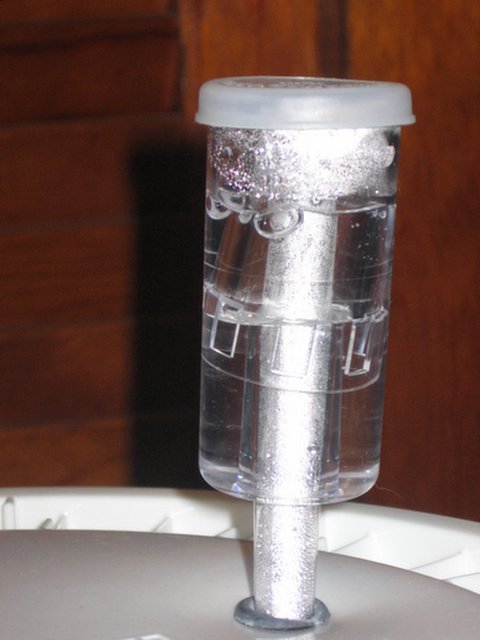
No bubbling in the airlock Sunday morning. Or Sunday night. By Monday morning, I had become convinced that the yeast, having aged in a corner of my living room through this summer's hellish heat spell, was dead-dead-dead-as-a-doornail-dead. So J. hauled over to the brew shop, got some more yeast (once given the blessing from the nice brewer-man to do so), added it to the bucket, and this morning.
Well, still no bubbles.
But look at what's going on tonight!
(Note: it's hard to get a photo of bubbles)

Bubble action! The beer, she is alive!
*Disclaimer - I don't actually like beer. Really. I like wine, and hard cider, and calvados, gin, tequila, rum, and sometimes bourbon, and I really think that's enough. I could learn to like beer, I'm sure, but I can't see a good reason to. But I love the idea of making it. I am pretty much in favor of learning how to do everything myself, so when the apocalypse comes - which George Bush is doing his best to make happen ANY DAY NOW - I will be deeply valued for my skills and knowledge. It could happen.
Monday, September 25, 2006
Good read
Sunday, September 17, 2006
Saturday's dinner
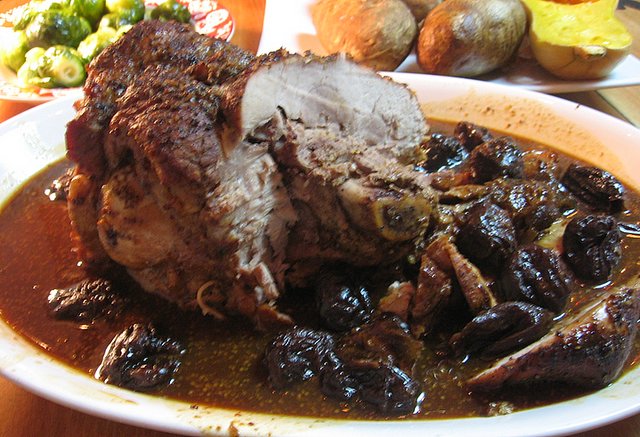
Well, this is a "cheese sandwich" kind of post.* So be it. The roast is from Simca's Cuisine, and some of the directions seemed a little off to me (I think the final cooking shoudl have been uncovered, for example), but the flavor was great. She calls for a pork loin roast larded with ham or tongue. I couldn't find a larding needle in any of the four stores I visited, including China Fair, which has such niceties as a spaetzle maker and a croissant-cutter, from which I restrained, but with delight that someone in Boston is making spaetzle and croissants. Anyway, the larding started to seem overwhelming, and the loin was so expensive, I just bought a pork sirloin roast, which comes with its own damned fat, but doesn't look as nice when sliced (see above). I followed her instructions to paint with mustard, then roll in brown sugar, and then brown - at least, up until the browning part. A roast covered in lots of mustard and brown sugar doesn't so much brown as simmer. After the "browning" you add a little bourbon, then light it, which was great fun, if a little scary. Foot-high flames from the pot! Exciting cooking adventures! Bouillon, cover, into the oven, cook cook cook, turn, salt, pepper, cook some more, then add prunes which have been soaked in more bouillon, cook just a bit more, remove meat, more whiskey into the sauce and a little arrowroot and voila! Deliciousness. Even without browning. Prunes and pork, always a winner.*For those of you who don't read a few dozen cooking blogs a day, somebody wrote a piece a while back about how bad most food blogs are, characterizing the great number of them as "I had a cheese sandwich for lunch today" sort of affairs. In response, the food blogger community posted an enormous number of essays about cheese sandwiches, which I found charming. A "cheese sandwich" post has come to describe a post that lacks any sort of thinking or interest, just a quick description of something someone ate for lunch or, as in this case, dinner.
Monday, September 11, 2006
The Boston Mycological Society
Well, college wasn't so much like that, but there were some late nights, and some quoting (if not in Latin) and some places that were magical, like the observatory or the book-filled attic office of my favorite professor, a man equally devoted to poetry and opera. Wesleyan had enough of the old spirit to let me retain a romantic attachment to the idea of academe.
What ruined things for me was Harvard.
I work at the School of Public Health, and a less romantic place has never been found on this earth. The building was thrown up in the great ugliness-construction efforts of the 60s and 70s. It is charmless. The people are intelligent and earnest and do good work for the world, but the idea of the passionate intellectual, the man or woman devoted to ideas, the Renaissance scholar who may specialize in one field, but reads broadly and deeply from across the body of human knowledge, the professional scholar who remains an enthusiastic amateur naturalist or gourmand or musician, Nabokov with his butterflies - well, that is gone, my friends, dead and buried by the pressures of publication and specialization. The brilliant scholars watch American Idol with everyone else, read Tom Clancy, eat from the cafeteria, and churn out work with an eye to the next conference, the next publication, the next award, the next research grant. Eccentricity can not thrive in this environment. It is tiring and dull.
But even at Harvard, the slickest academic institution around, there can be little places, little moments, in which the ghosts of older academe whisper again. Tonight, I went to the Harvard Herbarium for a meeting of the Boston Mycological Club, and I heard them singing.
The Boston Mycological Club is not strictly a Harvard organization, but its links to Harvard are strong, and they are permitted to meet on Harvard grounds. The club is the oldest amateur mushroom society in the country. They get together for walks in the woods to collect mushrooms, then they use their collective expertise for identification. I signed up for a four-night course of lectures on mushroom identification, their recommended introduction to the world of mushroom gathering.
The room was not an elegant one. I had hoped the Herbarium would be located in the lovely old building that houses the Peabody Museum, but it was next door in a much later, less attractive structure. No matter. The interest of the people there, their obvious pleasure in learning more about a subject they care about passionately, was a thrill. I was, not surprisingly, one of the youngest people there. About half of the attendees, and nearly all of those pointed out as good sources of information, were in their fifties or sixties of beyond. Many wore unfashionable moustaches. One expert looked like a white-haired Johnny Fever, an aged hippie who probably became interested in mushrooms for reasons best left ignored; another seemed the embodiment of the research scientist, enthusiastic and a little nerdy. The older woman who watched the door was delicate and birdlike, with lively eyes. The thirty- and forty-somethings generally had European accents.
One exception, besides myself, was a couple in their late thirties who had just come back from a trip to Italy. They clearly had food on the mind, which naturally was why I was there as well, but something about such a straightforward desire felt almost unseemly. Other people showed great interest in spore patterns and so forth; a real amateur naturalist would surely not look at the fascinating variety of colors, forms, and growth patterns laid out on the table of specimen and think only "dinner." But that doesn't mean the love the real mushroomers had for mushrooms was cold and intellectual. They stroked the gills, smelled the caps, took one bunch into the closet to see if it still glowed (!), and, yes, rhapsodized about the pleasures of the best eating mushrooms.
I walked out into the chill air with dual dreams: of afternoons spent wandering in the woods, comparing notes on species with quirky characters, consulting field guides and making very serious noted in a special leather-bound journal, and of sautéed wild mushrooms over pasta with thyme and cream. A proper Renaissance gal would want no less.
Tuesday, September 05, 2006
Whisper in his ear all her favorite fruits and the most exotic places they are cultivated...
I like nearly all fruits. Even my exceptions I don't actually believe to be exceptions - that is, I am convinced that if I lived somewhere where guavas grew, I would have the opportunity to try an excellent guava and would come to love them as much as I do pretty much every other fruit. That said, I have a fresh fruit hierarchy, like anyone else. Someone blogged about his or her fruit favorites list sometime in the last week (but I've forgotten who, so I can't credit.) At any rate, all things (like ripeness and peak-of-season perfection) being equal, my fruit ranking would be thus:The top, the top, Tower of Pisa:
Black cherries, blackberries, red raspberries, blueberries, figs, pomegranates, pears, apples, passionfruit.
Still excellent, but not quite as adored:
Plums, peaches, mangoes, Concord grapes, strawberries, pineapple, lychee, melons.
Very nice and all, but I won't go out of my way for them:
Green or red grapes, guava, papaya, starfruit, grapefruit, rhubarb.
I expect the most surprising thing in this list is the relatively low placement of those two universally adored fruits, strawberries and peaches. It's not that I don't like them: I do. But I don't get the same thrill from them that I do from the "A" list fruits, except under the right circumstances.
The right circumstances for peaches have been coming fast and furious in the last few weeks.
Some years are better for one fruit or another. Last year was a great year for pears. This spring was lousy for strawberries, but this year's peach crop has been fantastic. J. brought me three beautiful peaches this weekend, so juicy I had to eat them over the sink, sweet and perfumed. And last weekend, I made these little peach cobblers. There's something about having your own individual serving of cobbler that is particularly satisfying. Nothing special to the recipe, just a standard drop biscuit dough, unsweetened, over peaches lightly sweetened, thickened with a small amount of tapioca, and flavored with just a squeeze of lemon juice. I like to bake the peaches for about 15 minutes before covering with the dough, which gets sprinkled witha little sugar. As you can tell from the picture, these spilt over a bit in the oven, but they were plenty juicy anyway.
Wednesday, August 30, 2006
Reader, let's talk.
A little background: I am a graduate of Wesleyan University ( English) and the Culinary Institute of America (Baking and Pastry Arts). I spent some time working in kitchens, but have spent the last six years at Harvard as something of a factotum for a research group. My official title is "data coordinator," but that involves some research, some writing, some database development, some website management, some project management. I would like to find a job that would allow me to pursue my passion: the promotion of sustainable agriculuture, the development of relationships between farmers and consumers, the building of strong and healthy communities through the remarkable medium of our meals. I am ready to leave the city and would ideally be interested in a job somewhere in Vermont, NH, Western Massachusetts or southern Maine.
If you think you know of a job to which I might be suited, please email me at kjweldonatyahoodotcom. Thanks.
Tomato-Leek Tart
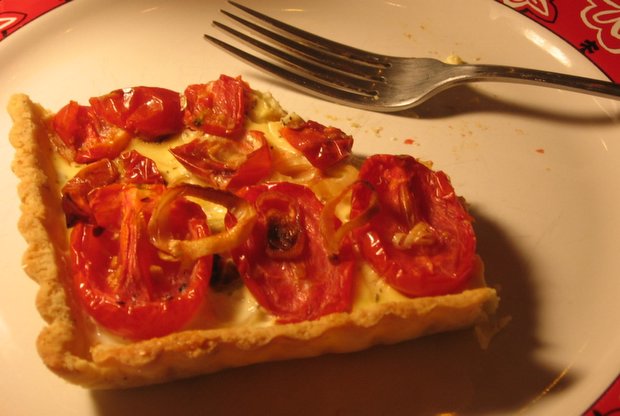
Everyone's doing it, the tomato tart. But how can I resist? This is classic late summer food. I don't follow a recipe, just work with what's around, but I might want to remember this version, because it worked out particularly well. I roasted some excellent local cherry tomatoes and plum tomatoes in the oven along with two leeks. No spicing but salt at that point. The next day I made the cornmeal crust from Nick Malgieri's How to Bake (3/4 cup each white flour and cornmeal, 1 tsp salt, 1/2 tsp baking powder, mix, use food processor to cut in 6T butter, then bind together with one beaten egg and chill). I lined the pan with the crust, brushed the crust with beaten egg white (helps keep the crust from getting soggy), threw it in the freezer for ten minutes, then baked it blind for about 10-15, while I prepared the filling. I had about half a package of cream cheese to use up, so that went into the food processor, then two eggs and some milk. Maybe 1/2 cup? And lots of thyme. Poured this into the partly-baked crust, lay the leeks on top and the tomatoes on top of that, and baked until the crust was browned and the filling set. I used some more of the Gray's Grist Mill cornmeal, which made the crust actually taste like corn, and of course roasting the tomatoes concentrated their flavor, so the result was very nice. I would like to try a corn on corn tart before the summer is out - cornmeal crust and fresh corn filling, but I'm not sure about the compliementary flavor. Bacon? Can't go wrong with bacon...
Monday, August 28, 2006
Maine Report Part Five: Bartlett Winery

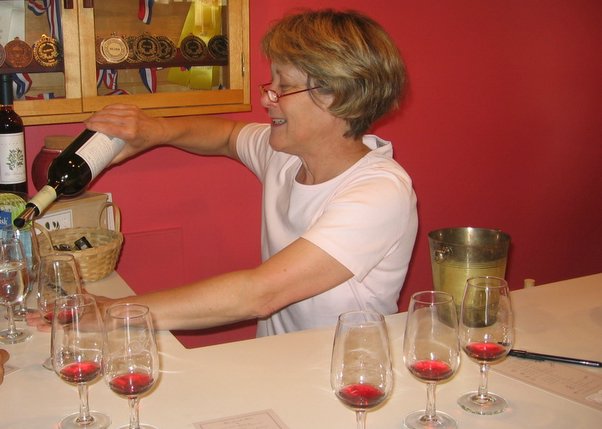
On the final day of vacation, a few of us went to the Bartlett Winery in Gouldsboro for a tasting. And we ended up buying, um, a little wine...

That was just what came home with J. and myself (minus a bottle that's already been given to a friend). Another in the party bought a case on her own.
I think some of the others thought we had gone a little crazy. The Bartlett winery is a fruit winery, you see, and the wines we bought were made from blueberries, pears, raspberries, blackberries, apples and peaches. The reputation of fruit wines is humble to say the least. At best someone might have a fond recollection of a grandparent's elderberry or dandelion wine. At worst, people think of Boone's.
Bartlett's wines are real wine. The dessert wines are sweet, but not syrupy, with bold clear fruit flavors. The dry wines are genuinely dry and crisp, with varying degree of fruit. In some of the whites, the pears or apples could pass for grapes; in the blueberry wines, the blueberry flavor comes through, but with the complexity of a grape wine. These are not souveniers for tourists; these are serious wines, and I was thrilled to try them. To me, this represents the best of the locavore impulse: the creative, intelligent use of locally-grown materials to create a fine product that tastes of the place of its origin.
Also, the woman who was pouring was very nice, and the winery itself is lovely. If you're ever up in that area, do try to visit.