Tuesday, September 26, 2006

In heaven, there ain't no beer, That's why we make it here


I have a thing for guys who brew. Or at least, I think I must. Why else would I keep giving guys brewing equipment?

You see, I gave my ex-husband a homebrew kit for Christmas one year, because he had said he wanted to try brewing. I should have know that wouldn't work out - he wasn't exactly the sort of guy who was interested in following through on hobbies that take time and effort. The box moved with us unopened through four apartments. Anyway, my boyfriend J. decided last year that he wanted to brew, so I toddled off to the homebrew store conveniently located just a few blocks away (Modern Brewer in Cambridge) and bought the man a brew kit for Christmas. Which then sat, gathering dust, in a corner of my apartment. Every once in a while I would roll my eyes and say something under my breath to the effect of "here we go again," but generally I tried not to bother him about it. God knows there are enough projects of my own sitting around the house, not finished or not even started. Shall we discuss watercolors? Or the sewing machine?

Moving on.

Finally, this weekend, J. decided it was time to brew. We were surprised that the initial part of the process went relatively quickly and easily. Of course, we're using a kit here, so there's no measuring or complications. Like a first time baker, we're learning the process before we start in on recipes. So we read the directions, sanitized the equipment, steeped the grains, added the malt, boiled the wort for a while, added the hops, boiled a little more, cooled as fast as we could, added the yeast and put the brewing bucket in a warm corner to do its thing.

Which it did not.

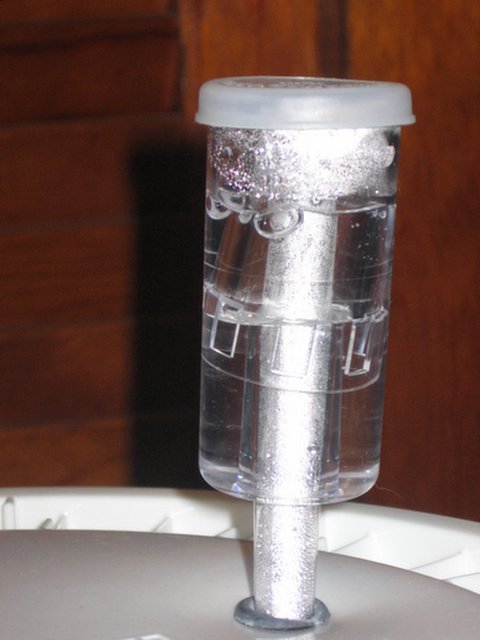
No bubbling in the airlock Sunday morning. Or Sunday night. By Monday morning, I had become convinced that the yeast, having aged in a corner of my living room through this summer's hellish heat spell, was dead-dead-dead-as-a-doornail-dead. So J. hauled over to the brew shop, got some more yeast (once given the blessing from the nice brewer-man to do so), added it to the bucket, and this morning.

Well, still no bubbles.

But look at what's going on tonight!
(Note: it's hard to get a photo of bubbles)
Posted by Picasa

Bubble action! The beer, she is alive!

*Disclaimer - I don't actually like beer. Really. I like wine, and hard cider, and calvados, gin, tequila, rum, and sometimes bourbon, and I really think that's enough. I could learn to like beer, I'm sure, but I can't see a good reason to. But I love the idea of making it. I am pretty much in favor of learning how to do everything myself, so when the apocalypse comes - which George Bush is doing his best to make happen ANY DAY NOW - I will be deeply valued for my skills and knowledge. It could happen.

Monday, September 25, 2006

One step at a time

Good news from the Boston Globe about dairy.

Good read

The New Yorker has a great article about the Food Network up online. I don't have cable, and my exposure to the Food Network has been mercifully limited. I'm always amazed at how interested the online food community seems to be in these shows, which don't really appeal to me at all. But I do love the recent DVD sets of the French Chef.

Sunday, September 17, 2006

Saturday's dinner

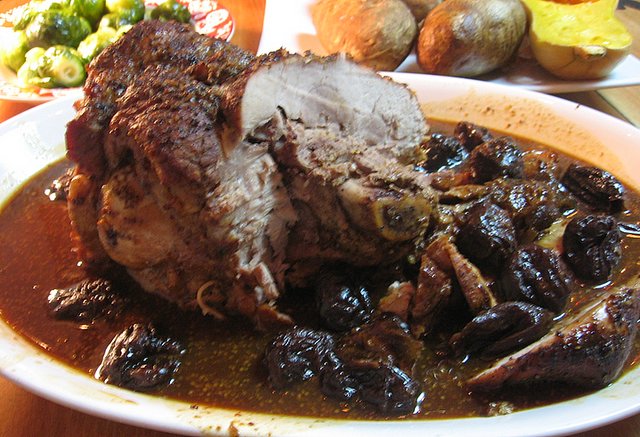
Well, this is a "cheese sandwich" kind of post.* So be it. The roast is from Simca's Cuisine, and some of the directions seemed a little off to me (I think the final cooking shoudl have been uncovered, for example), but the flavor was great. She calls for a pork loin roast larded with ham or tongue. I couldn't find a larding needle in any of the four stores I visited, including China Fair, which has such niceties as a spaetzle maker and a croissant-cutter, from which I restrained, but with delight that someone in Boston is making spaetzle and croissants. Anyway, the larding started to seem overwhelming, and the loin was so expensive, I just bought a pork sirloin roast, which comes with its own damned fat, but doesn't look as nice when sliced (see above). I followed her instructions to paint with mustard, then roll in brown sugar, and then brown - at least, up until the browning part. A roast covered in lots of mustard and brown sugar doesn't so much brown as simmer. After the "browning" you add a little bourbon, then light it, which was great fun, if a little scary. Foot-high flames from the pot! Exciting cooking adventures! Bouillon, cover, into the oven, cook cook cook, turn, salt, pepper, cook some more, then add prunes which have been soaked in more bouillon, cook just a bit more, remove meat, more whiskey into the sauce and a little arrowroot and voila! Deliciousness. Even without browning. Prunes and pork, always a winner.


*For those of you who don't read a few dozen cooking blogs a day, somebody wrote a piece a while back about how bad most food blogs are, characterizing the great number of them as "I had a cheese sandwich for lunch today" sort of affairs. In response, the food blogger community posted an enormous number of essays about cheese sandwiches, which I found charming. A "cheese sandwich" post has come to describe a post that lacks any sort of thinking or interest, just a quick description of something someone ate for lunch or, as in this case, dinner. Posted by Picasa

Monday, September 11, 2006

The Boston Mycological Society

In the fall, when the air in New England becomes crisp again, when the twilight falls early, I can feel nostalgia for the dream of academia I once held. You see, I remember when I believed that college would be like the old books I would read set in Oxford, anywhere between the early 1800s and the Second World War. There would be late nights of deep intellectual conversation, fascinating characters, professors with passion and wisdom and devotion to the great thoughts of man. People would sip sherry and quote in Latin. I would walk with the spirits of the great minds who had walked the ivy-edged paths before me.

Well, college wasn't so much like that, but there were some late nights, and some quoting (if not in Latin) and some places that were magical, like the observatory or the book-filled attic office of my favorite professor, a man equally devoted to poetry and opera. Wesleyan had enough of the old spirit to let me retain a romantic attachment to the idea of academe.

What ruined things for me was Harvard.

I work at the School of Public Health, and a less romantic place has never been found on this earth. The building was thrown up in the great ugliness-construction efforts of the 60s and 70s. It is charmless. The people are intelligent and earnest and do good work for the world, but the idea of the passionate intellectual, the man or woman devoted to ideas, the Renaissance scholar who may specialize in one field, but reads broadly and deeply from across the body of human knowledge, the professional scholar who remains an enthusiastic amateur naturalist or gourmand or musician, Nabokov with his butterflies - well, that is gone, my friends, dead and buried by the pressures of publication and specialization. The brilliant scholars watch American Idol with everyone else, read Tom Clancy, eat from the cafeteria, and churn out work with an eye to the next conference, the next publication, the next award, the next research grant. Eccentricity can not thrive in this environment. It is tiring and dull.

But even at Harvard, the slickest academic institution around, there can be little places, little moments, in which the ghosts of older academe whisper again. Tonight, I went to the Harvard Herbarium for a meeting of the Boston Mycological Club, and I heard them singing.

The Boston Mycological Club is not strictly a Harvard organization, but its links to Harvard are strong, and they are permitted to meet on Harvard grounds. The club is the oldest amateur mushroom society in the country. They get together for walks in the woods to collect mushrooms, then they use their collective expertise for identification. I signed up for a four-night course of lectures on mushroom identification, their recommended introduction to the world of mushroom gathering.

The room was not an elegant one. I had hoped the Herbarium would be located in the lovely old building that houses the Peabody Museum, but it was next door in a much later, less attractive structure. No matter. The interest of the people there, their obvious pleasure in learning more about a subject they care about passionately, was a thrill. I was, not surprisingly, one of the youngest people there. About half of the attendees, and nearly all of those pointed out as good sources of information, were in their fifties or sixties of beyond. Many wore unfashionable moustaches. One expert looked like a white-haired Johnny Fever, an aged hippie who probably became interested in mushrooms for reasons best left ignored; another seemed the embodiment of the research scientist, enthusiastic and a little nerdy. The older woman who watched the door was delicate and birdlike, with lively eyes. The thirty- and forty-somethings generally had European accents.

One exception, besides myself, was a couple in their late thirties who had just come back from a trip to Italy. They clearly had food on the mind, which naturally was why I was there as well, but something about such a straightforward desire felt almost unseemly. Other people showed great interest in spore patterns and so forth; a real amateur naturalist would surely not look at the fascinating variety of colors, forms, and growth patterns laid out on the table of specimen and think only "dinner." But that doesn't mean the love the real mushroomers had for mushrooms was cold and intellectual. They stroked the gills, smelled the caps, took one bunch into the closet to see if it still glowed (!), and, yes, rhapsodized about the pleasures of the best eating mushrooms.

I walked out into the chill air with dual dreams: of afternoons spent wandering in the woods, comparing notes on species with quirky characters, consulting field guides and making very serious noted in a special leather-bound journal, and of sautéed wild mushrooms over pasta with thyme and cream. A proper Renaissance gal would want no less.

Tuesday, September 05, 2006

Whisper in his ear all her favorite fruits and the most exotic places they are cultivated...

I like nearly all fruits. Even my exceptions I don't actually believe to be exceptions - that is, I am convinced that if I lived somewhere where guavas grew, I would have the opportunity to try an excellent guava and would come to love them as much as I do pretty much every other fruit. That said, I have a fresh fruit hierarchy, like anyone else. Someone blogged about his or her fruit favorites list sometime in the last week (but I've forgotten who, so I can't credit.) At any rate, all things (like ripeness and peak-of-season perfection) being equal, my fruit ranking would be thus:

The top, the top, Tower of Pisa:
Black cherries, blackberries, red raspberries, blueberries, figs, pomegranates, pears, apples, passionfruit.

Still excellent, but not quite as adored:
Plums, peaches, mangoes, Concord grapes, strawberries, pineapple, lychee, melons.

Very nice and all, but I won't go out of my way for them:
Green or red grapes, guava, papaya, starfruit, grapefruit, rhubarb.

I expect the most surprising thing in this list is the relatively low placement of those two universally adored fruits, strawberries and peaches. It's not that I don't like them: I do. But I don't get the same thrill from them that I do from the "A" list fruits, except under the right circumstances.

The right circumstances for peaches have been coming fast and furious in the last few weeks.

Some years are better for one fruit or another. Last year was a great year for pears. This spring was lousy for strawberries, but this year's peach crop has been fantastic. J. brought me three beautiful peaches this weekend, so juicy I had to eat them over the sink, sweet and perfumed. And last weekend, I made these little peach cobblers. There's something about having your own individual serving of cobbler that is particularly satisfying. Nothing special to the recipe, just a standard drop biscuit dough, unsweetened, over peaches lightly sweetened, thickened with a small amount of tapioca, and flavored with just a squeeze of lemon juice. I like to bake the peaches for about 15 minutes before covering with the dough, which gets sprinkled witha little sugar. As you can tell from the picture, these spilt over a bit in the oven, but they were plenty juicy anyway.


 Posted by Picasa

Wednesday, August 30, 2006

Reader, let's talk.

I don't know if anyone has ever successfully found a job lead through a blog, but it's worth a try. I am looking for a job, and I would be thrilled to hear about any possibilities my brilliant readers might know of.

A little background: I am a graduate of Wesleyan University ( English) and the Culinary Institute of America (Baking and Pastry Arts). I spent some time working in kitchens, but have spent the last six years at Harvard as something of a factotum for a research group. My official title is "data coordinator," but that involves some research, some writing, some database development, some website management, some project management. I would like to find a job that would allow me to pursue my passion: the promotion of sustainable agriculuture, the development of relationships between farmers and consumers, the building of strong and healthy communities through the remarkable medium of our meals. I am ready to leave the city and would ideally be interested in a job somewhere in Vermont, NH, Western Massachusetts or southern Maine.

If you think you know of a job to which I might be suited, please email me at kjweldonatyahoodotcom. Thanks.

Tomato-Leek Tart


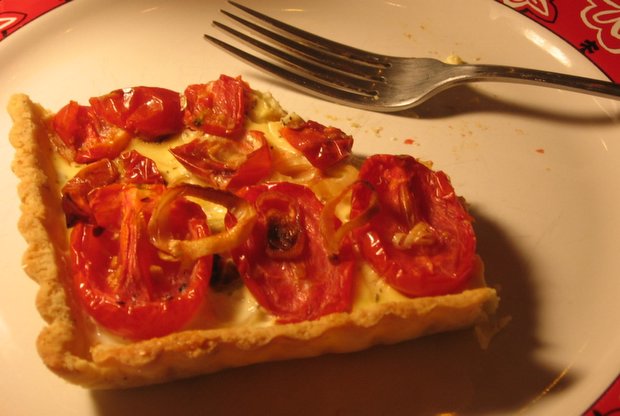
Everyone's doing it, the tomato tart. But how can I resist? This is classic late summer food. I don't follow a recipe, just work with what's around, but I might want to remember this version, because it worked out particularly well. I roasted some excellent local cherry tomatoes and plum tomatoes in the oven along with two leeks. No spicing but salt at that point. The next day I made the cornmeal crust from Nick Malgieri's How to Bake (3/4 cup each white flour and cornmeal, 1 tsp salt, 1/2 tsp baking powder, mix, use food processor to cut in 6T butter, then bind together with one beaten egg and chill). I lined the pan with the crust, brushed the crust with beaten egg white (helps keep the crust from getting soggy), threw it in the freezer for ten minutes, then baked it blind for about 10-15, while I prepared the filling. I had about half a package of cream cheese to use up, so that went into the food processor, then two eggs and some milk. Maybe 1/2 cup? And lots of thyme. Poured this into the partly-baked crust, lay the leeks on top and the tomatoes on top of that, and baked until the crust was browned and the filling set. I used some more of the Gray's Grist Mill cornmeal, which made the crust actually taste like corn, and of course roasting the tomatoes concentrated their flavor, so the result was very nice. I would like to try a corn on corn tart before the summer is out - cornmeal crust and fresh corn filling, but I'm not sure about the compliementary flavor. Bacon? Can't go wrong with bacon... Posted by Picasa

Monday, August 28, 2006

Maine Report Part Five: Bartlett Winery

Posted by Picasa

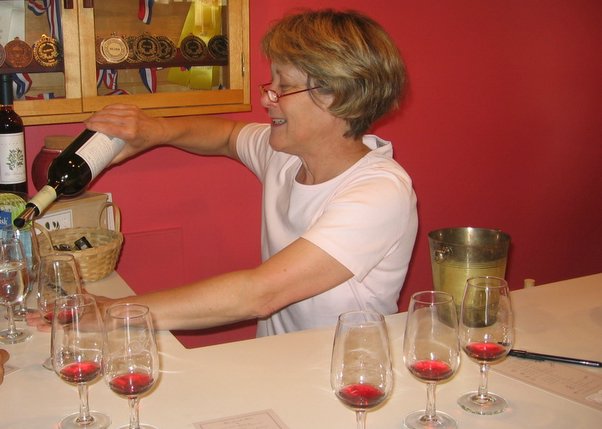
On the final day of vacation, a few of us went to the Bartlett Winery in Gouldsboro for a tasting. And we ended up buying, um, a little wine...

Posted by Picasa

That was just what came home with J. and myself (minus a bottle that's already been given to a friend). Another in the party bought a case on her own.

I think some of the others thought we had gone a little crazy. The Bartlett winery is a fruit winery, you see, and the wines we bought were made from blueberries, pears, raspberries, blackberries, apples and peaches. The reputation of fruit wines is humble to say the least. At best someone might have a fond recollection of a grandparent's elderberry or dandelion wine. At worst, people think of Boone's.

Bartlett's wines are real wine. The dessert wines are sweet, but not syrupy, with bold clear fruit flavors. The dry wines are genuinely dry and crisp, with varying degree of fruit. In some of the whites, the pears or apples could pass for grapes; in the blueberry wines, the blueberry flavor comes through, but with the complexity of a grape wine. These are not souveniers for tourists; these are serious wines, and I was thrilled to try them. To me, this represents the best of the locavore impulse: the creative, intelligent use of locally-grown materials to create a fine product that tastes of the place of its origin.

Also, the woman who was pouring was very nice, and the winery itself is lovely. If you're ever up in that area, do try to visit.

Wednesday, August 23, 2006

Maine Report Part Four: The Goats

The place we rented was a cottage owned by, and located on, Painted Pepper Farm, a maple syrup and goat farm in Steuben, Maine. The farm is owned by a lovely couple who raise chickens and goats (and daughters), as well as tapping maple syrup, growing some vegetables, making maple-syrup nuts and granola, and picking berries. They sell their products on the honor system from a farm stand attached to their house. The maple syrup items are inside, and outdoors there's a refrigerated case for the eggs, goat's milk yogurt and an odd watermelon or pint of blackberries.

We were surprised to learn that they do not make goat cheese. All their milk is used either fresh or in yogurt - amazing, rich, sweet yogurt. Their herd is made up exclusively of Nigerian dwarf goats, which produce a lovely milk, but not much of it. The milk makes great, but prohibitively expensive, goat cheese, so they focus on the yogurt. Actually, the yogurt was pretty pricey, too - I don't know if that was entirely due to the price of the milk, or if the elegant glass containers pushed the price up significantly. In any case, the quality of the yogurt justifies the price, and apparently their herd has quite a following. People drive several hours up the coast to stock up.
Posted by Picasa


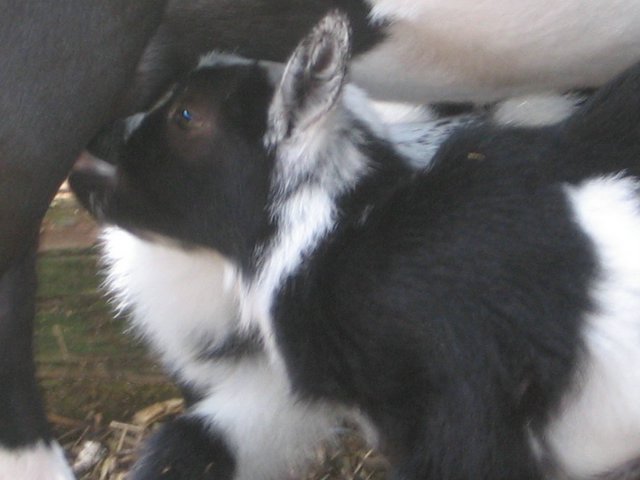
The goats were charming animals, very interested in our comings and goings. They loved to have their heads scratched, and one would respond to attentions by making a noise deep in his throat very much like a purr. There were one-week-old babies that left us weak-kneed. (Okay, they left ME weak-kneed).
Posted by Picasa


We city-slickers also learned a few things about goat-raising. First important lesson: the billy goats will start to smell - the stinkiest goat-cheese smell - just before breeding time, and if you pet them at that point, your hands will smell for days. We avoided the petting, but we can verify the stink. Also, the vigorous headbutting that was going on in the new mothers' pen occurs every time a new goat is added to the group. The structure of dominance needs to be determined. Sadly, Peppermint Patty, the new goat to the group the first night of our vacation, ended up clearly at the bottom of the herd. She failed to headbutt with proper vehemence.

So far, none of these goats have ended up in goat stew. The farm is expanding its herd, so females kids are welcome to stay. The boys are sold as pets - apparently, their size make them popular for 4H club members, and some people like to keep them as company for horses. Learn something new every day.

Posted by Picasa

Tuesday, August 22, 2006

Soda - An interruption

I interrupt the ongoing Maine report (oh, yes, there is more!) to bring you this article about soda making people fat. Okay, so this is hardly news. But my favorite part is this line, which seems to have been the pull-quote for almost every media outlet:

An extra can of soda a day can pile on 15 pounds in a single year.

I love that "extra." Don't worry, it's not your normal allotment of soda that's the problem, it's extra soda. Somebody should have spent a little more time working up the press release.

Maine Report Part Three: Roadside Stands

I lost my copy of the Jane and Michael Stern's Roadfood in my divorce, and it still makes me bitter. I have the new version, but I was attached to that copy that had travelled with me to so many drive-ins and clam shacks, diners and hot dog stands. I love road food, love the simple, strong flavors, the sense of joy and freedom of eating with your hands at a picnic table next to your car. Lobster fettucine has its place, but so do clam rolls. Particularly clam rolls made with fresh, big-belly clams.

Here's a plate of fried seafood to make you weep. Scallops, clams, shrimp, and under all that, a big slab of haddock. All fresh and local. All amazing.
Posted by Picasa

All that fried deliciousness was bought here:

Posted by Picasa

Notice the locally-made blueberry pies and cakes on the table in front of the menu. I dare any foodnik to drive by without stopping.

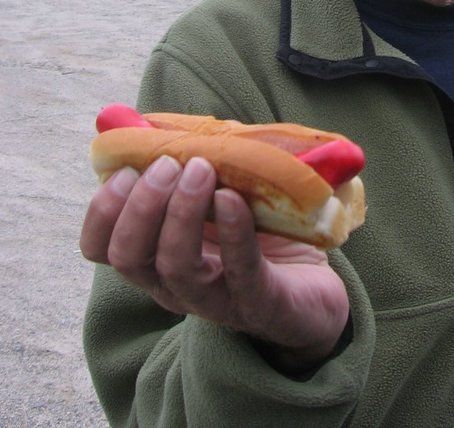
Sometimes, though, you just want a hot dog. This one, from a different stand, was rather alarmingly red:
Posted by Picasa

I saw the same hot dogs for sale at the fish shop later in the trip. J. asked the woman behind the counter what made them so red. In her heavy Maine accent, speaking very slowly, she replied, "They just come in that way." The mystery remains...

Maine Report Part Two: Seafood

"That don't have this in Austin." That was the review of a Texan in our vacationing group.

The blueberry may mean Maine to Mainers, but to out-of-states, lobster means Maine and Maine means lobster. And it's true that if you've only eaten frozen or pre-cooked lobster, or even lobster from a tank at a supermarket, the lively, just-out-of-the-ocean seabugs you can get in Maine are a revelation.

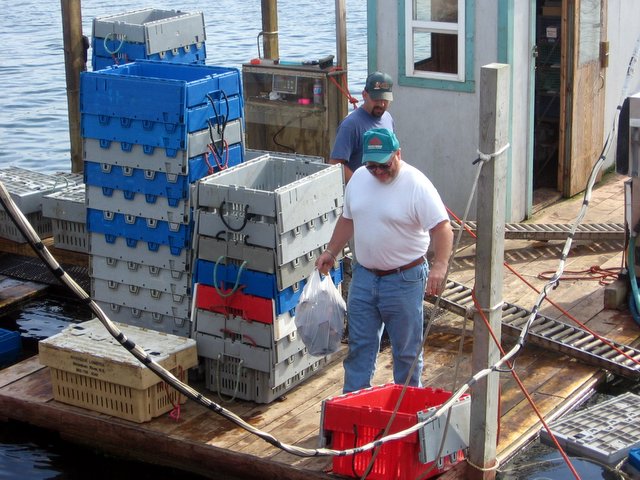
We took a lobster-fetching trip to Jonesport, about a half-hour ride up Route 1 from where we were staying in Steuben. Jonesport is a working fishing town, small and picturesque. To buy lobsters, you go down to the fisherman's co-op dock at about 5 at night when the boat comes in. You call down your request to the lobsterman, soft or hard shell and the number of pounds or number of lobsters. Then he takes the lobsters out of the underwater holding crates, weighs them up, puts them in a bag, and drags himself with his delicious bundle across to the stairs on a float. We paid $7/pound for hard-shell.


Posted by Picasa


Once home, the water should be put on the moment you walk in the door. Once you have a full boil, you're just six minutes away from seafood perfection.

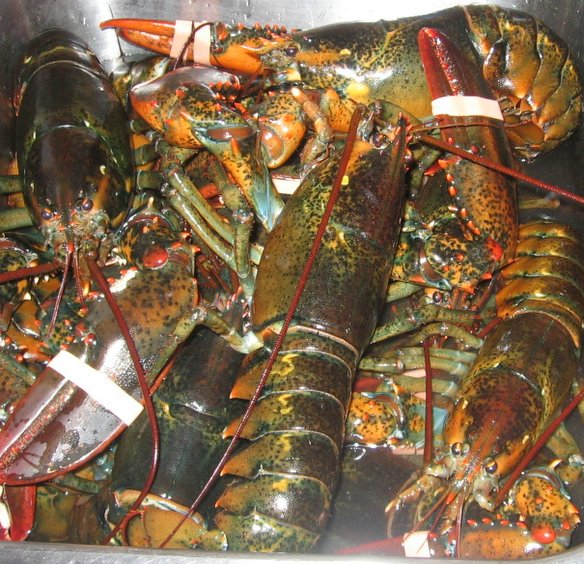
Before:

Posted by Picasa

After:

Posted by Picasa

We bought more lobsters than necessary for that first dinner, because nothing feels better than knowing you have leftover lobster in the fridge. All the carcasses, minus the liver, were put back in the pot to make stock. I simmered the shells for over an hour, then put the stock in the fridge and went to bed. The next day I removed the shells and simmered the stock down a bit more, until it was rich and condensed. We had enough shells to get two quarts of very flavorful stock.

For the second lobster dinner, I made sausage and lobster fettucine, a surefire winner. I'll try to give a recipe here, but really, I winged it, so this is not very precise:

Lobster-Sausage Fettucine
1.5 boxes fettucine (cook usual way)
Three lobsters-worth of meat, in large chunks
About a quart of rich lobster stock (if you don't have tons of extra shells from an earlier lobster dinner, you could use some shrimp shells to increase the flavor of your stock)
About eight sweet Italian pork sausages
1 tsp thyme
A shallot (I didn't have this, but have used in the past)
1 pint light cream
1 Tb. butter
1 Tb. flour
A little white wine or sherry
Pepper, salt, a pinch of sweet paprika

Crumble the sausage and brown in a little oil (or do as I did and use the butter in which the lobster had been dipped). Remove and drain. Pour off fat. Melt butter, add thyme, (add minced shallot briefly if using), then add the flour and cook roux to remove raw flavor of flour, about 30 seconds. Whisk in stock and cook until slightly thickened. Add cream and cook a few minutes more. Add lobster and sausage and heat until warmed through. Add wine, salt and pepper to taste, and paprika if the color needs improvement. Taste, make adjustments, pour over fettucine and serve.

Lobster is of course not the only seafood available in Maine. The last night of vacation, I used the last of the lobster stock in a chowder - J.'s favorite chowder, in fact, beating out clam.

Crab and Corn Chowder, roughly (all measurement are estimates)

1 pound crab meat (can use body meat)
6 ears corn
1 quart lobster stock
2 bay leaves
1 tsp celery seed
3 strips bacon
1 1/2 very large white onions
About a dozen smallish potatoes
1 pint light cream
1 tsp smoked paprika
Lots of black pepper, a little salt

Remove the kernels from the ears of corn. Put the cobs into a pot with the lobster stock and simmer at least 1/2 hour.
Brown the bacon, remove. Use the fat from the bacon to cook the onions. Add the potatoes and give them a few turns in the fat as well, maybe two minutes. Add the celery seed and smoked paprika and cook about thirty seconds more. Then add the stock and bay leaves and simmer on low until the potatoes are cooked. Add the crabmeat and corn kernels, plus the cream and allow to heat through. Taste and season with salt, pepper.


Both recipes serve about eight normal people, or six who have spent all day hiking up a mountain.

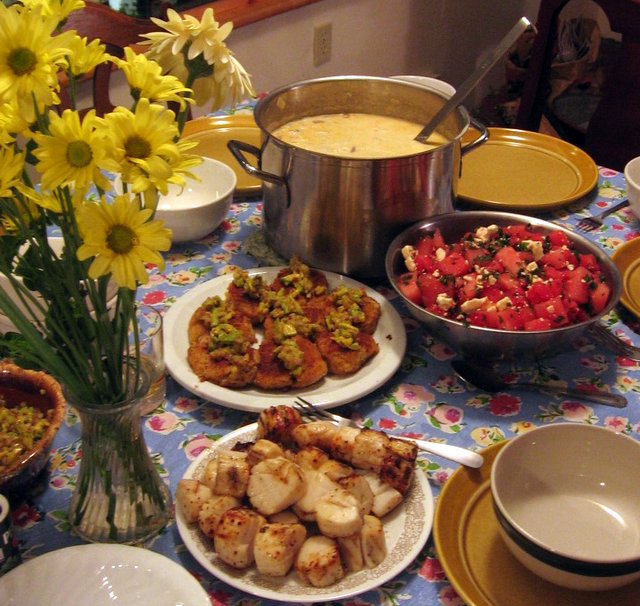
I served the chowder with Nigella Lawson's watermelon-feat-mint salad, some grilled vegetables, grilled scallops simply prepared with olive oil and pepper, and crabcakes. The crabcakes were pretty straightforward, just leg and claw meat bound together with a little egg and bread crumbs, spiced with Penzey's Northwoods seasoning, browned in butter, then topped with avocado, lime and red onion. The scallops were from Nova Scotia, not far away in those parts and the best source of scallops in the world. They were marvelously sweet.

Posted by Picasa


One member of the group had a piece of swordfish, but it's worth noting that in Maine, seafood mostly means shellfish and haddock. Other fish are caught in the local waters, including salmon, but scallops, lobster, shrimp, crab and even mussels, quahogs, and winkles seem to dominate over finfish, except for the ubiquitous haddock and the occasional cod.

That's fine by me. Despite the efforts of Beyond Salmon, I'm still a shellfish girl at heart.

Maine Report Part One: Blueberry Land

Posted by Picasa
Washington County, Maine produces something like 90% of the world's wild blueberries. If you hit the season just right (we were off by a few days this year), the fields along the road shimmer blue. In the fall, the berry bushes turn vibrant red. It's a lovely place.

Wild blueberries, in case you're unlucky enough only to have had the big, cultivated type, are tiny, a pain to pick (though they can be raked with a special device that catches the berries in a pan) and incredibly flavorful. They are also really good for you. They're high in antioxidants, I assume in part because they have such a high skin-to-flesh ratio. The good people at Wyman's, the major player in wild blueberries and a big employer in Washington County, have realized health benefits make for a good marketing opportunity. In recent years their wild blueberries have been made available frozen in the supermarket year-round, as well as in the form of juice, and of course the canned pie filling they have always sold retail. This is altogether a good thing, but, given the ease of acquiring wild blueberries in the last few years, I thought I would be less excited than I used to be about being in the wild blueberry capital during the peak season.

I was wrong.

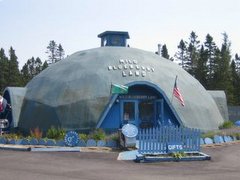
The people of Washington County have embraced the blueberry. The blueberry represents Maine as much as the moose or the lobster - maybe not to people "from away", but within Maine, there is no question. Blueberry pancake breakfasts are offered at every church and lodge. There's the big wild blueberry festival in Machias, with pie-eating contests, the blueberry musical, a blueberry run, and the annual raffle of a blueberry-themed quilt made by the women of the town. And then there's Wild Blueberry Land, a fantastic piece of roadside kitsch selling all things blueberry.

What I found particularly charming about Wild Blueberry Land (besides the building itself, of course) was that the blueberry items were all pretty good. Sure, there were some nationally sold brands that just happened to have offerings in blueberry flavors, like a blueberry iced tea. But there were locally-made blueberry pies (excellent), scones (also very good), muffins (average), truffles (the chocolate was high-quality and the blueberry fondant filling was bright and fresh in flavor), as well as very good blueberry ice cream from Giffords, a Maine brand.

In case you think that's all the blueberry products anyone should expect to find in Washington county - well, think again. Our group of vacationers decided to have a contest the last night to determine who had consumed the most blueberry items. I blush to declare myself the winner, the blueberry queen, as it were. In order to achieve such heights, I had to consume (or at least taste) raw blueberries, a blueberry scone, a blueberry muffin, French toast with blueberry compote, blueberry wine, blueberry ale, blueberry milkshake, a blueberry truffle, blueberry jam, blueberry soda, blueberry ice cream, blueberry banana bread, and blueberry coffee cake. But I did not even get a chance to try chocolate-covered dried blueberries, blueberry pancakes, blueberry tea, blueberry liqueur, blueberry sorbet, blueberry whoopie pies (!), blueberry mimosas and blueberry cheesecake. Clearly, I have goals to reach in my next visit.

Thursday, August 10, 2006

Party food

This weekend my siblings and I hosted a 45th wedding anniversary/70th birthdays party for my parents. I catered, so that meant all the cooking I’ve done since the end of the Eat Local challenge has been party-related.

For financial and logistical reasons, I knew I was not going to be able to buy locally for this event, but I found that I was mostly unable to bring myself to purchase regular supermarket meat or eggs. So the produce was Haymarket (not a farmers’ market, for you non-Bostonians, but a big open-air market of regular commercial produce of mixed quality but rock-bottom prices), but most everything else came from local Italian markets or Whole Foods. Strangely, though I wanted to use organic pork, I still couldn’t bear to use my great heritage, pastured pork on people who were unlikely to appreciate it. (“I am large, I contain multitudes.”)

I’ll give ya’ll the menu, because it was actually one of my best-planned parties. I fed about 45 people at a reasonable price; everyone ate a lot and seemed to really enjoy the food; the food wasn’t too scary for a conservative crowd, but was not so cliché-ridden as to bore me; and everything was done and in place when the first guest arrived without any last-minute craziness. I think the mix of purchased and homemade items was just about right - enough homemade to give flair and warmth, enough purchased to make things easy.

Cheese plate: Generously provided as far, far below wholesale price by my friend A., the cheese salesman. There were about a dozen lovely cheeses.
Crackers.
A basket of breads, including a large whole wheat Tuscan loaf, a long crusty white, some soft rolls, a ring loaf, and a multigrain.
A tray of cold, sliced roasted meats: a boneless pork rib roast, a pair of beef eye or round, and a half-turkey. I rubbed the pork simply with black pepper and salt, the beef with black pepper, salt, and celery seed, and the turkey with Penzey’s fabulous Northwoods Fire Seasoning.
An assortment of condiments, including (semi) homemade artichoke/caper spread, fig/caramelized onion spread, and horseradish spread, plus purchased tapenade, mustards, and mayo.
A vegetable platter made up of steamed green beans in basil oil, steamed asparagus, roasted tomatoes, roasted peppers, and a ruffle of prosciutto slices.
Purchased olives and pickled onions and homemade marinated mushrooms.
A fresh fruit tray with grapes in three colors, cherries in two colors, cantaloupe and honeydew slices, and some fresh figs, sliced in half and hit with the torch,
Devilled eggs. (Why do people love these so much? They were the first item gone.)
Two 12 inch cakes: one raspberry-almond, the other chocolate.
Purchased ice cream and homemade berry compote.

People ate pretty much everything. The spreads, which I hoped would elevate the simple cold-cuts-and-bread arrangement, probably were used the least. I think part of this was logistic: people circled in the opposite direction from what I had expected, so they hit the spreads before the meats. The fig and onion, which was simply a matter of caramelizing onions and folding them into purchased Dalmatia fig spread, was the most popular, and with good reason. It was delicious. But I think overall, people are more afraid of mixing together flavors than I expected. They weren’t sure what meat went with what spread, or if they were supposed to use the spreads with the meats at all, or just on the bread, so they skipped over the spreads entirely. Lesson learned. Next time I do something along these lines, I’ll either make the sandwiches myself or include suggestions on the labels for the spreads.

People ate less fruit that I would have expected, too. But they ate more vegetables – the roasted tomatoes were gone in a flash, and the asparagus and peppers soon after. There were beans left over, but I had made an awful lot of beans. The three meats seemed to go over equally; no distinct preferences were shown. Everyone ate the meat, but not with the excitement I think they would have had the crowd been younger. For the under-forty set, home-roasted meat is a comparative rarity, but for these folks it was nothing particularly special, though still a definite step up from deli cold cuts. The cheese was a big deal, though. Some people just stood there and noshed.

The raspberry almond cake was a huge hit. I used the Martha Stewart wedding cake recipe from Baking with Julia, brushed with amaretto syrup, then filled with raspberry jam, raspberries, and a plain traditional buttercream. People went back for seconds and thirds, which was gratifying. The chocolate cake was not ignored, but in the end, about a third was left – the raspberry-almond had been annihilated. The ladies loved the marzipan flowers and bees, a comparatively simple decoration that always goes over well. I like it because I do the marzipan work ahead and just place the flowers on the cake that morning.

My sister took pictures, but I forgot my camera, so I’ll post when she forwards hers along. That probably won’t be for another week – I’m off on vacation to Maine, where I expect to eat local vegetables and seafood and all sorts of good stuff. I’ll be renting a cottage from a goat/maple syrup farm, so I intend to take lots of pictures and come back with all sorts of food tales. See you then.

Friday, August 04, 2006

Reinventing the pig

This story is a little frustrating. I mean, I'm glad they want to breed some fat back into pigs. That's great. But Tamworth, Berkshire, and other heritage breeds already have enough fat. Of course, some of them won't thrive in a 2 foot by 4 foot cage, so we better rely on technology to avoid having to change our system...

Wednesday, August 02, 2006

Organic at the bodega

There's a really interesting article in today's Salon (you have to do the day pass thing to read it) about programs designed to bring fresh produce into inner cities. It's a hard battle, but there's some progress showing.

The farmers' market I go to with the most regularity is the tiny, two-stall one in Mission Hill, just down the block from my office. Although most of the people that use the market seem to be employees of the hospitals around the corner, many shoppers do seem to be local residents, some of whom pay with food stamps. Although some of the items (tomatoes, fruit) are more expensive than their grocery-store equivalents, the big bunches of greens, beets, squash and so on are very reasonably priced and provide a lot of nutrition to the dollar.

My mother works for a food pantry at her church that receives donated fresh produce from a local farm. Unfortunately, a lot of it goes to waste. It's not that people won't take fresh vegetables; it's that they won't take fresh vegetables they don't know how to cook. Many of the people who use the pantry are from South America or the Carribean. The farmer is Italian. The fashionable arugula and fennel he grows for his upscale clientele are completely foreign to the people at the pantry (and to my Irish mother for that matter, who calls me with questions: I've got this thing that has long frilly leave attached to a white stalk that kind of bulges at the bottom like a garlic, but flat - what do I do with it?). The cultural disconnects are as problematic as the logistics. But both can be overcome.

Tuesday, August 01, 2006

Eat Local Challenge: The Finale

Well, it's over. I actually gave up a little early, because my brother arrived in town and we had both breakfast and dinner out on Sunday, so I let things slide. Having a fridge full of local ingredients means that even a let-your-hair-down, non-local-eating day will include lots of local vegetables and fruits, though. Today's lunch is nearly completely local just because local has become standard for me. The exception is the bread and peanut butter I packed to go with my local salad, fruit and yogurt. I missed bread. It was far too hot to consider baking bread, and of course there are no available breads made from locally-grown wheat, although of course there are many locally-made breads.

Bread, lemons, pasta, coffee, gin, and nuts: if we could just find a way to ensure easy access to locally-grown versions of those items, I could do the eat-local challenge forever. And maybe some white flour and sugar to make the occasional cookie. And some chocolate.

Okay, so maybe I'm not really that interested in pursuing a fully-local diet for the long-term. But I realized there were definitely places where I could increase my local sourcing. I will continue to buy my cornmeal from Gray's Grist Mill, which is fantastic, and my dried mushrooms from Maine. I intend to be more stringent in choosing local dairy, which are widely available even at my big, mainstream supermarket. I hope to use honey and maple syrup more and sugar less. And, with the exception of the cooking essentials parsley and lemons, the first of which was rarely available at the farmers' markets and the second of which will not grow in New England, I think I can stick to all local vegetables in season without much trouble. I already sourced nearly all of my meat locally.

I think that I can move my in-season local eating from something like 50% to closer to 75% without much effort. Winter is another story, and one I fear is unlikely to change without a change in my living situation. With a cellar, more storage space, I could store, freeze and can more local food for the winter, but otherwise I'm stuck.

For a final big send-off meal on Saturday, I made a ground beef dish with zucchini, garlic, corn, onions, mushrooms, and peppers. It was supposed to be stuffed zucchini, but two of my zukes had gone soft on me, so I just sort of threw everything into the oven and baked it off (after browning the meat and sautéing the onions, of course). Only the oil and black pepper were non-local. I made cole slaw from cabbage and carrots, sour cream, and mayo made from an egg yolk, olive oil, mustard powder, and a teaspoon of vinegar (non-local items: vinegar, oil, mustard, black pepper, celery seed). I tried to make a cornbread using whole wheat flour, which came out terribly. I think the whole wheat flour absorbed more of the liquid than white would have, and so there wasn't enough moisture for the (non-local) baking powder to react with. As a result, the bread didn't rise well, and there was that unfortunate distinctive metallic-salty flavor of baking powder. (The whole wheat flavor also overpowered the corn flavor.) The guys ate it, though, and didn't think it was nearly as bad as I did. Everything in it was local, save the baking powder, and it might have been okay had I increased the milk. For dessert, we had a honey-peach-sour cream ice cream, and that was really good.
Here's a rough recipe:

Honey-Peach-Sour Cream Ice Cream
1/2 cup honey
1 cup milk
2 egg yolks
1 1/2 cups fresh peach chunks, pureed
1 cup sour cream

Make a custard with the honey, milk and egg yolks. Chill. Fold in sour cream and peach; freeze in ice-cream freezer.

Unlike the other honey-sweetened ice creams I've made, the honey flavor did not dominate. The peach came through strong and clear, with a nice sour tang in the finish. I'll make this again.

Wednesday, July 26, 2006

Media flotsam and jetsam

There's a nice article in today's Globe about local eating. Good to see so much attention given to movement.

I know everyone's already seen this story about CBS advertising its new shows on egg shells, but I just wanted to express my general disgust. There's this weird tendency in the mainstream food world to make food something other than food. Have you seen the Cheerios games on the back of the boxes? The whole business is creepy, particularly for those of us who try to avoid advertising as best we can.

According to the All Things Maine blog, this farm is the only place in New England growing hops commercially, which is interesting, because, as I understand it, hops will pretty much grow like gangbusters here. Good news for local brewers, which J. is supposed to start becoming as soon as the hot weather is over.

Finally, I'm thinking about writing an article about Boston food bloggers, with an emphasis on those who are interested in seasonal eating. Probably won't get started on this for a few weeks, because I have a lot going on just at the moment. But if you're a Boston-area blogger who might want to talk about blogging. let me know.

Tuesday, July 25, 2006

Week Three Summary

(Something went wrong with the photo this time - apologies.)

I was better this week about sticking to the system, only breaking once* for dinner out with the two friends I have from work (one of whom has left us, damn her, and the other is leaving in a few weeks. Sigh.) Lunches remained some variant on salad and potatoes or eggs or cheese, and breakfasts were mostly yogurt and fruit. I haven't felt much like eating dinner in the heat, but one day I was very clever and used the crock pot to cook a fine dish overnight. The farmers' market finally had some peppers, so I bought jalapenos, Italian sweet and green bell, sautéed them with some onions, browned some stew beef, and let the whole thing cook on low for about nine hours. If I had use of my usual ingredients, I probably would have thrown a little beer in there or crushed tomatoes, but I think it turned out better with the only liquid being the juices from the meat and peppers. The flavor was richly meaty and the different peppers gave a complexity I wouldn't have expected. Score one for limitations.

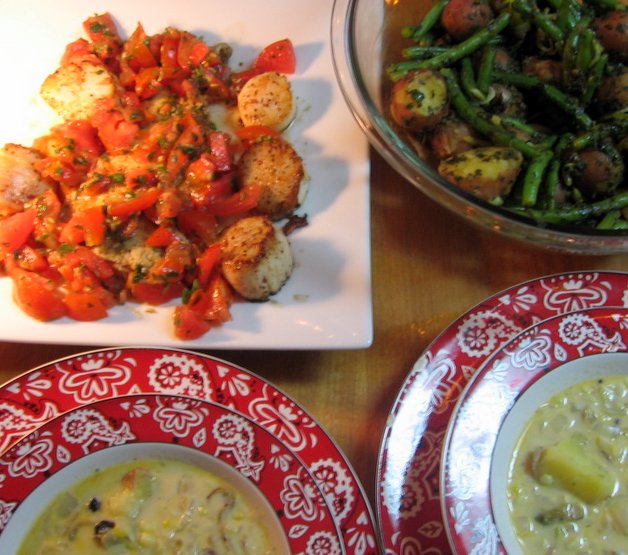
The meal in the picture was Saturday night dinner. Scallops and haddock ("local catch" at Whole Foods), pan-fried in butter, with tomatoes and fennel and parsley, green beans and potatoes in Parmesanless pesto, and clam-mussel chowder. The chowder was another case of broken habits leading to something good. Usually, I start chowders with bacon. (Actually, I start a lot of things with bacon. It is, as my friend M. used to say, the food of joy.) But, although I can find local bacons, they are all made with decidedly non-local sugar, so that was out. This chowder was based on a broth made from simmering corn cobs, to which I added the liquid from the canned mussels. Yep, I used canned mussels from Maine, which I had picked up at the end of June to have around for a quick local meal. Surprisingly, they were really good - not quite the same as fresh, of course, but more delicate and tender than one would expect from a can. Not a bad thing to have on hand. Anyway, to this base I added potatoes, then corn and the mussels, cream and a little salt, paprika and pepper and that was that. And again, really good. The mingled sweetness of the corn and the mussels was more prominent than it would have been if it had to compete with the smokiness of bacon.

This is my last week. The ingredients I have been missing most? White flour, lemons, Parmesan and wine. And chocolate, coffee and sugar, of course, but those haven't put any sort of cramp in my cooking, just in my habits.

*At least as far as meals go. I've also indulged in one or two iced coffees while out and about, and had a little chocolate a co-worker had brought back from a trip, because it would have been rude to refuse. Shut up, it would have! Posted by Picasa