Wednesday, August 31, 2005

Pig roast


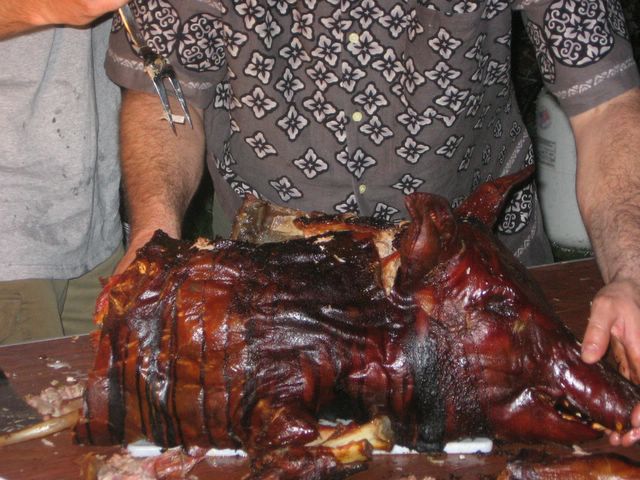
The guest of honor. Posted by Picasa

This weekend some good friends invited me to a pig roast in New Hampshire. This was my first experience with whole roast pig. They got a pastured St. Johnsbury pig, which was $1.25 less per pound than the Tamsworth, and was also, according to the butcher, better. I couldn't decide and feel that a side by side tasting is required. Maybe today. Mostly, I just want to eat more pork. My god, was that pig good. It was stuffed with apples and basted with a mixture that included hot sauce, mustard, cider, and a few other things. The fat rendered down to nothing; the fatback was thin and crisp and delicious.

There were probably fifty-sixty people there, including little kids. Despite the fact that people also consumed lots of corn, apples, potato salad, macaroni salad, mozz and tomato salad, cheese and crackers, baked ziti, beans, bread, brownies, four types of cookies, two cakes, at least two large watermelon, piles of blueberries from the stand of bushes on the property, and an ocean of beer and homemade wine, there was only this much pig left at the end of the day:


The remains Posted by Picasa

I love Italian families. People really eat. I hate parties where people don't eat.

(Yes, the head of the pig is a bit gruesome. This affected my appetite not a whit, though at least one meat-eater was unable to eat her pork. More for the rest of us. I've spared you the Lord of the Flies picture from the end of the evening, when one of the brothers decided to walk around holding the head before his face like a mask. Not that it wasn't funny, though.)

Thursday, August 25, 2005

I've been tagged for a meme! I'm a real blogger!

This is very exciting. I've actually been tagged for a meme, like the real bloggers. Thanks, Haverchuk!

(My first link, too.)

Okay, I'm supposed to come up with five childhood food memories. Forgive my longwindedness. Here goes:

1) Blackberry picking. In my adulthood, I have come to understand that not everyone considers berry-picking a basic family activity, like going to the beach. But my mother grew up on a farm, and my father could never resist anything free, so beryy-picking was a big thing for my family.

Our mainstay, berrywise, was blackberries. A small patch of blackberries grew behind my grandmother's house, so we could always get a few there, but the serious picking happened on state land under the pylons. We were suburbanites to the core, but we always knew which little patches of public land held blackberries. To protect from scratches, we would dress in jeans and flannel shirts despite the heat of summer, and we would spend hours picking bucketsful of berries, which my mother would make into jam and pies. The best and biggest blackberries, as any picker knows, grow deep in the brambles. After getting covered in scratches maneuvering to the center of the patch, I would be rewarded with perfect berries hot from the sun. One day we picked 18 gallons.

I live in the city now, and I can't bring myself to pay 4 dollars for a tiny box of flavorless blackberries, so I lead a sad, berry-free life.

2) Grandma W.'s biscuits. Grandma W. wasn't much of a cook. She served the same meal for pretty much every Sunday dinner - eihter roast beef or ham, with green beans, potatoes (usually scalloped), piccalilli, a simple salad of lettuce and tomato, and biscuits, with very dry brownies and coffee ice cream for dessert. Not a bad meal, and not badly prepared except for the brownies, but joylessly unchanging and served in neat, somewhat stingy portions. But those biscuits represented my Platonic ideal of biscuit. Not the high, fluffy biscuits promised by many recipes, these were almost dense and very flaky. The closest I've come to matching them has been with the recipe on the back of the Bakewell cream can. In her later years, she would give me some of the leftovers to have the next day, and I would eat them the next day with slices of cheddar cheese and butter.

3) If I have a Grandma W. memory, I should really have a Grandma J. memory, because that woman could really cook. I found out after she died that she had worked as a cook for the Mayor of Lowell in her younger years. Meals at her house were the polar opposite of Grandma W.'s - piles of food, sometimes two types of roast, all sorts of vegetables from her big garden, lots of the quickbreads the New England cook adore, big unfrosted sheet cakes, handsome pies. Her cooking was simple, in the Yankee/Canadian maritime tradition. But it was all good.

My strongest recollection of food from her house, though, is not the food itself, but the smell. My grandfather believed in a real breakfast of eggs and bacon and toast. (Cereal was a addition, not a replacement, and it was served with cream, not milk.) I can't imagine that the coffee was very good, because she sometimes used a percolater and sometimes boiled the coffee in an open pot, cowboy style, with an eggshell. Those methods, bad as they may have been for the coffee, make the whole house smell wonderful. Add in the smell of bacon. Then add a touch of the sawdust smell from my grandfather's basement workroom. I come upon that particular combination of smells sometimes, particularly in country stores that serve breakfast, and it always makes me feel seven years old.

4) God, I hope my mother never reads this. My mother is, well, a terrible cook. So any honest list of memories from my childhood has to include something borderline inedible. I guess the most appropriate choice would be liver. My mother believed firmly that children needed liver at least once a month for iron. She cooked liver like she cooked steak - a little water in the frying pan to keep the meat from sticking, then a nice long cook on each side, until the meat was gray all through. Note: no oil, no seasonings. I think that the liver was often served with onions, and I'm not sure how she made those. Also steamed? Or did she pull out the rarely used bottle of Crisco oil? At any rate, the kids weren't required to eat the onions, but we did have to eat our liver. I haven't touched it in years, though I love pate and liverwurst. I just shudder to remember liver night.

5) Baking. My mother was a much better baker than she was a cook, and she was very good about teaching me how to read recipes, measure, and so on. She was allowed me full freedom in the kitchen from a very young age, for which I am deeply grateful. My failures made the strongest memories, not surprisingly - blackened cream puffs that didn't puff, a tragic attempt to make fondant, and the Baked Alaska I tried to make on a very hot day that my family called "Baked Disaster." But I had successes, too, and I loved the process of baking, putting on the apron, finding a recipe in Fannie Farmer, measuring the flour, mixing the batter. If I had to pick a single dish as a locus of memory, I would choose gingerbread, which I made often and still do and which feels more comforting than any other food.

Wednesday, August 24, 2005

In which the Seasonal Cook sells out her principles for a bowl of ice cream

I have a confession to make. I don't really care about most fruit ice creams. I love blueberry ice cream made with real wild Maine blueberries, and I like orange ice cream, and other than that, I would rather mix my fruit and ice cream by putting ice cream on my pie. Peach ice cream? I don't hate it, don't get me wrong. I'll eat it if it's served to me, but I'll never order it. I generally tend toward the nutty flavors (hazelnut, pistachio, maple walnut, butter pecan), the austere dairy flavors (buttermilk, sweet cream), and the chocolate chip family (plain, mint, coffee).

Of course, by all rights, anyone with a blog sporting the name "Seasonal Cook" should be making peach ice cream right now. Maybe plum. There are still blueberries at the farmers' markets, though they are generally the big, cultivated berries. But since the orange-tinged ricotta business, I've been obsesses with orange ice cream. Actually, more accurately, I've been obsessed with orange/ginger ice cream. Orange and ginger is one of my favorite flavor combinations. I like it spicy hot in Chinese food, I like it bitter/sweet in marmalade, and I like it plain old sweet in biscotti. I love both orange and ginger ice creams, so the two together had to be great, right?

And, I am pleased to say, yes, this ice cream came out just the way I wanted it to, thank you very much. (I have been having a tough time in the kitchen of late, it being bloody August and all, so I was due a real success.)

But I had a moment of terrible shame when I was standing in line at the checkout counter with my oranges. I looked at the annoying little stickers the grocery stores always put on the produce and they read "South Africa." My oranges had been shipped halfway around the world. This is exactly what the Seasonal Cook is completely against. And in the middle of the harvest season no less!

I bought them anyway. What can I say? I really wanted this ice cream. (Considered as a percentage of my week's food, this was a small transgression. Of course, symbolically, the oranges are highly problematic.)

I merged the orange and ginger ice cream recipes from Caroline Liddell's book and made a few adjustments. Here's what I came up with:

2 cups cream
1 cup milk
5 egg yolks
3/4 cup sugar
Juice and shredded rind of two large oranges.
A goodly chunk of fresh ginger, minced
About 1/3-1/2 cup chopped candied ginger

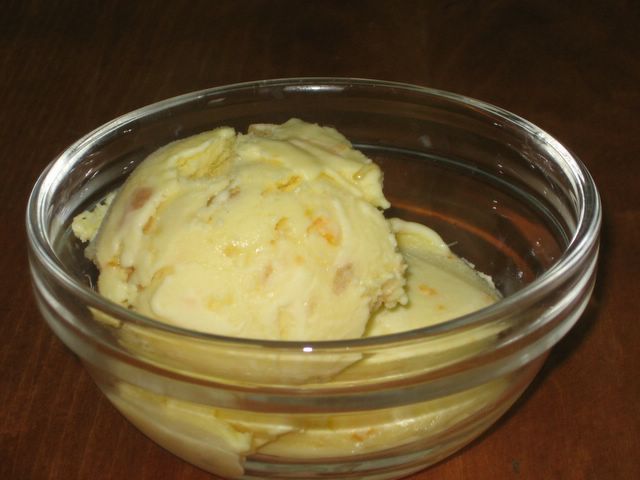
I simmered the juice of the oranges with 1/4 cup sugar, 1/2 the rind, and the ginger until it was reduced to a syrup. I let that cool a little, then strained. Then I heated the cream and milk together, whisked together the rest of the sugar and the yolks until light, poured the milk/cream mixture over, return to the heat, cooked to the custard point, removed from the heat, mixed in the orange/ginger syrup and the orange rind. Then I chilled the mix for a few hours before putting it in the ice cream maker. I added the chopped candied ginger a minute or two before the freezing was done.


Almost ready. Posted by Picasa

The one complaint I have about the frozen-canister-style ice cream makers is that the canisters can melt too quickly on really hot days. I would usually freeze the mix a bit more before transferring to the freezer, but it was 100 degrees in my kitchen and that machine wasn't going to freeze that ice cre4am one bit more than it already had. Besides, I would rather err on the side of beating too little air into the ice cream (low overrun) than risk beating in too much (high overrun).


The final product. Yum. Posted by Picasa


A few comments:

Candied ginger is great in ice cream; it doesn't freeze too hard, which one might expect.

I use a lot of eggs in my ice cream. Apparently, there are people in the world who worry about ice cream being too "eggy." I am unable to speak to this, as I consider "too eggy" to be as weird a concept as "too buttery." The eggs give a very rich mouthfeel, incredibly smooth. According to Liddell, the French in general favor richness and smoothness in ice cream, while the Italians prefer intensity of flavor, and the Americans sweetness. I am all with the French here - a good gelato is great, but I will sacrifice some flavor for mouthfeel, which is why I prefer ice cream to sorbet. Also, homemade ice cream with lots of eggs keeps a good texture longer. After three days, my ice cream still isn't icy.

I think that balance of orange and ginger in this ice cream is pretty good, but the orange was too strong the first night. The next day, everything had balanced out. Not sure why. If you like to eat your ice cream right away, you might use less orange zest and increase to a "big old chunk" of ginger.

Tuesday, August 23, 2005

I've been a bad blogger

No new posts, really, in about two weeks. But I've been a good home cook.

This weekend my landlord finally replaced my ancient and ailing fridge, and so I did some freezer cleanout in preparation. I made both chicken and beef stocks.

For the chicken stock, I used the bits of parsley, onion, and carrot I had kept in a bag in the freezer for that purpose, plus of course chicken backs (both from cutting up whole chickens for parts, which I am kicking myself for not having started to do sooner, and from Whole Foods, which occasionally sells packages of backs for stock very cheaply) and a couple of carcasses from roasts. Many, many hours of cooking later (I used a crockpot overnight), I was rewarded for my hoarding of bits with really beautiful, deep yellow, rich stock. Oh, I also followed Sally Fallon's advice, and included a spoonful of white vinegar in the pot. You can't taste it, but she claims the acidity helps to leach the calcium from the bone, making the stock more nutritious. Can't hurt. I believe deeply, by the way, that one of the weaknesses of the American diet is its lack of bone-based stocks, which are full of minerals. There's a reason recovering invalids used to be given mugs of hot beef bouillion or bowls real chicken soup. The broth-based canned versions most American eat don't stack up nutritionally or, of course, culinarily.

For the beef stock, I roasted the bones in the oven first until browned, then simmered them in water for hours. I cooled the stock, and left it overnight in the fridge. In the morning, I removed the fat from the top and stored it in the freezer, returned the gelatinous stock to the stove, and added a meaty shank for beef flavor. I cooked it a few hours more. The stock tasted meaty and gelled up completely. But the color was lacking, just a pale, greyish-brown. If anyone knows how to get my stock prettier, please post a comment.

I also cooked a lot of vegetables this weekend. I tried callaloo for the first time, having picked some up at the Brookline Farmers' Market. This green takes a while to prep, because the stalks are large and branchy. But the flavor is worth it, very much like spinach, but a bit deeper and more resonant, not at all bitter. I cooked it with garlic and red pepper, then tossed it with some pasta and ricotta salata. Excellent. I also made green beans and roasted potatoes with a basil-walnut pesto, which I liked quite a bit. I highly recommend the use of walnuts in the pesto for use with green beans; there's just something about the bean and walnut combination. Georgian cuisine uses that pairing frequently, and the results are fantastic.

I also made stuffed summer squash and green peppers for about the tenth time this summer. I seem to be caught in a rut. But the stuffing this time was the best so far: ground beef; homemade, rough, dried bread crumbs (bigger than crumbs, but smaller than croutons), shredded yellow summer squash; fresh corn; chopped parsley; garlic; and a touch of onion, plus dried oregano, paprika, white and black peppers, and salt. The corn added a lot to the texture and the flavor, while the shredded squash kept the mix light and moist. I'm sticking with this version.

Finally, I made terrific ice cream, but I'll post about that tomorrow, when I have my camera with me and can upload the pictures. I intend to call that post: In Which the Seasonal Cook Forsakes Her Principles for a Bowl of Ice Cream Flavored with Oranges from South Africa..... (oh, the shame)

Tuesday, August 16, 2005

Too hot

Normally after the weekend I have someting to post, Saturday being the best day to get some real cooking done. But ye gods was it hot this weekend. Too hot to cook. Too hot to move. I boiled corn and that was about it for the application of heat to food. Otherwise, this weekend was all about raw fruit, yogurt, tomatoes, ice cream, and lying very, very still on the couch.

But it's much cooler now; maybe I'll get something done tonight.

I hate August.

Wednesday, August 10, 2005

Hope you like jammin' too

I want to talk about jam, but first I want to talk about culinary failure. Reading many food writers can leave you with a sense of unworthiness. Everything they make sounds so good. Everything they eat is beautiful, nutritious, fresh and perfectly cooked. It's irritating.

Food blogs provide a nice corrective to traditional food writing. Regular people who describe the regular cooking in their lives write about overcooked meals, undercooked meals, fallen cakes, undersalted meat, dull soups. I have made all of these and more. Usually, at this point in my life, I can be fairly confident that anything I cook will be pretty good. (My early twenties, on the other hand, were a pretty sketchy time, culinarily speaking.) Sometimes, I achieve excellence. Maybe once a year I achieve transcendence. Sometimes, my food is edible, but not what you would call good. Sometimes, I fail utterly.

Now (deep breath) onto the jam...

I love making jam, and I've had a lot of success with it. Jam isn't hard, just a bit fussy. Lots of prep, lots of time, but the end product is pretty much assured as long as the fruit is good.

This summer I've had a hard time finding good fruit. One week I bought two quart baskets of strawberries from the same vendor who had sold me delicious strawberries the week before. The strawberries were flavorless. I sliced them, sugar them, doused them in Grand Marnier and ate them up. I was not going to waste the time to make jam out of lackluster berries, even if my very best jam of the year before had been strawberry with black pepper and balsamic vinegar, and I was dying for some more.

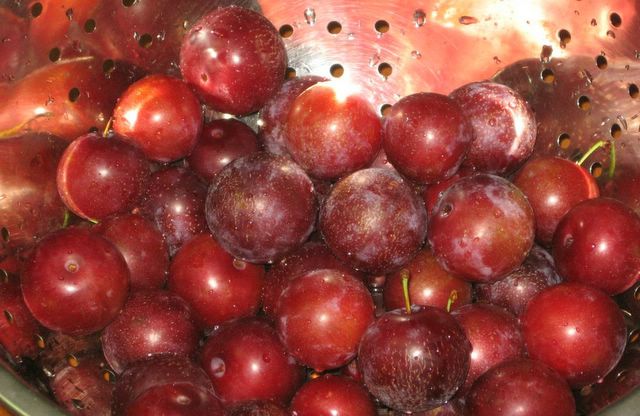
I've been itching to start making jam, so when I saw tiny red plums at the farmer's market, I figured the time had come.
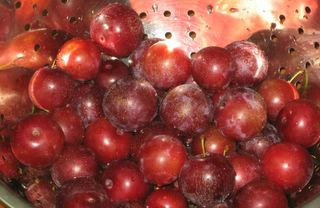

Plums like this inspire jam sessions. Posted by Picasa

I bought two baskets, which turned out to be less than the amount required for Christine Ferbinger's plum jam recipe, so I cut it down by a third. Her recipes are for small batches to begin with, so I was really taking on a lot of work for a tiny amount of jam, but I persisted. I cut the plums in half and removed their pits, then combined them with the sugar and lemon juice and let them sit for an hour. Then everything got brought to a boil, taken off the heat immediately, and allowed to sit overnight.

This is a pretty standard method for good jam. The fruit starts to absorb the syrup before the final cooking. You're minimizing the amount of time the fruit is actually cooking.

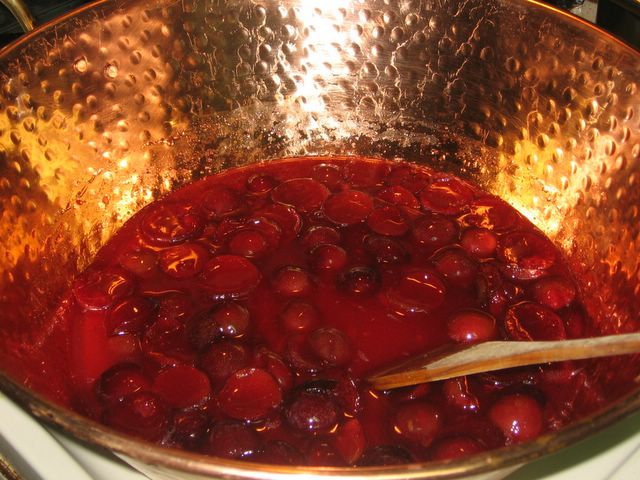
The next night, I strained the juice into my beautiful, Kitchens Etc.-closing-sale-bargain, wide copper preserving pan, reserving the fruit to the side. I brought the juices to a boil.

And here's where the failure part kicks in.

You see, there are two major methods people use to check whether a syrup has reached the jellying stage. The first is the homey, old-fashioned method: you chill a stack of saucers, remove one, put a bit of the syrup on it, wait a minute for it to cool, and tip it up. If the syrup runs like, well, syrup, it's not done. If it rolls down the saucer sluggishly, thickly, if you can run a finger through it and the line stays clean, then you've got jelly. I have used this method successfully for making jam for about ten years now, at least four or five batches a summer.

Then there's the candy thermometer method. It's easy, just check the temperature with a thermometer.

Gadgets are nice, aren't they? A number seems so much more legitimate than a saucer dripped with syrup. A thermometer seems so scientific, so precise. Also, the saucer method? You have to use a clean, cold saucer for each test. That's a stack of saucers to clean up afterwards. So I was lazy and only used the thermometer.

The syrup had only boiled a minute or two before I figured I would take a baseline temperature measure. The little red line kept rising and rising, until it shot past the aimed-for temp. I panicked. How could it have gotten so hot so fast? The syrup didn't even look thickened yet. Ah, but it was a tiny batch in a big pan - evaporation had clearly happened very quickly. Overcooked jam is worse than undercooked. I added the fruit, let everything return to a boil, boiled five minutes as instructed, then processed.
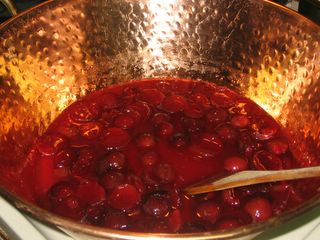

Cooking the jam, round one. Posted by Picasa


The processing is the part that makes jam-making a bit of a hassle. You have to wash the jars, then boil the jars, scald the lids, fill the jars, wipe the edges of the jars very carefully, put the lids on, put the jars back in the boiling water, boil ten minutes, then remove them. Your reward is the incredibly satisfying popping noise each jar makes as, cooling on the counter, it seals.

So I processed 5 tiny 4 oz jars and 1 smallish 8 oz jar of jam and went to bed most pleased with myself. I woke up and went immediately to the kitchen, because when you've made jam the night before, you have to inspect your jars first thing, and put the labels on, and hold them up to the light, and admire them endlessly. Except that when I held a jar up, it sloshed.

My jam hadn't jellied.

I had made red plum halves in syrup.

The only other complete failure I've had jam-making was also red plum, so now I'm very suspicious of plum jams and don't intend to be making them in the future. But I still had jars of red plums in syrup, and frankly that's useless. Red raspberry syrup is fine, or blueberries in syrup, but what the heck am I going to do with red plums in syrup? So I screwed up my resolve and when I got home last night, I emptied the jars into the strainer, recooked the syrup, added the fruit back in, and actually ended up with jam.

I was too irritated to go through the whole processing business, though, so I scalded two big jars and just put the jam in the fridge. Instead of cute little jars for giftgiving, I've got my own personal plum jam stash for flavoring yogurt and spreading on toast. Not bad, really, except plum isn't really my favorite jam flavor. Sigh. But at least I saved the fruit.

Monday, August 08, 2005

Frozen Ricotta Cream

I had lunch at Dave's Fresh Pasta in Somerville this weekend (and as an aside, the sandwich with prosciutto and fig spread was amazing), and while I was there I picked up some ricotta for making ice cream. I had come across a ricotta ice cream recipe a few month ago, and I was intrigued. I have a soft spot for all things dairy, especially cold sweet things in which the dairy flavor dominates. I love buttermilk ice cream and sweet cream ice cream and clotted cream ice cream. I love buttermilk sherbet and yogurt sherbet - not the almost-ice-cream-but-not-quite fro-yo that people order to pay lip service to their diets, but a tangy frozen combination of yogurt, lemon juice and sugar. So how could I miss with ricotta ice cream?

I found a couple recipes online, all of which contained ricotta, honey, sugar and a bit of water. Some contained up to a cup of water, some just a couple tablespoons. Those recipes that only used a little water included cream as well.

I had intended to add pieces of candied orange peel and chocolate chips to the ice cream at the end to make a "cannoli" cream, but didn't make it to the store that carries the orange peel. I decided instead to go with a fresh orange flavor, hoping that I would come up wth something that might possibly be described as "sophisticated creamsicle." Really, I love creamsicles beyond reason. I also have a secret shame - I love Hostess cream-filled orange cupcakes. Keep your Twinkies, your Ho-hos, your Devil Dogs and your Moon Pies. I cast aspersions upon Krispy Kreme, Mrs. Frisbie's pies, and all other mass-made, transfat-ridden, overly sweet baked goods. But about once a year, I sneak a delicious, forbidden orange cupcake...mmmm...cupcake....

Anyway, my point is, I like orange and cream. So my recipe was thus:
1 pound ricotta
3 T honey
1/2 cup sugar
Juice and grated peel from 1 large orange (came to 1/3 cup plus 2T juice)
2/3 cup light cream
I mixed the sugar with the 2T juice and peel and heated until the sugar dissolved, then let that mixture cool before throwing it in the blender with the rest of the ingredients. When everything was well-whirred, I froze the mix in my ice-cream maker.

And the results? The flavor was great, the cheese and orange balanced perfectly. But the texture took some getting used to. This was definitely not ice cream in the usual sense. It was dense, a bit grainy, the tiniest bit icy. The texture was, quite frankly, exactly what you would expect frozen ricotta to be, if the words "ice cream" at the top of the recipe hadn't blinded you to the fact that no blender is going to completely liquefy curds.

My boyfriend said it was good if you didn't call it ice cream, and, though at first I disagreed, I'm coming around to his way of thinking. By the second dish, the texture didn't bother me, and by the third, I actually rather liked it. From someone who tends to be narrow-minded about ice-cream-type products texturally (don't like granitas much or icey eggless ice creams), that's actually saying something. So I give the ricotta ice cream a B+ (a real B+ from the old days before grade-inflation), maybe even an A-, and recommend it to those who want to try something different. But definitely give your dessert a chance and call it "Frozen Ricotta Cream."

Wednesday, August 03, 2005

Book recommendation

I just finished reading Reclaiming the Commons, by Brian Donahue, and I want to recommend it. This book is both a study of a community farm in Weston, Massachusetts and a blueprint for the development of community farms and managed forests for the future. The book would probably appeal most strongly to New Englanders, as he develops his discussion with historical information about agricultural in New England, specifics about the New England ecosystems, and so on. But I think anyone who is interested in local farming could get something from his very practical approach. The section on forestry is particularly well done. Check it out.

Tuesday, August 02, 2005

Culinarily dull weekend

Proof that the world maintains its own balance - this weekend was a culinary near-washout, which I guess is only fair given the splendors of last weekend. Friday night I made Nigella Lawson's watermelon salad (watermelon, lime juice, black olives, feta, mint, parsley and red onion), which was great, and a fine steak from my stash, which survived my overcooking with some flavor intact. I always screw up great steaks. Sigh. Then I spent to weekend at a friend's house, so lots of pleasant, but not noteworthy, suburban barbecue fare. I returned to a fridge full of limp vegetables.

Now is the time to confess the dark side of the CSA program. A farm share is a commitment. If you go away for the weekend, if you get a hankering for pizza out Friday and Chinese buffet Saturday and someone invites you for dinner Sunday, if you work late every night for a week, the vegetables will still be there, slowly rotting, reproaching you every time you open the door for a beer or some leftover chow mein. Every lunch hour cheese sandwich will feel like a failure when you know there are salad makings slowly turning inedible in your fridge. Be warned.

What is usually needed in the case of produce neglect is a big cook-up, a ratatouille or vegetable soup or something that will enlongate the lifespan of your vegetables, and possibly fill up your freexer. This, of course, also requires a night of cooking. After a weekend of carousing, I would rather rent some episodes of Six Feet Under and collapse on the couch with the cats, so a hefty dose of guilt is needed to force me into the kitchen. Thank the gods I was raised Catholic and have guilt to spare.

So last night I made a great big salad for today's lunch, and I also baked calzones. Calzones are actually a good weekday cooking choice. The Shaw's down the street sells an acceptable pizza dough with ingredients that are readily identifable as the makings of pizza dough (flour, water, salt, yeast, shortening). On the weekend, I would make the dough myself, but we're competing with Ruth, David, Brenda and Claire here, so we're making things easy for ourselves. I made two fillings. First I mixed some grated Parm and black pepper into some ricotta and put it aside. Then I sauteed some onions, put half aside. To the other half I added some steamed spinach and chopped dried-and-reconstituted wild mushrooms, plus thyme, oregano and pepper flakes, cooked a few minutes more. Mixed that with half of the ricotta misture, and that was one filling. Then I sauteed some sliced yellow squash, added that and the rest of the onions to the rest of the ricotta mix, along with a bit of chopped sundried tomato and the rescuable part of a bunch of basil on its last legs. That was filling number two. The dough had come to room temp by this point, so I made the calzones and threw them in the oven, then made a basic tomato sauce with some garlic and a can of tomatoes, a few spices, some olive oil. I ended up with six enormous calzones, enough for dinner and two lunches for both my boyfriend and myself.

Calzones are a great way of using things up, because they will take just about any filling. A bit of ham or sausage would have been nice if I had any hanging around, or some olives. I used up a goodly bunch of vegetables, and so tonight all I have to do is cook some carrots and wax beans and I'm home free.

This farm share stuff can be work.

Tuesday, July 26, 2005

Culinary windfall weekend

This weekend = Culinary Bonanza!

I had such a great food weekend, I’m not sure where to start. I guess I’ll go with the tried and true chronological order, since it builds to a great finish.

I went camping on the Boston Harbor Islands this weekend, which was a first for me. I highly recommend it. A subway ride, a ferry ride, and you’ve gone from to city to the great outdoors. There are no campfires allowed, however (though beach fires are okay), so we planned an old-fashioned picnic. I made fried organic chicken, following some tips from a discussion on chowhound, and it was pretty fine, although better fresh from the pan in the morning than out of the Tupperware later in the day. From my farm share, I had green beans, simply steamed, then dressed with a little olive oil and chopped sun-dried tomatoes. I used yellow squash in a tart that I thought came out very well. The shell was a ½ wheat pastry crust I happened to have in the freezer. I spread it with goat cheese, then sprinkled the cheese with shredded basil, then arranged half-moons of lightly sautéed yellow squash over top. Half and half was poured over the top, more basil sprinkled on, and then the whole thing baked off. I think this would work well with feta, too. This was one case where I believe the flavor of whole wheat in the crust was an advantage; its earthiness set off the pungency of the goat cheese and the mild flavor of the squash.

I also brought blueberry cobbler, made from a mix of local cultivated blueberries from the Mission Hill farmers’ market and some frozen Wyman’s wild blueberries from Maine. Blueberries freeze marvelously, and Wyman’s product comes from my favorite part of Maine, the beautiful and unspoiled Northern coast. The tiny wild blueberries have so much more flavor than their cultivated counterparts that I always mix in some when baking with fresh berries. The cobbler was good, but a warning to all: do not rely on the plastic lids that come with the foil pans from the supermarket to keep a cobbler in one piece while being hauled through the T, onto a series of boats, and up a trail to a campsite. Fortunately, cobbler is still edible when smushed. Tasty, too.

********************************************

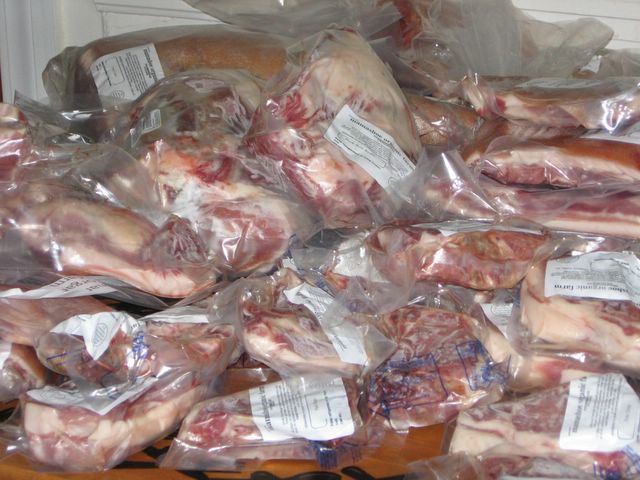
I returned from the camping trip on Sunday. Monday I took the day off from work to go with my friend to pick up our half cow. We bought a quarter cow from River Rock Farm back in January, and our supplies were depleted. Since everyone involved in the first beef-buy has essentially been ruined for regular beef (River Rock Farm beef is grass-fed, dense and meaty and flavorful), we decided to go for broke this time with a half cow. Split five ways, that’s over 50 pounds of fantastic meat per person. My freezer is stuffed to the brim with meat. It looks like this:


Freezer of joy. Posted by Picasa

As an aside, the abattoir was a surprise. The farmer delivered our first purchase, but asked that we pick up this order from the butcher/slaughterhouse. I don’t know what I was expecting - a big ugly building with a stench of death, I guess. Certainly I wasn’t expecting this:


An elegant little slaughterhouse... Posted by Picasa


Really. Posted by Picasa

Apparently, there’s more money to be made in the small-slaughterhouse biz than one would expect.

**********************************

My friend and I got back to her house a bit later than expected, and our other friends who were coming to pick up their share of the cow were late as well. This turned out to be great for me, because my friend and her husband were planning to attend the Farmers’ Market Tasting Dinner at Bistro 5 in Medford, and since they were running too late to drive me home, they invited me to join them. I have lovely, generous friends with great taste in restaurants, which I greatly appreciate, since the only restaurant I frequent is Bistro Moi.

Here’s the menu:


Bistro 5 has a farmers' market tasting menu available every night in the summer. Go. Posted by Picasa

(Sorry the scan isn't very clear. This is the best I could do.)

The produce for the meal came from the farmers’ market in Central Square that afternoon, and the whole meal was fresh, organic and local. The quail came from a supplier in Vermont, who sells fresh, not frozen, game birds. The wines were all either completely organic (no sulfur) or from organic grapes.

Now, Vittorio, the chef at Bistro 5, is basically a genius. This was one of the best meals of my life. A true chef can transform even mediocre ingredients into something complex and interesting, but when the best materials are in the hands of a master, every bite is nuanced, complex, yet at the same time strong and clear in flavor. That may sound like restaurant-reviewer speak, but describing truly incredible food is difficult. I can’t explain why Vittorio’s arugula pesto is better than mine, but it is better, much better: there is more flavor, more arugula bite, more tang of cheese. Everything is just bigger.

(Did I mention that the lamb was to die for? And that nasturium leaves have a spicy flavor like horseradish?)

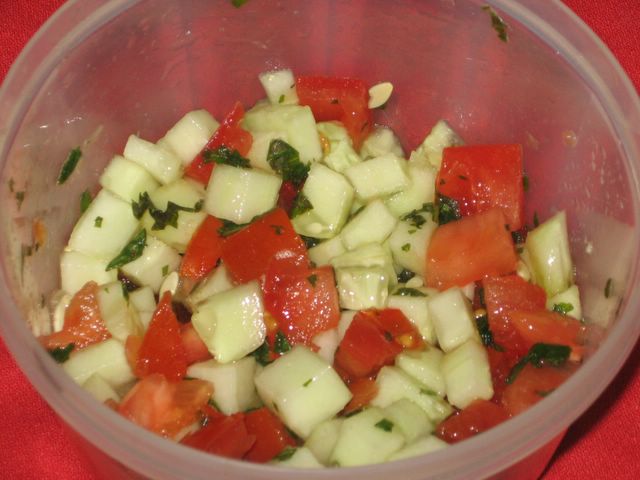
As nice as it is to enjoy the work of someone who relly knows his way around a kitchen, you don’t need to be a genius to make good food at this time of year. My lunch today, in its humble Tupperware, is still pretty fine. Ingredients: cucumbers, tomatoes, basil, salt.


Simple is good. Posted by Picasa

Thursday, July 21, 2005

Corn Alert!

Grilled corn update - fresh corn now available at farmers' markets! Rejoicing over all the land!

Wednesday, July 20, 2005

So after the family dinner Sunday, my mother was pressing leftovers on her children, as a mother will do, and she asked about the grilled corn. I said I would take some for a salsa or a salad or something. One of my sisters commented that that was the difference between her and me: she just heats up leftovers, and I cook with them.

Now, my sister cooks. She has three kids, and she makes dinner and bakes cookies and all that. But I do think that there is a point in your development as a cook when you start to think, not in terms of meals, but in terms of household food planning. This is a skill that doesn’t come until you’ve been cooking for yourself for a number of years, so that you have the culinary wherewithal to wing it a bit, and you have to be making most of your meals, so that you have ample opportunities to use things up. It takes a while to get there, and I think fewer and fewer people manage it these days, what with all the prepared foods available.

This sort of culinary strategizing really gets my frugal little peasant heart a-beating. Maybe it’s not the sexiest side of cooking, but it has its appeal. There’s a certain thrill in knowing you haven’t let anything go to waste, that all of your sows’ ears have been sewn up into pretty little silk purses.

So here’s a round-up of possibilities for that grilled corn (which by the way, is not quite in season locally yet. Mom jumped the gun. But this summer is hot; maybe we’ll have some soon.):

Salsa – mix with chopped tomatoes, chili, cilantro, black beans if you like, a bit of cumin.

Quesadilla – make a similar mix to the salsa, put inside a quesadilla with cheese.

Cornbread – A local restaurant used to make a specialty cornbread with real corn in it. Frankly, I found it a bit gross. But I had many friends who loved it.

Chowder – Cut the kernels off the cobs. Put the cobs in some chicken broth and simmer ½ hour. (Extra points for use of part of the vegetable normally thrown out). Meanwhile, chop and sauté some onion and red pepper. Add some red pepper flakes, a bit of celery seed. Add the corn-infused broth and a bay leaf, bring to a simmer. Add chopped potato. Cook until potatoes are tender. Add corn kernels and cream (light, heavy – your waistline, your decision). Heat through. Variation: Use sweet potatoes, a chili or two, a touch of cumin, skip the cream, add cilantro at the end.

Pasta – This is what I had for lunch. Cook up some penne. Saute a couple slices Italian sausages. Remove from pan, pour off most of the grease. Add a few cloves of garlic, cook for two minutes, add a bunch of kale, Swiss Chard or other slightly bitter green. Saute until the greens are wilted (if you have a lot of greens, you can lower the heat and cover for a minute or two to let them steam). Sprinkle with red pepper flakes. Add the corn to warm. Mix together sausage, greens/corn, pasta. You could definitely add roasted red peppers, either from a jar or grilled with the corn. A little Parm is nice; a lot of black pepper is necessary. This is a variant of something I used to make back when I had a grill, called “Every-vegetable-you-can-think-of-plus-sausage-over-pasta.”

Salad - Grilled corn, black bean, avocado, arugula salad with cumin-lime dressing.

Corn pudding – Put corn in buttered ramekins, add shredded cheese, pepper. Pour a mix of egg and milk over. Bake in hot-water bath until set in the middle. Again, roasted red peppers would be a nice addition.

There is no need to eat corn on the cob reheated in the microwave. Resist!

Monday, July 18, 2005


Sometimes the leftovers are better than the meal. Posted by Picasa

It's true. This weekend I had a family get-together at my parents' house, which gave me access to a charcoal grill. I saw this as a golden opportunity to grill-roast the pork shoulder which has been waiting in my freezer.

But family events are tricky, and cooking for family events is trickier. I know my mother doesn't like hot spices and my sister doesn't like much of anything, and I try to please them both. I also have to remember to bring everything I need to cook out there with me, because my mother still has spices that were given to her at her wedding over forty years ago. She still thinks I can use them. (You see, my parents and I don't really see eye to eye on the whole cooking thing.) So I have a law:

Pyewacket's First Law of Cooking for Other People: It is impossible to cook transcendent food for one's family.

You can cook good food for your family, even on rare occasions great food. But transcendent food, no. Even if you start with transcendent pig.

The shoulder was rubbed with garlic, pepper, salt, celery seed and a little allspice, and roasted over a low grill for about three hours. It came out juicy and succulent. But I failed to make any sort of sauce or relish or chutney to go with it, out of a combination of feeling overwhelmed by a hectic schedule this weekend and being worried that my sister would hate anything too elaborate. So it was simple, pork and grilled potatoes and grilled corn. Good, not transcendent.

But I got the leftovers.

The sandwich above is the result. Chewy Italian bread. Pork. Grilled corn. A little of Grandmother's Sweet Pepper Relish. Homemade relish would have been better, but we're talking about a work day lunch here. Besides, I have a soft spot for Grandmother's because they used to be a little family-owned operation in my hometown of Natick, Massachusetts.* Anyway, the sandwich, which I just finished eating for lunch, was smoky, a little sweet, deeply meaty, chewy and satisfying. I might even say "transcendent."


*(They're now owned by Allied Old English, which also owns Ah-So and a few other small brands. Not exactly Coca-Cola, but not the Whipple Company of Natick, either)

Monday, July 11, 2005

The ravishing radish


Radishes: A woodcut Posted by Picasa

So I had a funny experience regarding radishes.

I'm a regular poster on Chowhound, a discussion board for people who love food in all its forms. A while back, I posted something on Chowhound about the benefits of farm shares (CSAs). A few weeks later I got an email from a Wall Street Journal reporter asking me if I would be willing to talk to her about my experiences.

Now, I'm not very comfortable with the idea of my name being in the paper. Fools' names and fools' faces are often seen in public places, and all that. Also, I get stagefright so badly even a metaphoric stage will set it off. But I believe deeply in supporting local farmers, so I decided that I really should not be such a wimp about something so trivial and should just call the woman and talk to her.

So I called her and talked for a long time about my experiences with the farm share. I stressed the importance of supporting local farming, the value of eating with the seasons. I talked about the sense of comraderie among the people in line to get their weekly boxes, the community that was being built. I talked about the quality of the produce, the heirloom varieties that had been bred for quality of flavor and texture, rather than the ability to be stored and shipped.

She didn't want a quote on any of that. From the article which appeared in the Journal:

And if the farm's strawberry crop is a bust, but there's a bumper crop of kale, you had better like kale. Pyewacket (named withheld for blogging purposes), who joined a CSA in Cambridge MA recalls last year receiving one box that was almost all greens and radishes. "It does push the boundaries of your culinary expertise," she says. "I didn't know you could cook radishes."

There it is, my one moment of fame: "I didn't know you could cook radishes."

Really, I said more interesting things. Honest.

But interestingly enough, every time I tell this story, I get the same response. "You can cook radishes?"

Yes, you can. The best method is a quick saute in butter (of course), preferably finished with a bunch of chopped fresh dill and sprinkle of vinegar. The radishes maintain their crispness and color, but their sharp edge is tempered to something more mellow.

If you roast them, they become mellower still, to the point of tasting a bit dull. But they add some color to a pan of roast vegetables. If you have them around, which I usually do, it's worth throwing a few in.

Thursday, July 07, 2005

Ooh, la, la, Canada!

Damned Canadians are spoiled. Really, they’re hopeless. Soft. Like children. For example, a Montreal resident wants to make a nice dinner, what does he do? Wanders down to the Jean Talon market, buys himself any cut of organic meat he desires, picks up organic baby vegetables and fruit, freshly made pasta, maybe a little smoked fish, some local raw milk cheeses, poppy-seed strudel and a few chocolates, made on the premises. Then he goes home, cooks up dinner and enjoys his meal.

Pathetic.

In Boston, you would have to order the meat from the farmer, go fetch it. The meat will be frozen, of course, since you can’t eat a side of beef fresh. Or you could go to Savenor’s and pay through the teeth. Your choice. Then to the farmers’ market – which day is it? Check the schedule, find out which market is open. It’s on the other side of town. Go get your vegetables. If they don’t have what you need, as they well may not, run to Whole Foods and pay, pay, pay. While you’re there, pick up the fish. You would like to run into town to another fish market, but you’re running out of time. Fresh raw milk cheese? Well, that’s impossible, because the government is heavily involved in flavor-censorship. Settle for pasteurized. Fresh pasta – great, just run out to Dave’s or Capone’s! In Somerville. Skip the search for poppyseed strudel, if you’re not a masochist. Chocolates, no trouble. Just a quick trip to the Fenway or maybe Harvard Square.

We Bostonian cooks, we WORK for our results. We become lean and tough. Canada, pftth!

******************
Okay, so the Jean Talon market was amazing. If you’re not in the know, the center of the market is a tented area filled with vegetable and fruit vendors, the whole about the size of a city block. The perimeter is filled with bakeries, meat and fish markets, cheese shops and so on. There is a great store just as you enter that sells all sorts of Quebec-made foodstuffs, from venison pate to local cheeses to pickled cattails.

My haul included walnut-sized potatoes (the hazelnut-sized ones sold out just before I bought mine), tiny zucchini, radishes, spinach and lettuce; three local cheeses, all excellent (especially the very creamy, mild blue called “Bleubry”); almond-paste and poppyseed-filled strudels; a bag of dried mixed forest mushrooms; ice-cider (like ice wine, but made from frozen apples instead of grapes); assorted fruit liqueurs; fresh lychees; fresh tortellini, both meat and cheese; chocolates; and of course some maple syrup. I thought I was quite restrained, really. I left behind gooseberries, which are impossible to get in the States, and everything in the fish and meat markets, and all sorts of cheeses, and – well, you get the idea. It’s like paradise, or would be if you actually had a real kitchen to cook in, not just your brother’s bachelor pad with the one pan/one pot mojo.

I wanted to take pictures of pretty much everything, but my batteries died the moment I got there. Grr.

It’s not just the quality of the food, or the abundance, or the variety, or the fact that so much is organic. It’s the display. The vendors put a serious effort into making the booths beautiful. You get a sense that they just care more. It was wonderful to see, but at the same time, a bit depressing. Why don’t we have anything like this in Boston?

*****************
A note: I have no idea how to add accent marks. Forgive me.

Thursday, June 30, 2005

Cherry, cherry

Got some cherries at the Central Square market on Monday. The sign in front of them clearly read "Sweet Cherries." But apparently there are varying degrees of sweet. These were sweet enough to eat straight, but only just, and had the bright cherry flavor of sours, rather than the winey depth of Bings. I decided to bake with them.

And, surprise, they were really good. Generally, I dislike cooked cherries - the sours have just the one sour note, which is normally overwhelmed by heavy sweetening. The Bings lose all complexity. But these retained their sprightly* cherry flavor, and also kept a nice firm texture while giving off a good bit of juice. I baked them in a simple crumble with a few drops of almond extract and a touch of tapioca to thicken. I was quite happy with the results, which looked nice too, and if I had remembered to bring my camera home from the office, you could have seen that. But I, um, didn't.

I will be sure to ask the farmer about the variety of cherry a week from Monday. But this Monday I will be in Montreal, taking pictures (I promise) at the Jean Talon market.

* Yeah, I said sprightly. You got a problem with that?

Monday, June 27, 2005


This little piggie went to market, part three: Dinner Posted by Hello

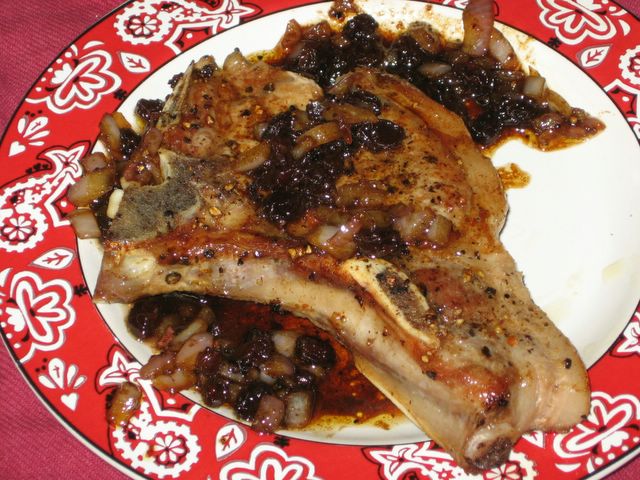
My pork chop, my love.

I made a couple chops when we got home from the farm, one each for J. and myself, but (and I hang my head in shame here), I overcooked them. Look, I haven’t cooked a pork chop in years – the nasty dry things that you can get at the supermarket aren’t worth cooking. I followed the method and timing given by The Best Recipe, high heat to sear one minute on each side, then reduce to medium and cover for 4 minutes on the first side, then five minutes on the second. This produced an overcooked chop. Maybe my chops were thinner than theirs? They weren’t completely dried out, but were clearly overdone. Frustrated, Sunday night I decided I had to have another go at it. Salted and peppered the chop, using both white and black peppers. One minute sear per side, then three minutes covered on medium-low, followed by another three minutes covered, then a test. A little underdone. Back on for one minute. Perfection. I took the chop out, poured off all but about a tablespoon of fat, then cooked in the fat about a ¼ cup of finely chopped onions. After a few minutes, I added a mixture of cumin, allspice, and ground chili pepper, and sauteed for another minute. I added about ¼ cup of rum, in which had been soaked about ¼ cup of raisins, and 1 T dark brown sugar, which was satisfying because the pan gave off a tremendous hiss. I let that mixture reduce for a minute or so, then added the juice of half a lemon. This sauce provided a spicy/fruity counterpoint to the chop, which actually tasted like meat instead of cardboard, and was tender and juicy. If you like something a bit more piquant, a tablespoon of vinegar could replace the lemon juice.

This little piggie went to market, part two: The booty Posted by Hello

When you tell people that you’re buying a pig, and you’ve gotten over the whole issue of it being a butchered pig, not a pet, then I’ve found they want to know about the logistics. How do you buy meat directly from the farmer, how do you order, how do you split the meat up and so forth. It can be intimidating to go through the buying process for the first time, so I figured I would write up the lowdown for the pig-buying process, in the hopes that I will encourage my imaginary readers to try out buying from farmers for themselves, to serve to their imaginary families.

I contacted the farm about two months ago to inquire about the price and availability of a whole hog and to discuss farming practices. I had talked to quite a few farms about pork. Unlike organic, pastured beef and chicken, organic, pastured pork is hard to come by. But I finally found the Mamashoe organic farm, which has exemplary farming practices (see This little piggie went to market, part one). They also had a few pigs they had overwintered. Usually, pigs are slaughtered in the late fall, so I wasn’t expecting to be able to get pork until then, but I wanted to get my order in early. These small farmers tend to have devoted followings, and many will sell out each year’s pigs, cows or chickens months in advance. Anyway, I lucked into a June pig.

I sent a small deposit, and then we had another call to discuss cuts. I love that part. Basically, you have a few options for each part of the pig – for example, the loin can be left as a single long roast or cut into chops. I told the farmer what I wanted from each part of the pig and then set a date to pick up the meat.

Here’s what we got:

4 Boston butt roasts
2 extremely large fresh hams
2 shoulder roasts
26 packages of chops (2 chops per package)
5 packages of ground pork
2 packages of spare ribs
8 packages of fresh bacon
2 packages of ham hocks
1 package, two kidneys
1 heart
3 packages of liver

We paid $5.50/pound for the above. He also threw in for free:

2 packages, 2 each “trotters” (yeah, that’s the feet)
6 packages of fatback


There were four people splitting the booty. Overall, it was easier to split up than the cow we bought in January, which had more odd pieces of wildly varying quality (a little tenderloin, a little shank, a flank steak, a chuck roast – it’s hard to work out a balanced split). Everyone got a butt roast; the people with bigger families got the hams, the others got the shoulder. The spare ribs were a little problematic, but I made a supreme sacrifice, took the extra ground and an extra chop, and insisted on an invitation to dinner on spare rib night. I kept all the fat to render the lard, which will then be distributed back to all parties who want good pie crusts. The woman with the Italian husband and Fergus Henderson’d book on offal wanted all the odd bits, so she’ll be getting the kidneys, heart, liver and feet. They’ll also be smoking the bacon, an event which will get its own blog entry.

The only really troublesome part was divvying the chops. I had asked for the loin to be gut into chops because I thought it would be easier to split up. It would have, if the loin chops had been labeled as such, but all the chops, the rib chops and loin chops and whatnot, were just labeled “chops.” We did our best to give each person chops that looked like they came from different spots on the hog, but really, we had no idea.

This works out very well if the people you are splitting your pig with are easygoing generous sorts who care more about making sure all is fair than about getting the best for themselves. I can imagine there would be some people who would be very unpleasant to include in an endeavor like this. Fortunately, I don’t know them.

This little piggie went to market, part 1: The Farm Posted by Hello

So my boyfriend J.,* friend and co-worker C., C.’s adorable 18-month-old, and I all got in the car and trundled out to Petersham, MA to get our pig.

Petersham is a lovely small New England town, heavy on the quaint, just east of the Quabbin. The center of town is picture-perfect, complete with bandstand, white churches, and a country store that sells ice cream. We got to know it pretty well, seeing as we forgot the directions and so had to drive back and forth down the main road a half-dozen times before we found someone who could point us to Mamashoe Organic Farm.

But we did find it, at last, and pulled up to find the farmer and his adorable daughter waiting for us on a tree stump.

Now, you may have in your mind an image of a small New England farmer, a taciturn Ethan Frome type of character, or maybe something a little more charming, a wrinkled Norman Rockwell gentleman in overalls with a pipe. Your image would be a bit off. Our pig farmer is a loquacious former Cambridge hipster, who used to have a band and almost surely went to Burning Man, and now raises hogs, goats and chickens. I found this deeply inspirational, possibly because I have never managed to be hip enough to be readily identified as a hipster nor have I had the courage to chuck all for the farming life.

And then of course there was the farm.

This family is raising food in the most balanced and environmentally sound way imaginable. They’ve planted paw-paws and other tree. They use goats and pigs to help clear land for planting, and use a moveable chicken coop to spread around the chicken manure while giving the chicken fresh land to range upon. They’re clearing invasive foreign plants like honeysuckle. They’re making raw milk goat cheese and kefir. They do their own smoking of meat. They are homesteading for real, just a little over an hour outside Cambridge.

And then there are the pigs.

The pigs are kept in the woods, just like the Spanish do when raising pigs for their famous ham. The farmer has used electric fencing to mark off three acres of land for the pigs to forage in and supplements their foraging with organic feed. He moves the fencing to different areas over time to give the hogs new land to explore. These were really happy pigs.

And magnificent. There was something amazing about these creatures, so strong and primal. They belonged in the woods – you could see the wild boar in their ancestry. We watched them use their powerful snouts to burrow in the ground, all the time making rough snorts and deep snuffles and grunts. As J. said late, “You know, I could have looked at those pigs all day.” Me, too.

And, um, cough, they make great pork.

So I got home and made pork chops for dinner. And, no, seeing the pigs didn’t make me feel bad about eating the pork chops.** Seeing the pigs living in the woods, with room to roam, eating acorns as well as feed, rolling in good clean mud, made me feel better about eating this pork. What I felt bad about was the bacon that came with my restaurant breakfast the next morning. There’s no excuse for raising those noble beasts in the horrifying conditions of factory farms. But at least there are some people raising pigs conscientiously, and we can support them in a thoroughly pleasant way by buying their excellent pork.

*I’m being all Victorian with the initials and all because using full, real names on the internet weirds me out. So I’m paranoid.

** None of the pigs appeared to be named Wilbur. I am sure this helped.

Friday, June 24, 2005


A tribute to this seaon's asparagus, in woodcut Posted by Hello