Tuesday, May 31, 2011

Summer in May

After weeks of grey, cold, and drizzle, Memorial Day weekend was sunny, hot and humid. Of course, window ACs were not yet installed, so we had to conquer the heat with low-tech methods.


I broke out the rocket pop molds, one of my most-used kitchen items during the summer months. Regular old store-bought popsicles are just sugar, water and food coloring: no flavor, no nutritional value, no point. Homemade are easy, fast and really worth the minimal effort. Starting with a very ripe banana is always a good idea, since it will usually give you enough sugar to ensure both sweet flavor and appropriate texture. I added some pineapple and a little pineapple juice, plus a couple spoonsful of coconut milk, whirred it all up until smooth, and then froze for four hours. Working prep time was five minutes. As you can see, these no-sugar-added treats were a hit with big and small alike. Score one for laziness.

Tuesday, May 24, 2011

Beyond basic black

(This was my first submission in the food writing class I just finished. My instructor informed me in her final evaluation that it was a "snore" and made her fear I would be "competent, but dull." Fortunately, I improved over the course of the semester. But it does offer some useful information, and so here it is.)


Freshly ground black pepper is the culinary equivalent of the little black dress: always respectable, exceedingly useful, and as predictable as mill-wielding waiter at a white-cloth restaurant. Every roast or chop gets its rub; every plate of pasta is duly sprinkled. But peppercorns come in a rainbow of colors, each with a different personality, and even basic black offers more exotic variants.

This array of pepper choices can inspire new ways of seasoning. Add a fresh grind to foods traditionally finished with salt – roasted nuts, fries, crackers or popcorn.  Quick bread favorites like biscuits and popovers gain sophistication with the addition of some spicy bite. A bit of fiery buckshot has a place at the dessert table too, offering its kick to a deeply spicy gingerbread, warm fruit compote, surprising and addictive lemon cookies, or in the classic Italian combination, to a dish of strawberries anointed with aged balsamic vinegar. Cooks who experiment with other options may discover a whole new wardrobe.

Black peppercorns are the dried, ripe berries of the Piper nigrum plant that most people are familiar with. Varieties are known by their place of origin: the unmarked bottles in the grocery store are generally the classic, bold Tellicherry, but adventurous cooks can also find Sarawak, Singapore or Malabar. These vary in complexity and heat level. Combining several in a grinder will provide a full spectrum of flavors, while using just one will highlight its particular personality. Some specialty merchants have started to offer peppercorns that have been smoked over hickory chips or in bourbon barrels, offering the possibility building layered flavors with a single ingredient.

White peppercorns are stripped of their dark skins and, with them, the characteristic taste of black pepper, revealing a nose-twisting musky aroma, as well as a powerful heat that fills the mouth with a slow-building burn. The French use tiny pinches of finely powdered kernels to give a hint of warmth to cream sauces like béchamel without marring their perfect whiteness, while other cuisines feature the spice front and center. Jamaican and Cajun spice blends both rely heavily on its characteristic intensity, combining it with cumin, cayenne and other spices to make aromatic and tongue-tingling blends. The most surprising use might be with nutmeg and allspice in a traditional English cake mixture.

Green peppercorns are the unripe berry, preserved by drying or brining. The dried version lacks much of the power and depth that ripening brings to its darker sibling, but does offer a clean, bright flavor in a softer shell that can be used whole. Preserved in brine, or rehydrated in water, wine or vermouth, these caper look-alikes can be used in many of the same ways as their doppelgangers: as the basis for sauces for poultry or rich-fleshed  fish, such as mackerel, or in pork terrines or cheese spreads. Just a few atop a deviled egg add zing.

Pink peppercorns are not a true member of the pepper family, but their similar size and shape and their appealingly rosy hue make them the traditional partner of real peppercorns in glass-sided mills. Mild and just a bit sweet, this seasoning makes a marvelous infusion into vodka, producing a genteel cousin to the popular but brash chili pepper vodka. This blushing aperitif manages to be both demure and piquant, like the society doyenne who pairs her pearls with a leopard-skin cape.  Some pastry chefs feature pinks in unusual desserts, such as meringues or compotes.

In the early days of the spice trade, Indonesian long pepper (sometimes called Javanese or Indian long pepper) was considered to be the same as true black pepper. In fact, these long pods come from the Piper longum plant, a close relative to Piper nigrum. Once found almost exclusively in Indian grocers, these fragrant treasures are now available atspecialty grocers and spice dealers.  Resembling tight brown pinecones up to two inches long, these seed capsules need to be ground fresh. An ordinary table mill might not be up to the task, but an electric coffee grinder should yield a fine powder with a strong bite and a nearly floral scent. Try these in a pork rub or a lamb stew.

Monday, May 16, 2011

High on the Hog

Having just read Frederick Douglassm Opie's Hog and Hominy: Soul Food from Africa to America, I was afraid Jessica Harris' High on the Hog: A Culinary Journey from Africa to America was going to be a retreading of familiar material. I was pleasantly surprised. The two authors' styles are very different - while Opie tries, somewhat unsuccessfully, to hold together personal reminiscences and academic history, Harris is a natural storyteller who uses the lives of black cooks, eaters, and entrepreneurs to enliven the larger cultural discussion of food and race. She brings to light nearly-forgotten figures who deserve to be widely known: the life of Hercules, George Washington's genius black cook, is just waiting to be turned into a novel or screenplay.

This book is a highly entertaining read, but I admit to wondering how accurate some of the material was. Harris chose not to include a professorial flurry of footnotes, which certainly keeps the book accessible, but also prevents it from carrying a certain authority. Popular history requires walking a very fine line - Harris generally does a good job, but might err a bit on the side of popularity. Ultimately, it doesn't matter, as the quantity of fabulous primary material she draws on tells its own story with clarity, and her lively prose will draw in any reader.

Thursday, May 12, 2011

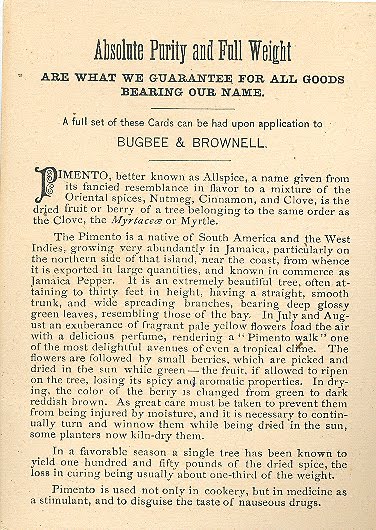
Pimento, otherwise known as allspice

Last piece of culinary ephemera I picked up last weekend. The image here is lovely, one of a collectible series of cards featuring the spices sold by Bugbee and Brownell of Rhode Island. The company lasted less than a decade, closing in 1888, so that makes dating this pretty easy. I had no idea that pimento was ever used as a name for allspice, which is a pretty important thing to know if using old recipes.


Wednesday, May 11, 2011

More ephemera


I like this because it encapsulates the romantic aura that developed around the idea of New England - even if the company using the name was based in Chicago. The region came to stand for honesty, traditionalism, Grandma, thriftiness and efficiency (that Yankee ingenuity!). That image remains in some ways - would the Vermont Teddy Bear Company have the same cachet if it were called the New Jersey Teddy Bear Company? I think not. But at the same time, New England is also thought of as the land of wild-eyed liberals, traffic jams, and bad clothing. Of course, both perceptions might be true....

Tuesday, May 10, 2011

Not exactly mother's bosom


This is a somewhat morbid little piece of culinary ephemera I picked up at the Boston Book and Paper Expo this weekend. Those tubes the babies are sucking were known as infant-killers, and for good reason:


According to Valerie Fildes (1998), ‘it seems likely that the eradication of the long-tube feeding bottle was a major factor in the… fall in infant mortality'. Before 1900 a glass bottle with a long rubber tube attached was popular. The convenience of the tube was that the child could be left to suck unsupervised. The problem was that these tubes, and also the bottles, were difficult to clean. Accumulations of dirt and congealed residues were inevitable and it is no surprise that infections and deaths were much higher for babies fed with this method than with the newer, boat-shaped bottle, which had a rubber teat and was much easier to keep clean. Medical Officer of Health data indicate that tube bottles were used in about 78 per cent of cases of artificial feeding in 1904, where a child had died, falling to nil by 1925.


P.J. Atkins, "Mother’s milk and infant death in Britain, circa 1900-1940." Anthropology of Food, September 2, 2003.

Friday, May 06, 2011

Rox Star

As a frail grey-haired gentleman slowly eases his way out of the booth, the waitress rushing past with a pot of coffee gently lays her hand on his shoulder, “Don’t hurry, dear,” she says. “Take all the time you need.” A toddler fusses at another table, and she offer the parents a bag of oyster crackers to keep him distracted. She fills a half-empty mug and delivers a hot plate of eggs and toast. Another morning at the Rox.

Located on a stretch of Centre Street in West Roxbury, where insurance agents and nail salons give way to bookstores, bakeries, and funky thrift shops, Rox Diner (formerly Auntie B’s) represents a curious blend of 1950s small-town and 2011 hipster locavorism. The waitresses, wearing t-shirts that read “I Was Born a Scrambling Man” or “Bread Zeppelin,” serve a clientele of families grabbing breakfast after Mass at Holy Name, aging bachelors socializing at the counter, and middle-aged ladies from the neighborhood fortifying themselves with gossip and a side of eggs Benedict. The regulars may not be aware that those eggs come from free-range hens in New Hampshire, that the beef is hormone-free and certified humane, that the bread is made at the esteemed Fornax Bakery. But the food tastes great, and so they return often.

All the morning standards are here, cooked with care: over-easies appropriately runny, bacon nicely crisped, orange juice freshly squeezed. More extravagant offerings include thick brioche French toast oozing with bananas and melted Nutella ($9.95) , blackberry, pecan and mascarpone pancakes ($9.95), and omelet with pear, goat cheese and avocado ($9.95).

The pancakes are especially well-executed, with the lightly crisped exterior that marks an exceptional flapjack. Specialty versions come with real maple syrup, but you have to request the good stuff with a basic stack ($4.95, plus a surcharge of $1.50 for the syrup). Unfortunately, Belgian waffles ($4.95) are not up to the same standard, too soft and floppy to merit the indulgence. Stuffed French toasts (stuffed $9.95, plain $7.50) are gloriously decadent, but the plain thick-cut brioche toast could stand a longer soak in the egg mixture. The center remains bready, rather than custard-like.

There are good options for the health-conscious, including the Juliana (named for a waitress’ daughter), a generous bowl of rich plain yogurt topped with ripe fresh fruit, granola, and a drizzle of honey, served with two eggs and toasted peasant bread ($9.95), and the health-nut French toast, made with multigrain bread nearly invisible under a deluge of pecans, blueberries, and bananas ($9.95).

Although the restaurant offers lunch, breakfast is draw here. On Thursdays it reopens for burger night, a favorite event with kids. The ground beef is certified humane and hormone-free, a full-flavored patty to be topped with standard options or some unusual ones, like smoked paprika mayo (basic burger, $6.25). Almost-too-thick-for-a-straw milkshakes and crisp onions rings can’t be beat.

The next time you’re in the mood for an all-American plate of eggs and bacon or a burger with the works, skip the chrome and neon flash of the mall diner chains and experience the real McCoy. Your maiden visit won’t be your last - and don’t be surprised if the waitresses say hello when you return. They’re like that.

Wednesday, September 22, 2010

Eating alone

There's a bit of an online kerfuffle about a tumblr site called Table for One, which consists of nothing but photographs of people eating alone at restaurants Links have been posted to it from Metafilter and Andrew Sullivan both, and in both cases the posting has met with outrage. Most folks seem to feel that the site is mocking the people eating alone. It probably is, though it's hard to tell; no context is given. Maybe it's trying to give some sort of picture of 21st century loneliness? Who knows? Who cares? It's a pretty crappy site anyway; the photos are poor and in poor taste, given that the subjects clearly don't know they're being photographed.

The response to the site, however, is rather interesting. About half of the people who have commented on it seem to feel sorry for the people in the photographs and want to spare them further embarrassment. The other half don't see what the big deal is about about eating alone - particularly if they have a book.

Ah, yes, the book. I have eaten out along many, many times with a book. I worked as a temp in New York for a long time, and temps eat alone. But there is a huge difference between the lunchtime pizza with book in hand and actually dining out alone. The former is commonplace, but the latter can be scary. I suggest everyone try it - and don't bring a book.

One of the best scenes in the very food-aware movie Moonstruck comes when Olympia Dukakis's character, left alone for the evening while her husband is out with his mistress and her daughter with a new love interest, goes out to dinner alone at the local white-cloth restaurant. The waiter comes to greet her by name; she is known here. He asks whether anyone will be joining her. No, she replies, "I want to eat."

And she does. She orders a proper meal for herself, with a soup to start and a nice Martini. She doesn't pull out a book and hide in it. She looks around the restaurant. She watches people. She is completely and utterly self-possessed.

Many women of a certain age, having spent their lives cooking for others, are so relieved to have a night off from the obligations of the stove they would gladly eat cold leftovers standing in front of the fridge. That Dukakis's character chooses to go out and have herself a real dinner instead gives us enormous insight into the woman - she believes in doing things properly; she is sure of herself. As she tells us later in the film, she knows who she is.

I did quite a bit of business travel for one short period of my life. For a couple months, I ate endless subs and pizza slices and salads in plastic clamshell boxes. One night, unable to face another Formica tabletop or florescent light, I walked into the nicest restaurant I could find. I sat at my table for one near a roaring fire. I ordered a gin martini and a rare steak. I did have a book with me - a blank one. Now and again, I wrote in it. I got dessert and coffee. I lingered. It was a lovely evening, and I came away feeling like I had crossed some milestone of adulthood. I highly recommend the experience. It was as luxurious and self-indulgent as a massage, but more bracing.

Friday, May 21, 2010

Friday, April 02, 2010

Great news! Well, maybe...

You gotta love the maple syrup folks for trying.

Pure Maple Syrup Contains Medicinally Beneficial Compounds, Pharmacy Researcher Finds

Of course, the story is a little less exciting than the headline. Maple sap contains these compounds (antioxidants, etc.) at really, really low levels. So next they're going to see if maybe boiling down to syrup concentrates them to the point where they're actually useful. They hope so, because after all, syrup comes from trees, and trees are plants, and plants are just chockful of healthy goodness:

"We know that plants must have strong anti-oxidant mechanisms because they are in the sun throughout their lives," Seeram said. "We already know that berries, because of their bright colors, are high in anti-oxidants.Now we are looking at maple syrup, which comes from the sap located just inside the bark, which is constantly exposed to the sun."
Oh, please.

I love maple syrup. It's a crop that is grown without chemicals (as compared to the astonishingly toxic array used on sugar cane) and over with minimal environmental damage. It's an industry with a backbone of small producers. Most importantly, it's delicious. I think that should be enough.


Monday, March 08, 2010

Quick sauce

We had nothing in the house last night, and yet, a dinner emerged! I'm estimated quantities here, but I think this is a pretty good pasta sauce dependent almost solely on pantry items:

1 T olive oil
3 cloves garlic, minced
2 large jarred roasted red peppers, diced
1 T tomato paste
1 tsp. smoked paprika
1/2 cup chicken broth
1/3 cup light cream

Cook garlic in olive oil for about two minutes on medium. Add the peppers and tomato paste and cooked about five minutes. Add the paprika and cook another 2 minutes. Add the chicken broth and cook until reduced to a fairly thick sauce (about five minutes). Add the cream and reduce again (about five minutes). Salt and pepper rather generously. Serve on pasta, of course.

Thursday, February 25, 2010

Saturday, October 31, 2009

America Eats

America Eats!: On the Road with the WPA - the Fish Fries, Box Supper Socials, and Chitlin Feasts That Define

The growing interest in local food systems combined with the economic downturn makes for a good climate for books about American food of the Depression period. The rationing of World War II was followed by the transfer of wartime technologies for food preservation to the general marketplace, changing American food forever from a patchwork of regional cuisines to a national diet based on chain restaurants, frozen and canned food and, above all, homogeneity. The Depression period, for all the limitations that poverty brought to the tables of most Americans, can seem now like the last hurrah of real food.


So it’s a great time for the release of two new books about WPA food writing, a nearly-forgotten part of the great cultural projects of the New Deal. Though writers and editors were engaged to create a national guide to American food, the project was never completed and the writing produced never published, until this year. I haven’t read Mark Kulansky’s book The Food of Younger Land, which outlines the history of the project and then includes selections from the archive, focusing on writing from major authors like Eudora Welty and Zora Neale Hurston. Pat Willards’s America Eats: On the Road with the WPA takes a somewhat different approach, interlacing excerpts from the original WPA pieces with her own reporting from church dinners, harvest festivals, and other food-centered gatherings that have continued from WPA days.


This is a somewhat disorderly, frustrating book, which may result from the sheer variety of material Willard includes. The writing that was done for the WPA project spanned a range of styles, from journalistic reports to sentimental sketches to fictionalized accounts. The quality of the writing is a varied as the style. Among the best Willard included are a sensitive short story from Iola Thomas of the Iowa office about a threshers’ dinner and a description of the conch-eaters of the Florida Keys by Stetson Kennedy. Some of the other selections tend toward the twee, in some cases condescending to the subjects to a degree that is deeply off-putting.


Willard’s prose is clean and straightforward and her interest in American food and cultural tradition seems genuine. Some of the limitations of the book seem a direct result of the limitations of the primary material. Some regions were neglected in the original project; many arbitrary decisions were made about which immigrant foods were to be included and which were not “American enough;” cities other than New York were completely neglected. Willard, in following in the footsteps of the project, is forced into some of the same limitations, and she acknowledges them. But perhaps the greatest limitation, one which Willard references only briefly, is the focus on food events, rather than broader food traditions. We hear about the fairs and festivals, church suppers, political dinners and funeral feasts, but not about daily home cooking or, for that matter, professional cooking done in small eateries. This would not be a problem if Willard didn’t try to make larger claims for the meaning of the decline of these events in terms of larger culinary and social history. When trying to discuss these issues, particularly in the final chapter, Willard is weak, making poorly-supported assertions and moving on quickly without any depth of analysis. She lacks the subtle sensitivity for regional food evidence by a writer like John Thorne and the scholarly comprehensiveness of someone like Waverly Root. But she has skill at drawing a scene. I very much enjoyed her portrait of the Basque Sheepherders Ball, the funeral feast of the Choctaw Indians, and the Mexican coaches of South Sixth Avenue in Tucson.


In trying to find and report upon the closest equivalents to events described in the original WPA pieces, Willard also fails to look at newly developing food traditions. The resurgence in interest in local foods has lead to new celebrations of regional specialties. In my part of the country, there are maple syrup days, cheese festivals, harvest fairs and homebrewer competitions that may be recent in origin (some dating to the first “back to the earth” gatherings of the seventies, others part of the most recent local food revival), but are nonetheless authentic inheritors of the spirit of those festivals of the 1930s, social events truly centered on a shared love of good food. By ignoring new traditions, Willard paints an incomplete picture of the current state of American food and its place in community life.


Overall, the book may not provide a lot of insight into the changes in America’s food culture, but it is enjoyable as a kind of scrapbook of American food celebrations of the Depression and today.

Thursday, September 03, 2009

Quick post - quick side dish

I don't even have a picture. But I wanted to remember a side dish I pulled together the other night, because I found myself wishing there were more of it left over, even though at the time it didn't seem particularly special. Maybe it's not, but it's good nonetheless, and easy and fast and made up of stuff I almost always have on hand. The proportions here are approximate, I didn't measure:

Carrot-Orange Salad
About 3 cups of shredded carrots
One heaping tablespoon of mayo
One heaping tablespoon Greek yogurt
1 tablespoon orange juice
1 canned mandarin oranges, drained well
1/2 teaspoon cumin powder

Blend mayo, yogurt, juice and cumin powder. If you are serving right away and don't plan to have leftovers, just mix in the rest of the ingredients. If you want a salad that will stand up, you should salt the carrots lightly and let them sit for at least a half-hour. Then come back, rinse off the salt and squeeze the carrots until they give up some of their excess juice. That way, they won't give off juice while sitting in the dressing, making it watery. Also, if you only have regular, thinner yogurt, you might cut back on the orange juice to just a 1/2 tablespoon.

The cumin gives a nice smoky edge to the simple carrot-orange sweetness, and of course there's the creamy-tangy aspect to the dressing. This is a very easy-going salad that would complement many other dishes. You could, of course, use segmented oranges instead of mandarin, but that's adding time and effort. And personally, canned mandarin oranges are a guilty pleasure, a weakness of mine. They're also good for the husband with Crohn's, since all the fibrous stuff is removed completely.

Thursday, August 20, 2009

On a food imagery kick

And I'm loving these posters, the United Plates of America, each one depicting a particular state map as a food item. Check out Massachusetts as calamari, Vermont as a carrot and (just to expand our horizons here), Michigan as bacon and eggs.

Of course, I would really have loved these if each state were represented by one of its more characteristic foodstuffs, but still very cool.

Wednesday, August 19, 2009

Monday, July 27, 2009

The Haymarket: Strategies for a Recession

I grew up in the suburbs, not in Boston, so I didn't go to the Haymarket until I was about ten or twelve or so. But I knew about it, because my father's job would take him into the city some days, and if he were there on a Friday or Saturday, he would come home with bags and bags of produce. I always loved fruit, so this was a treat, because he would buy things he didn't buy at the regular supermarket, like plums and cherries and black grapes.

The first time I saw the place in person made quite an impression, though. In high school I participated in a writing contest, and for the creative portion I submitted a piece about feeling agoraphobic at the market. It's still a rather disorienting place to be: far more people than space; sometimes overwhelming smells, particularly on hot days; lots of shouting. But it's been a big part of my food-buying life since I moved to the city, and I have great affection for its somewhat rough charms.

For those of you who don't know about Haymarket, let's first clarify what it is not. It's not a farmers' market. The guys who sell produce there are certainly not farmers. It might better be described a sort of outdoor fruit and vegetable outlet store, a last chance discount center for overstocked, aging produce.

The Haymarket has a long history, having started in the 1830s as an area of produce vendors selling from horsecarts. Now the vendors set up tents in U-shaped area about two city blocks long on Fridays and Saturday and sell produce they buy at the Chelsea wholesale market on the cheap before the new shipments come in for the new week. The prices are unbelievable. The quality is, to say the least, mixed.

Culturally, shopping the Haymarket is a authentic Boston experience. The vendors are mostly from Italian families who have owned their stands for generations. A few Asian families have gotten in on the act, too, which is nice. The clientele is far more diverse. There are lots of old Italian women from the North End, students on budgets, slow-walking tourists getting in everyone's way, and many, many recent immigrants from all over. I once heard a vendor tell his buddy, in a thick Boston accent, that he could name vegetables and count to ten in 15 languages. He didn't mention the number of languages he could swear in, but I bet it was impressive. The vendors can be rude or at least brusque, but if you smile and are polite, generally they're fine, and they might just call you sweetheart, which I always like.

But what about the goods? I go to Haymarket primarily when there are no local options (dead of winter), so I would be buying supermarket produce anyway, or when I need stuff that isn't possible to get locally, like limes and pineapples. This miserable, rainy, busy, exhausting pregnant summer, though, I've been going far more often. I'm not the only one. It's been crazy-crowded at the market since last fall, when the recession started to really hit a lot of people hard. But if you're going to get the most out of it, I suggest a few strategies:

1) Go early in the morning - preferrably on Friday, but early Saturday is better than late. The produce won't have sat out in the sun all day, so it will be fresher, and there won't be so many of the aforementioned slow-moving tourists.

2) Bring your own bags. Don't be a jerk and bring a shopping cart. Everyone will hate you. Just bring a bunch of tote bags, because you will buy more than you mean to, and carrying a bunch of heavy bags on your shoulder will be more comfortable than carrying a bunch of heavy bags in your hands. If you can find someone to come with you, do it - then you can get a watermelon.

3) Don't touch the produce unless the vendor tells you it's okay. Some things you can just pick up, like a pineapple or the top bunch of leeks. But the soft, delicate stuff, which unfortunately is just the stuff you would probably want to pick out yourself, is strictly off-limits. Is this a tactic to pawn off crappy produce on you? Yes, sometimes. But it's also reasonable - if every customer was allow to paw through the displays picking the perfect figs or tomatoes, everything would be bruised within an hour.

4) Expect rot. Have I mentioned that you will be paying a pittance? I used to say that you had to expect to throw away about 1/3 of what you bought here. Now, I would say I throw away less than a 1/4 (see strategy 6 - what to buy), but I still go through the bags when I get home and immediately toss anything that looks bad - one bad apple and all that. Also, if you're buying something that's likely to be delicate, plan on using it that day - don't even think about buying raspberries on Friday for a dessert Monday.

5) Take a walk through the market first. Sometimes only one vendor will have something you want, sometimes prices vary from stand to stand, quality almost always does. Walk through, then buy on your way back.

6) There are things you should buy here, and things you should not.

Great choices:

Limes. Standardly 8 or 10 for a dollar, usually in great shape. Lately they've been selling whole boxes for $2.50 - I'm guessing that's about 50 limes worth. If you're feeling ambitious, it would be smart to buy, juice and freeze in ice cube trays.

Lemons. Not quite as cheap or reliable as limes, but still cheaper than the supermarket.

Cherries and plums. My dad's favorites are very cheap here compared to supermarkets, and generally the quality is good, although sometimes the plums can be soft. I have been buying two two-pound bags of Bing cherries each week for about a month now, and have yet to get a bag that wasn't close to perfect, every last cherry. I will switch off to local plums once I see them at the farmers' market, but until then I'm stocking up here.

Bananas. My husband has all sorts of medical limitations on his fruit consumption, but he can have all the bananas he wants. I got a lovely bunch of about ten large bananas for a dollar this weekend.

Watermelon. Another fruit that can be hard to find at the farmers' market, and I have a hard time getting through summer without it. The little "personal-sized" ones have more edible area than you might think, because the rind is so thin, and they're easy to carry home.

Ginger. No local option, always cheap here and almost always of good quality.

Some things are generally okay and well-priced, so if your other choice is the supermarket, not a farmers' market, no reason not to save money on fennel, peppers, leeks, carrots, cabbage and other fairly long-storing basics.

Be careful, but consider looking for:

Tropical and Asian fruits and vegetables. The range of tropical fruits and vegetables has definitely increased in recent years, but the quality is questionable. Pineapples are usually a good bet, but a week ago, every pineapple I saw was rotten to the core (which was why they were selling for 50 cents). Sometimes you can get great mangoes; sometimes the mangoes look good, but inside they're rotten. But they generally have two types of papaya, and often you can find lychees, jicama, ripe platains and other things you might not be able to get at your standard supermarket.

Figs in season. I love figs, but only the most doting and devoted Portugese and Italian gardeners are able to nurse a tree through a New England winter. In supermarkets, the price is prohibitive, but figs at the Haymarket can be very reasonable. They can also be moldy, especially if you buy a little pint pack. Pick a weekend when you'll have company on Saturday, and go for broke with a whole case for 7 or 8 dollars. Eat them immediately.

Herbs. Generally, I would rather pick up dill, parsley, mint and so on at the farmers' market, but in the off-season, herbs are much cheaper at Haymarket.

Proceed with caution - or maybe just skip altogether:

Berries. I often give in for convenience if I'm there already, but the raspberries and blackberries will always be rotten. Strawberries are a mixed bag, but they will taste like supermarket strawberries even on the best of days. Blueberries are okay, and hard to come by at the farmers' market, probably your best bet.

Garlic. All they ever seem to have are those six-packs of garlic in the net bags. The garlic is always either dried or sprouting. Don't bother.

Bags of salad greens. Look, these are of questionable safety from the supermarket, let alone from a tent that sits in the sun for hours. It can be quite exciting to see a pillow-sized $3 bag of organic mesclun mix at Haymarket, where once organics were unknown, but the bottom half of the bag will be black mush. In season, you can get far better salad greens at the farmers' market. Off-season, the supermarket is still a better choice.

Pears. I don't really eat pears out of season; they just don't have the perfume and flavor of a real pear (rarely do I eat apples out of season, either, though sometimes I cook with them). The widely available commercial pears tend to rot from the inside out, making appearances deceiving. Get your pears from an orchard in the fall, and then forget about them until next year, or splurge on Harry and David of you're rich (and if so, why are you reading this?)

Potatoes. I don't know why the potatoes are so often bad. But they are. Again, farmers' market first, then supermarket.

Good luck. In this economy, we all need all the help we can get. A cheap bag of limes is a nice place to start.

Tuesday, June 23, 2009

New Orleans, again

So my husband and I took a sort of belated long honeymoon (as compared to the short honeymoon we took after the wedding) to New Orleans. Basically, this was a huge excuse to ignore my pregnancy diet for a week and eat marvelously unhealthy things. Note I didn't go off the wagon completely - some fruit smoothies, cereal, and salads here and there kept me in vitamins and fiber, and I drank oceans of water, pulling my eyes away from the cocktail lists with a defeated whimper.

Notes and observations:

I never get tired of beignets. I could eat them every day. Of course, I would be enormous.

The best fried chicken I ever tasted was at Coop's. I have to work on my fried chicken technique.

Even the places that seem crappy are pretty good. At one point we needed to find a place to sit and eat in mid-afternoon, just because I got suddenly terribly hungry, the way the pregnant do, and it was hot, and I needed to sit down. We walked into the first restaurant we saw. It looked okay, but probably a bit touristy. Whatever- I had a fabulous plate of crawfish cakes and my husband had a huge and delicious muffuletta. The worst place we ate was a pub near the hotel, where we stopped for just a bite mid-afternoon, late enough that we were concerned about ruining dinner. We ordered three side dishes: mac and cheese, alligator sausage and jambalaya. The mac and cheese was pretty bad, the jambalaya just okay, and the alligator sausage pretty good. But the fellow served everyone out, making a plate each for my husband and myself, and after I downed two or three glasses of soda water, he brought me one in a to-go cup to take with me - without my asking.

I often find it's the little things I eat that stick in my mind the most, more than the meals. There was a woman selling fresh-squeezed fruit juices at the farmer's market - non-standard flavors, like watermelon lime. Mine was delicious.

Club soda with two types of bitters is better than club soda with only one. New England lacks bitters options.

The Southern Food and Beverage Museum is still a work in progress and comes off as a bit thin and probably underfunded. That said, it's got a lot of potential and it makes for an entertaining and very affordable hour or so.

My dream job would be curating a museum like that for New England.

Mandina's has the best fried oysters I've tasted.

I deeply appreciate the waitress there sending us up the block to Brocato's for ice cream, even when I was clearly going to order dessert at Mandina's until she recommended the gelato. That's putting customer service above self-interest, a rare virtue.

I had a scoop each of pistachio and gianduja. Awesome.

The bread is the secret to the po-boy's superiority over the standard sub.

The bacon brownie is interesting and good, but not exactly as delicious as I want it to be. But the Thai chili chocolate chess pie is, indeed, all that. AS were the smoked scallops.

It's hard to eat as much as you want when it's humid and over 90 degrees. That may be what keeps people in New Orleans from all being morbidly obese - no one can bring themselves to eat before sundown.

Also, tourism can get in the way of eating. Sometimes the things you want to see and the things you want to eat are not located right next to each other. This presents an unfortunate dilemma.

Friday, May 15, 2009

Someone noticed!

Headline in today's New York Times:

Food Companies Are Placing the Onus for Safety on Consumers


Yup. And they've been doing it more and more for years. Basically, food companies think that there's nothing inherently wrong with selling something that is contaminated as long as they tell you to cook the heck out of it first. And if you don't, that's your problem. It's just too bad that meat cooked as long as necessary to make it "safe" is tough and flavorless. Sorry that homemade mayonnaise is a completely different animal from the stuff in the jar - you'd better not make the good stuff, because we're just assuming you're planning to hard-boil those eggs into safety, so we're going to keep raising chickens in their own feces. It's all on you! Foolish consumer, not using your thermometer - didn't we tell you to always use a thermometer? I'm trying to imagine how one would use a thermometer on, say, the half-inch thick preformed hamburger patties so many people seem to throw on the grill. The New York Times wasn't even able to get the chicken pot pies they were testing to the right temperature without burning them.

I can tell you that from my explorations of the academic literature on food safety, the presumption that food safety is primarily a consumer preparation issue and not a production issue runs very, very deep. So deep, in fact, that I am just pleased as punch that the Times was actually able to see it; it is rare to see past the things we take for granted. But maybe, just maybe, after the salmonella in peanut butter and the contaminated pet food from China and the swine flu and the antibiotic-resistant bacteria and the contaminated tomatoes-whoops-we-mean-jalapenos, people are starting to realize that our food system is not really working. It's about time.