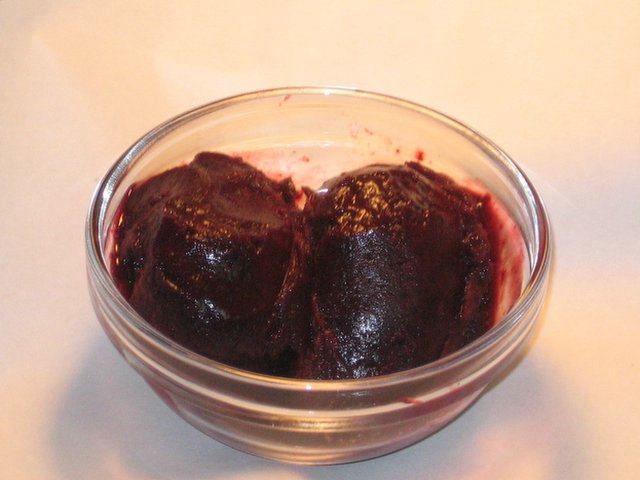
Monday, February 27, 2006

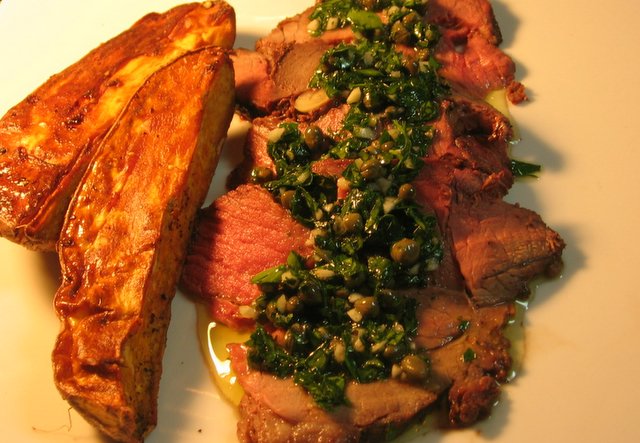
Roast beef with caper/parsley sauce.

Posted by Picasa When I can't think of what to make for Saturday supper, I always default to Chris Schlesinger. Chris is the chef behind the East Coast Grill, my favorite Cambridge restaurant. He likes his food with a tropical flair - he'll take ideas from anywhere, but his heart lies in the Caribbean and Latin America, which appeals strongly to my boyfriend. John's culinary imagination is fired by hot, exotic places, and Chris is his favorite chef.

Now, my own culinary imagination is geared toward colder climates.
I am, at heart, a New England cook, who was raised on Fannie Farmer gingerbread, baked beans and hotdogs, and cod on Fridays, with a little Julia Child for food-fantasy. Ultimately, I don't think cooks can completely overcome their roots, and when I try to cook, say, Asian food - well, it tastes okay, but you can tell the only Asian food I ate for the first eighteen years of my life came from the good people at LaChoy.(In case you haven't heard, they make Chinese "swing American.") When I browse through cookbooks, I tend to get excited by recipes from cold places - England, Russia, northern France.

But, the hot-climate cuisine that I feel the most comfortable with is definitely Caribbean. (Why? No idea, unless it has something to do with the old rum/sugar/slave trade routes bringing an Island influence on New England cooking. Certainly I used ginger, allspice, and clove, those staples of jerk seasoning, long before I had ever heard of tarragon or fenugreek or anise.) I also tend to like the bold flavors of Latin American food.

So, Saturday I had a top round roast that needed cooking, and I turned to Chris (or, more accurately, to his book How to Cook Meat.) This cut makes a decent, if not earth-shattering roast, so I wanted to spice it up a bit. What I liked about this recipe is that it was a Latin recipe (Argentinian, apparently) that reminded me of something from a colder climate. The sauce is simple, just parsley and capers with a little oil and vinegar. It wouldn't have seemed out of place on an Italian table or a British one, for that matter. But the roast itself was rubbed with cumin, as well as salt and lots of pepper, and the recommended side was roasted sweet potatoes, so there was definitely an exotic edge. It was delicious, and the prep took about twenty minutes total, plus cooking time (about 1.75 hours, though I left it in too long. I think I need to calibrate my thermometer.) Recommended.

Friday, February 24, 2006

The neglectful blogger

Hi, folks. I know I've been pretty negligent about new postings. It's hard to come up with interesting posts about food when you're eating out of the cafeteria for every meal.

It's true: the world's most militant bring-you-own-lunch-er has been eating at the cafeteria lunch and sometimes dinner every day this week.
Breakfast, too, though that's a regular thing. I like to have my breakfast when I get to work, so I do tend to buy a bagel downstairs. But lunch! And dinner!

This is what I'm learning about American food for quick consumption (I'm not eating fast food, precisely, but wraps and steam tray hot meals and salads and such) - there's more fat in this crap than in your fanciest, creamiest, butteriest French food. I had a turkey club the other day that had more bacon than turkey. It was also slathered in mayonnaise. I now understand why Americans are so damned obese. Egads.

I had a "mandarin chicken salad." I was expecting the crispy wontons. (Nods to Margaret Cho fans.) But I wasn't expecting the peanuts to be seemingly deep-fried. I wasn't expecting the chicken also to be battered and deep-fried. I wasn't expecting the dressing to drown the handful of lettuce leaves that were tossed in to convince people that this was really a "salad" and therefore really healthful.

Here's the most shameful part: I had some perfectly good meals in the freezer. I did. But every one of those meals was...soup. Now, I love a good soup. Soup is my warming, tasty, frugal kitchen friend. But sometimes, when faced with yet another meal of soup, I can be overcome by what I can only call despair. So, every day this week, I left the soup at home, optimistic that perhaps today's lunch would be better, somehow. It never was.

So this weekend, in my limited time between doing research in the library and writing papers at home (and cleaning the house), I've got to find a way to make really quick meals for the week that I will actually take to work. Any suggestions?

Tuesday, February 21, 2006

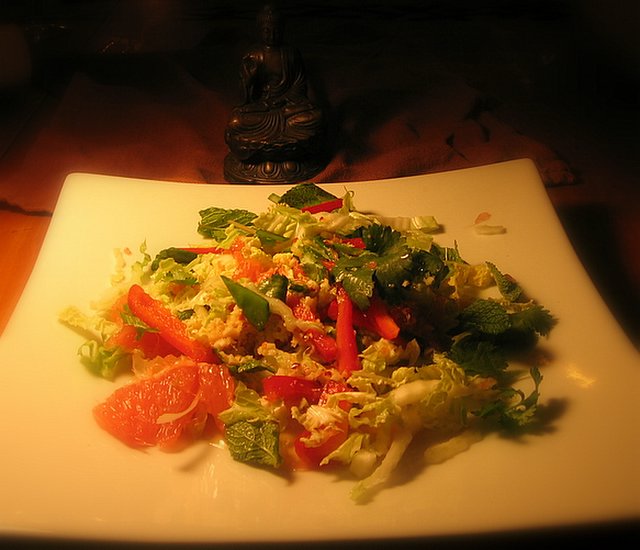
I used the plate. For Martha's Hot and Sour Salad

Okay, so it's not the MOST exciting use of the plate, but I used it! For food that was edible!

I actually liked this salad a lot, though the boyfriend thought it was too much work for something "not transcendent." This may be the first recipe I've ever used from Martha Stewart. I confess, blushingly, that I adore Martha Stewart. Maybe not Martha the gal, who is distinctly scary, but Martha the style-brand-concept. I love the look of her magazine; I love the food photos; I love how absolutely amazing the staff of MS Living can make the worst junk look. I'm sold on the whole deal. But it's just never occurred to me to make the recipes.

This is a salad from a recent issue. I gave it to the boyfriend because he loves salads, and salads with Asian flavors particularly. Also, I had to make it because the picture in the magazine showed the salad on a plain, square, white plate! Clearly, this was a sign. Anyway, the dressing was a bit bland, despite the presence of fish sauce, lime juice, and fresh ginger, so himself was disappointed. But I liked it even without the dressing, because the combination of grapefruit and mint is one of my favorites, and the crisp mildness of the Napa cabbage set those flavors off well. It stood up well, too. Left naked, it was nearly as fresh tasting Monday afternoon as it was Saturday night. Posted by Picasa

Sunday, February 12, 2006

I shouldn't have bought the plate.

I bought a nice plate. You see, I love my red-bandana-patterned plates, they're cheery and bright and my favorite color red-red-red, but unfortunately, they don't make the best food backdrop for pictures. They have too much presence. I had been wanting a new plate for some time now - just one, something plain, sleek and modern, for pictures. So I indulged myself with a nice oversized white square plate from China Fair, just the thing.

That's where things started going wrong.

You know how put pressure on yourself over little things, and suddenly you can't do stuff that you can usually do with your eyes shut. Like, um, cook? This weekend consisted of one cooking failure after another, and I blame the damned plate.

Saturday night I decided to make a dish from Chris Schlesinger, the wonderfully talented chef from the East Coast Grill in Cambridge. He's my boyfriend's favorite chef, so I figured I would make something special for pre-Valentine's (Valentine's Day itself I will spend sitting in a deeply boring reference class, thank you very much). I had a lamb shoulder roast in the freezer, so I chose a recipe for - get ready - Mustard-Crusted Roasted Lamb Shoulder in a Rosemary Jus with Tomato Ginger Confit. Now, that's a fab-sounding dish, don't you think? Me, too. I put aside my principles about out-of season tomatoes (California-grown, what isn't this time of year) and made the confit, which consists of chopped onions, minced fresh ginger, and whole cherry tomatoes, roasted in the oven until the onions start to caramelize, then the whole mix combined with brown sugar and lemon juice (I subbed lime). That was perfect.

I also roasted the shoulder in the mustard crust, and made the jus, which included balsamic vinegar and red wine as well as the rosemary and pan drippings, and that jus was also fab.

But the roast....There was something wrong with the roast. I had been a little skeptical about roasting a shoulder anyway, thinking it would be tough. But I trusted Chris, who has never before led me astray. And the meat was good, really good, tender and deeply flavored from the mustard/salt/white pepper coating.

But there was barely enough meat on the 4 pound shoulder for two people.

I had bought this lamb from the same farmer who had sold me a couple lambs last year. She was very nice, but a bit flakey. Unlike the beef man and the pork guy, the lamb lady (as we call her), never seemed to have it together. She forgot about parts of order; her whole lamb seemed to be missing some parts and have extras of others. And I think her butcher was drunk.

Maybe it's me. I've never made a lamb shoulder roast before. But this was the weirdest roast I've ever seen. It was all bones and cartilage and fat. There were ribs and what must have been the upper part of the leg bone and whatever the sheep equivalent to the scapula is. Between the bones there was a tiny amount of meat. Cutting it into presentable slices was impossible. We hacked at the meat and finally resorted to tearing with our fingers. I was very unhappy, because the sauce and the confit and the flavor of the meat were all fantastic. But the roast itself was a mess.

Sunday. Determined to salvage the dinner, I put the leftover bones in the pot to make stock. I then thaw some lamb stew meat, slice some onions, cut up a few potatoes. I sauteed the onions, removed them, and browned the stew meat, but again I was a little horrified by my meat. This stew meat is more than half fat. It had also been cut into chunks of greatly varying size - hacked, really. I put the onions back in, poured over the lamb stock and the remains of last night's jus, plus a little wine, and simmered away, adding the potatoes after the meat had cooked a while and finished with rosemary and black pepper. The stew was okay, nice and flavorful, but really, really fatty. I decided that I'm finding a new source of pastured lamb.

Okay, that should have been enough. But I had to go and make chocolate mousse.

Now, I consider mousse a personal speciality. I've made mousse without a recipe, just estimating the eggs and chocolate and so on, and had great results. Maybe I should have stuck to the estimation method. But no, I had to try a new recipe, from Francois Payard.

The recipe is probably fine. I just should never have 1) tried it while grumpy and tired and 2) cut it in half. Rule of thumb - don't cut a recipe in half if it calls for sugar syrup. There is no way to get your syrup to a precise temperature if there's only 1/2 inch of the stuff at the bottom of the pot. I burned the sugar. I started again. Meanwhile, I had taken the melted chocolate off the hot water, because I need the smallest pot for the syrup, so the chocolate was getting colder and colder. When I mixed the chocolate into the eggs, the whole business stiffened up, and I was left with all sorts of textural problems when I tried to fold in the whipped cream. Frankly, the whole thing was a waste of good chocolate, though we ate it, because unless actual burning is involved, anything made with chocolate and whipped cream can only be so bad. (The boyfriend called it "tapioca mousse" and proclaimed it delicious.)

So no pictures. Blame the plate.

Friday, February 10, 2006

Growing season

Growing season has begun, at least for those people who live in somewhat warmer climates or have cold frames or greenhouses. I remember that having a garden made the winter so much more bearable. There were decisions to be made and plans to make, and you could just feel the crocuses and snowdrops underground, waiting for showtime. My current apartment doesn't have access to a yard nor a porch nor even a fire escape. Winter seems very, very long.

So I press my nose up against the computer screen and look with yearning at the pictures posted by everyone who is planting seeds. I have just one thing to say: don't tell me to keep a a pot of herbs on my windowsill. I hear that a lot: "If you can't have a garden, you can always have a pot of herbs on your windowsill!" No, you can't. Not if you have cats who destroy plants with a patented combo-method of eating and knocking over. Not if your south-facing windows are under a tree. I've killed enough pots of rosemary for one lifetime, don't encourage more carnage.

Monday, February 06, 2006

Cacciatore, marengo, and polynesian

I was making a chicken dish the other, just pulling together what I had on hand: some mushrooms, a little celery, a can of tomatoes, some wine, onions. I browned the chicken pieces, then remove them from the fat, sauteed the vegetables, added the chicken back, plus the wine and tomatoes, covered and cooked slowly. I was halfway through the dish before I realized I was making chicken cacciatore.

Party dishes in the seventies usually meant chicken, browned in oil, then cooked in some sort of liquid (unless, of course, you want to stuff the chicken). The variations were endless, of course. Want to be all Polynesian? Use pineapple juice. Italian? Tomatoes, of course. French? White wine and mushrooms. Hungarian? Tomatoes, paprika, and finish with sour cream. You get the idea.

The pineapple juice was canned. So were the tomatoes, which was reasonable. So were the mushrooms, which was not. The cut-rate ingredients, along with complete disregard for authenticity in the naming, sent these dishes into disrepute in the eighties. It was with some abashedness that I told my boyfriend I had made chicken cacciatore for dinner, even though chicken cacciatore is apparently a perfectly legitimate Italian dish. (I don't think you can say the same for Chicken Polynesian). Cacciatore apparently means hunter's style. Maybe the hunters were finding mushrooms while they were out hunting. I don't know.

Anyway, I shouldn't have worried. My boyfriend was raised in an anthroposophist community in England: he has no sense of this sort of American suburban cooking or the snobberies around it.

Besides, there's nothing shameful about chicken cacciatore or marengo or mexicaine, except in certain cases the names. The method of cooking is simple fricasee, the ingredient list is flexible, and the results are usually pretty good. A little retro action never hurt anybody. Just skip the canned mushrooms.

(By the way, how the heck do I do accents? It's making me crazy.)

Monday, January 30, 2006

Nice butt.


Helen over at Beyond Salmon made herself some pork butt recently, and seeing her picture made me start obsessing about pork. You see,
I had used up the last of my Tamworth about two months ago. What to do? First, I called my favorite pig farmer, Jeffrey from Mamashoe World Headquarters. God bless him, he was willing not only to sell me a whole bunch of pig at the "whole pig" price, but he was willing to drop it off in the city. Now I only had to wait a few days for my pork.

So of course I broke down and went to Whole Foods. How could I wait a few days?

The pork above is organic, but not pastured. There's definitely a difference. This pork was good, but the fat was not edible on its own. I can't even tell you how good the pastured Tamworth pig fat is. I probably shouldn't be confessing publicly that I eat the fatty bits all by themselves, but if you only knew how good they were, you would understand. Still, this pork was pretty good, mostly because it's hard to go wrong with a Boston Butt.

My favorite cut of pork is probably the shoulder, which has the deep flavor of the butt, but without quite the fat. The butt's pretty good, though a bit fatty if you can't cook it slow and low over an open flame. The loin is useless, at least if you're buying at the grocery store.

At the end of my college-vegetarian period, I started cooking meat for the first time, and I was confused about pork roasts. I kept going to the store and asking for the best pork roast. Of course, I was given the loin, and I could never understand why it didn't taste like the roasts my grandmother used to make. Turns out that the "best" in American standards means the blandest meat, like the breasts of turkey and chicken. Once I figured out shoulders, butts and fresh hams, I was in business.

I cooked the butt above using a variation of a recipe from Please to the Table. Of course, the original recipe is for goose, and the "stuffing" it is roasted on includes green cabbage and apple cider. I used pork, no cabbage, and beer, but I retained the paprika/caraway rub and the mix of sauerkraut, prunes, and apples. This is peasant food, anyway - it will hold up to endless variation. Which is good, because soon I'll have a couple shoulders and a couple butts to play with... Posted by Picasa

NO NAIS

Lately it seems like I've been having conversations with everyone I know about NAIS, the crazy-stupid animal tracking system the USDA is planning to make mandatory, at the expense of small farmers and the people who love them. Now Walter Jeffries has written to let me know that he has started a blog exclusively devoted to following the NAIS debate: NoNAIS.org. (Guess you know where Walter stands on the issue, huh?

Sorry to be so long away from posting. I have a few posts-in-progress, so I won't be quiet for long.

Wednesday, January 25, 2006

Alarming statistics. And leftovers.

I read a rather alarming statistic yesterday that the average American throws out 25% of the food s/he purchases. I find that deeply upsetting. I hate to waste food. But I'm wondering exactly what people are throwing away. I've placed a moratorium on the purchase of bean sprouts, because I never eat them before the rot. I also throw out herbs a lot (the last third of a bunch of parsley), single lemons or limes, bread ends that mold before I get a chance to turn them into crumbs, and milk and cream.
That's about it. I eat my leftovers, and usually manage to use up vegetables in time.

But I do know people who can't stand the thought of leftovers and never manage to eat them. I also know people who decide they are going to save money by cooking, buy a bunch of food, get overwhelmed, then toss it all. But 25% still seems high, particularly given our pre-packaged, single-portion-sized world.

Monday, January 23, 2006

Guide to shopping for organics

Consumer Reports has published a very useful little guide to buying organic. Realistically, very few people can afford to buy organic food all the time. So it makes sense to get the most out of your organic dollars. My rule has always been to prioritize meat and dairy, as the concentration of pesticides in animal food is greater than that in vegetable foods, and hormones and antibiotics are a concern as well. After shelling out the money for the milk and the meat and the eggs, I look for organic strawberries, bananas, apples, and peppers, as these crops tend to be heavily pesticide-laden when grown conventionally.*

Consumer Reports seems to have reached the same conclusion. The only point on which we disagree is corn. Consumer Reports is only concerned with the health consequences for the, well, consumer, not for the environment. Corn may not hold its pesticides, but those perfect ears were sprayed to within an inch of their lives. If you are concerned about the environment, buy organic corn.

I was particularly impressed to see a big mainstream publication like Consumer Reports recommend farms shares, farmers' markets, and farm-direct mail-order. A good sign, I think.

To read the guide, click here.

*I hate the term "conventionally-grown." "Conventional" manages to imply that growth hormones and pesticides are in some way more normal, more "traditional" than those crazy, wacky organic farming methods - you know, the ones that have been around since man developed agricultural? I want to see a new name, like "Chemically-dependent."

Thursday, January 19, 2006

Obsessed with agricultural issues

You know you're getting obsessed with agricultural issues when you're watching the early part of Brokeback Mountain and thinking: "Now, that's how sheep should be raised! On open pasture!"

Wednesday, January 18, 2006

Unphotogenic soups.

I have actually been cooking quite a bit lately, though I've only been posting about things peripherally related to cooking. I realized why, just last night. I make unphotogenic soups. I don't know why, but the photos look terrible, even though the soups look fine. I don't want to post the pictures, so I don't post about soup. And soup is pretty much what I've been making this winter.

When I was in college, I made "kitchen sink" soup all the time - vegetarian broth, a can of tomatoes, and the odds and ends in the fridge, usually beans, pasta and bits of vegetables. These soups were frugal, nutritious, and ultimately a relief to stop making. Through my post-college years, I made soup less and less, until just a few soups formed my repertoire. I made carrot-ginger, minted pea, and lentil soups, corn chowder, and that was all. Even giving up vegetarianism didn't expand my interest in soups. I just added some sausage to my lentil soup, some bacon to my corn chowder and called it a day.

I had not yet discovered the secret of stock.

I had been a vegetarian for quite a long time, you see, and I still thought that the chicken broth from the supermarket was the same thing as chicken stock. So, when I would occasionally make a soup, the results were fine, but not exciting. In order to make a soup that really tasted like something, I need cream to round out the mouthfeel. Of course, what I really needed was gelatin; I just didn't know it.

There was no eureka moment. I don't remember the first stock I made. I'm sure it happened after I started dating my boyfriend, who loves roast chicken, something I never really made before. Roast chicken leaves carcasses, and I hate to waste. At some point, I started to look for organic chicken backs on sale at Whole Foods, so that I could keep up with my stock consumption without having to roast a chicken every week. Vegetable scraps gained a special spot in the freezer. And of course, when I started buying beef directly from the farmer, I received free boxes of bones, and I became accustomed to have rich beef stock in my freezer.

Now I make soup almost every week, and I wonder how I spent all those years without it. I had somehow forgotten how much I like comfortable, homey feeling of soup on the stove. In the past month or so, I've made Julia Child's French onion soup, potato-cheddar soup, garlic/lemon soup with poached eggs, and a kale-tortellini soup. Since every one was begun with a stock of bones and scraps, these soups, in addition to being flavorful and nutritious, have given me that virtuous sense of having made something from nothing, a rare and satisfying feeling indeed.

I just wish I could photograph them.

Tuesday, January 17, 2006

Stupidest product ever.

Yes, those are pre-measured little packages of spices. For $5.50, which is outrageous. But what makes this product particularly bizarre is the recipe on the back which you are supposed to use the spices to make. It's pretty complicated. You need garlic, onions, chiles, fresh ginger, chicken, and so on. So this product is design for whom, exactly? People who like to cook, but are afraid of measuring spices? People who are fairly comfortable in the kitchen, but only intend to cook once this year and so don't want to bother having a jar of cumin around? Clearly people with lots of money to throw around, and who are willing to buy into the message that home cooking is really hard....

The Kitchen Guru spice pack is in the running for the "Frozen Peanut Butter and Jelly Sandwiches Memorial Useless Product Award of 2006." Posted by Picasa

Monday, January 16, 2006

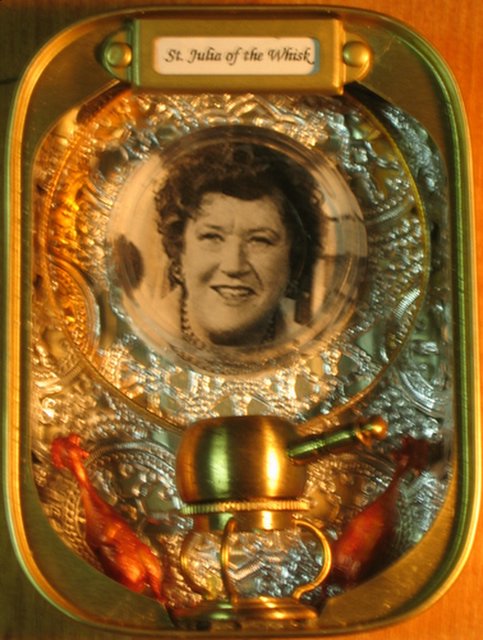
I love Julia

This is a piece of kitsch for my kitchen, the first in what I plan will be a series of icons I'm calling "The Culinary Communion of Saints." (Pardon me, dear, your upbringing is showing...) Julia, of course, has to come first.

Almost no one has anything bad to say about Julia Child. (Except the Curmudgeon, and his argument is based on the law of intended consequences, not really on any failing of Julia personally.) Some argue that she is given perhaps a bit more credit than she is due, given that other chefs and writers had promoted French cooking before her. But generally the others wrote for serious home cooks and restaurant chefs. Only Julia reached young girls growing up in suburbia.

I watched Julia on rainy or cold Saturday afternoons, when television choices were limited to golf, the Creature Double Feature, and PBS cooking and woodworking shows. Julia was always my favorite; she was always everyone's favorite. After her death, the tributes spoke of her casual style, the famous mistakes, her charming willingness to try anything, her excitement in learning. She was a great cook and an even greater teacher. Many American cooks point to her as the major culinary influence in their lives, the person who open their horizons, told them that more was possible in home cooking than they had ever dreamed.

I certainly absorbed a lot of culinary information from watching her shows, and her can-do attitude was infectious. But as a ten-year-old girl in the suburbs, I wasn't attempting French cooking. Julia was very forgiving about ingredients, but the margarine and Wonder bread I had access to wouldn't suffice. When I cooked, I used the Fannie Farmer cookbook and made simple cakes and quick breads.

But Julia was still a role model for me. Not as a cook, but as a woman.

That may seem a strange thing to say, but it's true. You see, my Irish/Scottish, New-England-by-way-of-Canada, Catholic environment was a little, shall we say, repressive? Sensuality was frowned upon in almost all forms. I remember clearly the scorn with which my parents, and my mother in particular, held perfume, makeup, baths, incense, even things like brightly painted walls,
"fancy" food, the most innocent pleasures of the flesh. They had the Madonna/whore thing going in a big way. Good women were like my mother and her friends: overweight mothers, in printed loose dresses, who didn't dye their hair or wear makeup or drink. Almost all were nurses or teachers (a few had become real estate brokers), and almost all had stopped working permanently when their children were small. Their world was small, and they distrusted those whose worlds were not.

Like Hollywood women. I know it sound like a cliche, but cliches exist for a reason. I had an aunt who had committed two major sins: she had left New England to move to L.A., and she had had no children. My mother always talked disdainfully about my aunt's love of glamour, so I always assumed she was a great beauty, an Elizabeth Taylor or Rita Hayworth. I was stunned when I finally met her, a regular middle-aged woman, just in heels and lipstick.

So in my world, there were two ways to be a woman. You could be a mom, or you could be Elizabeth Taylor. The second was more appealing, but dangerous - you might risk your immortal soul. Also, it seemed to have some serious entrance requirements. Only the beautiful need apply, and even by the age of ten, a girl knows if she's likely to be beautiful. I was not.

But Julia! She fit no categories. She was no beauty, that was certain. She was big, not fat, but oversized, tall and broad. So where did she get that self-confidence? She had charm; she had wit. She had lived in France, which was of course the pinnacle of sophistication. She was married, to a photographer no less, one who worked with her on projects that were hers first. She wasn't a mother. She had a job, a really cool job. She wrote books and was on television.

And she was a sensualist.

It was obvious, the intense pleasure she took in food. She closed her eyes when she tasted a particularly delicious dish. She inhaled aromas. She drank wine. She patted chickens affectionately like she was patting her lover's bottom. She flirted with the camera. Once, when asked the secret of a long-lasting marriage, she replied coyly, "The three Fs: food and flattery." I hadn't heard that quote when I was ten, and I wouldn't have know what the heck she was talking about anyway, but it doesn't matter. What came through loud and clear was that this woman was utterly comfortable in her own skin.

I wanted to be just like her. I remember making a list around that time of the things I hoped to do in life. Living in France and attending the Cordon Bleu was one of the first things on the list. So far, I've only spent a few weeks in France, but I did go to culinary school. I live in the city, just a few minutes' walk from where Julia herself lived, and I take pleasure in good food and wine every day. I think Julia would approve. I will always be grateful to her.

Bon appetit. Posted by Picasa

Thursday, January 12, 2006

"Health" food

I love the voyeuristic pleasure of peeking at other's people's shopping carts in grocery stores: the families stocking up on Coke, potato chips and cold cuts on a big game day, the middle-aged men with frozen dinners and canned beans, the dieters with their Lean Cuisine frozen dinners and Dove bars. Groceries are revealing.

What they often reveal is a depressing lack of understanding of nutrition or of interest in health. Everyone's seen the carts filled to the overflowing with processed meats, soda, sugar cereals and cookies. But this weekend I saw something I found just as sad, but much weirder.

The couple behind me in line were in their late twenties, slim and presumably healthy. They had a very full cart, and as they laid out the items on the conveyor belt, I was amazed to see every single one was something highly processed being marketed as health food.

Low-fat, no-sugar yogurt in cheesecake flavor. Hi-fiber cereals with "crunchy yogurt coating." (How does yogurt get crunchy? Forget it; I don't want to know.) Protein bars. Vitamin water. Low-fat frozen dinners. An entire cart of this stuff, and not a single vegetable or piece of fruit or meat, no grains or dried beans, nothing readily identifiable as food.

I can't believe this crap could possibly be good for people to consume. Sure, it's probably better than Cheez-Wiz and Vienna Fingers, but egads. I wanted to lean over and say, "You know what's low in fat, high in vitamins and fiber, and tastes really good? A carrot. Give it a try."

It depresses me that people who are clearly interested in eating nutritious food are still trapped into eating such highly processed, artificial junk. Is it the inability to cook? I know that many people are highly intimidated by the idea of the most basic kinds of cooking. Or is it just cultural, the tendency to see bright packages and cellophane wrap as symbols of sanitation and prosperity? I don't know. A little of both, probably.

On the positive side, I suppose I should look on these people as a potential market for real, fresh, healthful food. They are concerned about their food. Now we just have to convince them that fresh food, living food, with enzymes and vitamins and anti-oxidants and all intact, tastes better and provides better nutrition than all the crunchy yogurt cereals out there and isn't even that hard or time-consuming to prepare.

Tuesday, January 10, 2006

CSA links added

As you can see, I've added a nice long list of farms that offer CSA programs to the sidebar links. There are also some links to listings from various groups like NOFA (the Northeast Organic Farming Association) and the USDA, which can be helpful because not all farms have websites. Of course, most of these farms also have farmstands or sell at farmers' markets.

If you know a farm you would like me to add to the list, let me know.

Friday, January 06, 2006

It's CSA time

If you've been considering joining a CSA, now is the time. Most CSAs in New England start to accept payment in January and February. If you're lucky, there may still be spaces in some CSAs as late as June. But the popular programs, particularly the ones that have city drop-offs, can fill up early.

Just to review, CSA is an acronym that stand for Community-Supported Agriculture, and it's a way for farmers to market their products directly to the consumer. By paying in advance for a whole season's worth of food, you give the farmer money when s/he needs it most. In return, you get a box of food each week that is as fresh as can be.

Different CSAs have different structures. Some require that, in addition to the money you pay for the food, you volunteer some amount of time at the farm. Others don't have any sort of requirement. Some ask you to come to the farm to pick up your food; others have drop-off locations one night a week. Some have only large shares available; others offer the option of full or half-shares to make the program more manageable for small families and couples. Some may include some items, like strawberries, on a pick-your-own basis.

Different CSAs offer different products as well. Almost all include the basic vegetables, starting with salad and cooking greens in the early summer, then offering tomatoes, corn, zucchini, peppers and summer squash in high season, and finishing up with winter squashes and pumpkins. But some also include unusual vegetables, seasonal fruit, meat, dairy, and even flowers.
Some are organic, some IPM, others conventional.

It's worth doing a bit of research on your farm share, because it will provide a large portion of your food for about half the year.
It's a big investment, and not for everyone. Some things to consider:

1) Can you commit to picking up your box every week? You don't want to spend a lot of money on food you never manage to get.

2) Are you flexible with your cooking? You have to be willing to experiment with new vegetables or find new things to do on the fourth week of kale.

3) Do you eat a lot of produce? Most CSAs give a generous box of vegetables every week. There is nothing more depressing than a fridge full of rotting vegetables.

I have been very pleased with my CSA the last two years. I like the rhythm of getting my vegetables one the same day each week, planning my cooking for the same day, and so on. I liked the challenge of not choosing my produce. I like how fresh everything was. And I liked the sense of community I got by getting in line with the other CSA members, talking about what we got last week and what we made with it.

Alas, this year I don't think I'm going to be able to join a CSA. I am starting school at night and I don't know what night my classes will meet in the summer or fall. With a varying schedule, farmer's markets seem like a better choice. Fortunately, there are quite a few markets that are convenient for me, so I won't have any problem getting local vegetables.

I'm putting together a listing of New England CSA resources that I hope to add to the sidebar links soon, in case anyone is looking for a farm share to join. I can also recommend Parker Farms, the IPM farm I received my share from the last two years. No website, but you can call Steve Parker at 781 209-8644. He's a nice fellow, and there are drop-offs in Cambridge and Somerville.

Wednesday, January 04, 2006

Brussels sprouts


I don't understand why Brussels sprouts get such a bad rap. I love 'em.

I came to Brussels sprouts late in life, after I had gone to college. They retain for me an association with asparagus and artichokes - all delicious vegetables, a little exotic and very European, that grow in funny, distinctive ways very different from beans or lettuce. So it was quite a shock to find out that, unlike asparagus and artichokes, most Americans hate Brussels sprouts.

I can't imagine why, unless there's some sort of unspeakable frozen or canned Brussels sprout product lurking in other people's childhoods. Properly made, Brussels sprouts are tender, delicate, mild and a bit nutty. I prefer them steamed and then turned in a bit of butter, though you can reverse the fat/liquid exposure and braise them with great success. The picture above shows one of my favorite Brussels sprout dishes. After the sprouts are lightly steamed, I throw them in a pan with a knob of butter and walnuts. I cook them a bit longer, until I can begin to smell the walnuts, then I add a little maple syrup and cook just a bit more, to meld the syrup and the butter. Sprinkle with a little salt, and you've got either a very nice side dish or, if you happen to be single and able to get away with such idiosyncratic meals, dinner. Posted by Picasa

Friday, December 30, 2005

The best banana bread. Really.

I hate to talk trash, but my banana bread is the best in the world. Really. Now, you may be thinking, "Hey, MY banana bread is pretty damned good!" And I'm sure it is. It may be an excellent banana bread, but since mine is, objectively speaking, the best possible banana bread, it only stands to reason that all other banana breads are, tragically, inferior.

But have no fear! In the spirit of holiday generosity, I am willing to share my banana bread recipe with you, and then you too can brag safe in the knowledge that your claims are backed up with absolute, verifiable truth.

(This recipe is adapted from that at the joy of baking website.)

Banana Bread
1 3/4 cups all purpose flour
1/2 cup white sugar
1/4 cup dark brown sugar (I'm sure you could substitute wildly here, whatever combination of brown and white you've got. But this is what I use.)
1 tsp baking powder
1/4 tsp baking soda
1/2 tsp salt
1/2 tsp cinnamon
2 eggs lightly beaten
1 stick melted butter (cooled)
Between 1 1/2-1 3/4 cup ripe banana (Use as much as you've got. The riper the better. Rotten even. Wait until the flies circle.)
1 tsp vanilla extract

Optional items (Without them, I fear you might only end up with the second-best banana bread in the world. But if allergies or weird food prejudices prevent these additions, you can omit them. But you should really try the full monty.)
1/4 cup wheat germ
2/3 cup chopped dates
1 cup chopped and toasted walnuts or pecans
1/2 tsp Frontier natural walnut flavoring*

Mix together butter, banana, eggs, and extracts. (Do yourself a favor and just mix them in the saucepan you used to melt the butter.) Sift together the dry ingredients in a large bowl, then fold the wet ingredients in. Do not overmix. Add the dates and nuts when you can still see big streaks of flour, to avoid overmixing. Bake in a buttered loaf pan in a 350 degree oven until done, about an hour.

*I have no idea how "natural" Frontier Natural Walnut Flavoring is. It's probably walnut shells infused in petroleum, with maybe some ground walrus tusks. I don't know. I don't care. I love this stuff. It gives a subtle nutty flavoring throughout a bread or muffin or cookie. I add it to anything baked that includes nuts. If the company ever goes out of business, I will buy up a case. Posted by Picasa

Wednesday, December 28, 2005

More local food


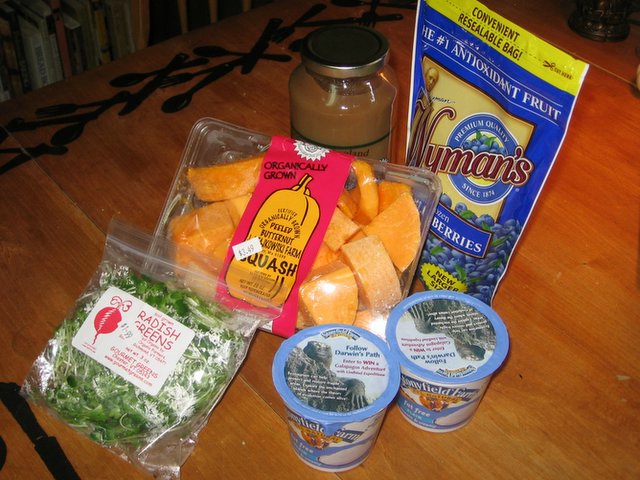
I decided to look around my local supermarket to see what I could find that was New England grown. Even in the dead of winter, I was able to find a few things: Wyman frozen wild blueberries, radish sprouts grown in Vermont, Stonyfield Farms yogurt, local applesauce, and even some butternut squash. I also could have bought local butter and milk, mushrooms grown in Connecticut, lots of local cheese, maple syrup and honey. I also know some supermarkets, though not this one, carry A-1 dried beans "State of Maine" label, which are Maine-grown. Not exactly enough to live on, but more than I expected. Posted by Picasa

Tuesday, December 27, 2005

I'm back

Hello, everyone. I'm back.

Where have I been? You might well ask; I haven't posted in almost two weeks. Unfortunately, I haven't been, say, on a trip to Paris. I've just been here, nursing a serious case of the holiday blues.

So the post of all the baking I did over Christmas? There won't be one. Because I didn't. For the first year in recent memory, I didn't bake cookies for my co-workers; I didn't make marmalade or jam for gift baskets; I didn't get together with my best friend to make candies; I didn't make a Yule log. I bowed out of Christmas this year. Partly because I have a touch of SAD. Partly because I'm starting school in a month and I'm nervous about it. Partly because I wasn't looking forward to this Christmas.

(Warning: what follows is deeply self-indulgent, rambling, disorganized, and probably dead-boring to anyone but me. Proceed at your own risk.)

My whole family got together for Thanksgiving: my sister from Albany with her husband and three kids, my brother from Montreal with his best buddy from college, my other single sister who lives near here, and my parents. There were two types of stuffing, the turkey of course, a multitude of vegetables, and a full dessert table. With the whole family there, it seemed worthwhile to spend days ahead prepping for the big event.

But my brother wasn't coming for Christmas, nor my married sister and her family. Christmas this year was my parents, my sister and me. My mom and her two spinster daughters. God help us all.

It was a small Christmas. But it wasn't just that that kept me from having the Christmas spirit.

I love my parents. But I don't exactly get along with them very well. We don't fight, but we aren't close either. So holidays that consist of just them and me and sis; well, they're not fun. We spend a lot of time skirting nervously any topics on which our differences of opinion might become obvious - politics, religion, culture, television, and, yes, since this is a food blog, I might as well talk about it: food.

Food is a much more loaded topic than we usually consider it to be. I mean, if you're stuck with a group of people you don't know, talking about food seems a pretty safe bet. You can talk to almost anyone about which are the best ice cream parlors in your city, or where to find great pizza, or what your family always has for Christmas Eve dinner.

But we define ourselves by what we eat, and we read meaning into other people's choices as well. When I bring my grass-fed organic beef to my parent's house to roast for Christmas dinner, I am bringing my own associations - connections to local farmers, traditional British Christmas feasts of roast and Yorkshire pudding, festive holiday indulgence in fine food. But I also carry associations I don't intend: snobbery, rejection of the turkey dinners of my childhood, prodigal extravagance. And when my mother puts her grocery-store whoopie pies on the dessert table, she intends to show indulgence, a bit of holiday frivolity, and what do I see? Transfats, preservatives, and a greasy mouthfeel.

We're not terrible people. We take each other's offering in the spirit in which it is intended: my mother praises the roast, I eat a Whoopie pie and reminisce about my brother's fondness for them when he was a child. But we notice the gap between us, the lack of connection where it seems like connection should be easiest, the effort we are each making shows, and it seems to sadden us both.

Simple matters of taste resound with significance, even when they shouldn't. If you don't believe, try a simple experiment. Ask someone what sort of person they would imagine would order the following flavors of ice cream: vanilla, dark chocolate, hazelnut, chai, Grapenuts. I'm guessing the answers will go something like this, depending on the respondents' own preferences : dependable (boring), sensual (dramatic, self-indulgent), sophisticated (pretentious), edgy (ostentatious), old-fashioned (old).

Now, these sort of judgments are the type of thing maturity should get us beyond. I can't tell anything about the sort of person you are from whether you prefer venison or chicken, and I'm not going to start ordering chai ice cream when I really want chocolate chip just so I won't feel boring. These differences are shallow, and food-lovers are the worst offenders when it comes to putting too much weight on them. Taste-preferences are meaningless.

But taste isn't the only way we define ourselves by food. There are also ethnic connections, restaurant vs. homecooked, fancy bakery versus supermarket, and so on. Most of these are as frivolous as ice-cream choices - people who love Italian food are not more in touch with their feelings than people who would rather corned beef and potatoes. But some differences do have more significance.

Organic food matters to me because I believe we are poisoning our planet with pesticides. Sustainable food matters to me because I believe that organic isn't enough to ensure a healthy environmental future. Local food matters to me because I believe it helps to support community, the environment and the local economy. Pastured meat matters to me because I believe it is morally wrong to confine animals for the whole of their lives and because I believe that grass-fed meat feeds our bodies better than grain-fed meat. These are moral beliefs, things that get to the core of what I care about: finding a healing way to live in a society that is, in my mind, very ill.

This point of view is so far from my parent's as to be completely alien.

I am not judging them in this. Their generation (they turn 70 this year) was not raised to think about consumer choices as moral choices. There is only one virtue they understand in regards to purchases, and that is frugality. Morality, to them, is primarily a question of being honest, being chaste if unmarried, and having faith. My parents are very good people - they give to the poor, my mother visits shut-ins, my father volunteers his services at a nursing home. I am in no way as generous with my time as they are. They do service work that I admire greatly. They would consider the idea of doing good by spending money on oneself to be absurdly frivolous.

And they would be right. I make no sacrifice in buying fantastic beef. I get enormous pleasure out of going to farmers' markets. I don't want to be the holier-than-thou Whole Foods customer: given the price of much organic food, being able to buy it is a sign of a financial security many can only dream of having.

And yet, and yet....I still believe that Big Agriculture, factory farms, and junk food harm not just the bodies, but the soul of my country. I have stopped trying to communicate this idea to my family; they can't help but understand my interest in these foods in terms they can understand, and unfortunately in those terms local, sustainably-grown food is simply overpriced, a personal indulgence that hints at fiscal irresponsibility (a sin mostly ignored in our credit-card-mad days, but one that is nonetheless at the heart of much misery in this world).

If this attitude were a personal quirk of my parents, this blog entry would simply be its own display of personal indulgence, just me trying to work out the issues between myself and my family in a public forum. And, um, well, it probably is just that. And I should probably be embarrassed. But I know that my parents are more like most Americans than I am. In many ways, this is the defining problem of the sustainable food movement: how do we convince people that sustainable agriculture is a necessity, not a luxury? I don't really know how.
Okay, I've come a long way from my Christmas blues. I don't want to leave anyone with the impression that my views on sustainable farming ruined my Christmas, because that would be completely skewed. But you start thinking about one thing, and it leads to another...As for the other issues...well, let's just say the War on Christmas found its way to our festivities this year, and there were representatives of both armies. Sigh.

Had enough of my personal issues? Good, me too.

The rib roast was fantastic, particularly the gravy, which I made from red wine, pan drippings, onions and roux. The Yorkshire pudding puffed less than usual (pan not hot enough?), but was still crisp on the outside and soft on the inside. I did make two batches of cookies: chewy walnut for my nut-loving mother, and snickerdoodles for my sister. The food was good. Even the Whoopie pies.

And now I'm home. I've got beef stock simmering on the stove, which soothes me to no end. Tomorrow, my boyfriend will get home form his mother's. We'll eat soup and salad and a pasta with nice ragu sauce. And I'll have lived through another Christmas. God bless us every one.

(I'll make yet another confession - I've gone back and forth on posting this for hours. I've got too much Anglo/Celtic blood to feel comfortable talking about personal things without the benefit of a few glasses of whiskey. But I'm trying to overcome my reticence. After all, how many entries about last night's dinner are you poor people supposed to take?)

Wednesday, December 14, 2005

Tongue Sandwich

Cooking the tongue was easy; so was peeling it. The outer skin came off in a stiff thick sheet, like pulling the wax off a wheel of cheddar. Inside, the tongue looked pink and vulnerable and, frankly, just as disturbing as it did when it was blue and bumpy.

My boyfriend and I tried it while it was still warm, and you can see that today I've got a tongue sandwich for lunch. The overall verdict was that it was pretty good. The texture is a bit tougher than I would like, ideally, but the flavor is good, like a cross between corned beef and liver. I can't imagine making a special search for it or anything, but it made a nice sandwich today, and I'm going to try making some hash with it tonight.

****************************

In response to some of the comments about local eating: I know that most people in the lcaol eating movement define "local"
as within 100 miles of your home, but I'm a bit more generous. I would say within about 300 miles. That's an easy day's drive, and in my case happens to roughly outline New England (with the exception of Northern Maine), so there are cultural reasons to define local that way as well. Like so many things, "local" and "non-local" are not two distinct categories, but a range. It's only sensible to choose truly local produce - no need to go more than a few towns over for me to get greens, strawberries, and tomatoes. But apples and cider, seafood and meat might require a bit longer drive, and grains might reasonably be considered "local" if they are grown in Northern Vermont rather than in the Midwest.

Considering that most food in the U.S. travels 1,500 miles before it hits the plate, 300 miles is pretty good.

Also, if I ever really were to do the local eating experiment, I would allow myself one exemption: a box of spices. I figure that given the relatively low weight/volume of a year's worth of spices and the enormous culinary advantages of the same, along with the fact that it would be impossible to grow vanilla, cinnamon, cardamom, nutmeg or black pepper in my area, spices are a reasonable exception to the local-eating rule. I would give myself no exemption for herbs, because those are easily available locally. And no exemption for chocolate, coffee, citrus, or liquor, tragically. All of which may keep me from ever actually taking on such a crazy project. But if you would like to read about some people who did, click here. Posted by Picasa

Tuesday, December 13, 2005

Yeah, it's kind of gross

That, my friends, is the tongue of a cow. It's in my refrigerator at this moment, where it has been for the past week, bathing in a brine of salt water, sugar and spices. Tonight, I will simmer it for 3 hours on the stovetop in water with onions and carrots and bay, and when it is cooked, I will skin it. And maybe then it won't look so goddamned nasty.

I've never cooked tongue before. Heck, I've never eaten tongue before (it's impossible to write about this without sounding obscene.) My boyfriend, who has, claims it taste a bit like ham, with the density of liver. We'll see. In the meantime, I'm amazed by how very creepy I find it.

Generally, I don't get bothered by foods. I can throw a calf-hoof into the braising liquid of my French-style pot roast without a qualm. Lobsters I murder without a twinge of conscience. I love slurping oysters. I yearn for a source for organic chicken feet to improve my stock.

But the tongue is different. First off, it looks so very much like our own tongues. So very like, but yet different - enormous, for one thing, and also a disconcerting dark gray/blue color, a color that would signal some sort of horrible illness if it were to appear in my tongue, or the dainty pink tongue of my cats. And there's so much of the base of the tongue to it, the clear severed connections where this tongue was removed from its mouth. (That reminds one of something most of us would rather not think about, that throughout history, cutting out the tongue has been a not-unheard-of torture, inflicted as punishment for heresy, among other things.)

I'm sure it will look better once it's cooked. It had better taste good. Posted by Picasa

Friday, December 09, 2005

Eating locally - some musings

It's officially winter now. The first real snow is coming down outside, and all I can think about is farm-fresh vegetables.

It's hard to eat locally in New England in December.

Hard, but not impossible. I've been thinking more and more about what it would take to eat completely locally for, say, one year. Various people in the eat-local movement have done this. Many of them are, admittedly, located in much warmer and more hospitable places, but some are not.

I don't think I can engage in this experiment quite yet, though I think I might at some points. I think anyone attempting this in New England would need the following things:

A deep freeze
A dehydrator
A "cool, dry place," aka, a root cellar
A car, for taking trips to farms

I have the first and could easily manage the second, but I don't have the third or fourth and likely won't for another two years or so. But with all four, I think it would be possible.

In the summer, of course, there would be no problem with vegetables and fruits. In the winter, I could still have root-cellared potatoes, sweet potatoes, parsnips, beets, carrot, cabbage, winter squash, celery, collards, apples and pears; frozen green beans, peas, corn, broccoli, blueberries and peaches; various pickles and relishes; and dried and canned tomatoes, assuming I start in the summer and plan ahead.

Local meat is easy to come by, of course, and local dairy is available at the regular grocery store. There are quite a few local producers of cider, which I prefer to beer, so that's no sacrifice. There are some local wines, though the quality of most is questionable. There are some providers of local mushrooms, or I could grow my own. There's even local sea salt.

Sugar would be a problem. I am sure it would be good for my health to replace all the white sugar in my diet with local honey and maple syrup, but it wouldn't be easy. I have been able to find no commerical growers of nuts in New England, so I couldn't even make maple walnut ice cream.

I haven't been able to hunt down many producers of local grains. Gray's Grist Mill grows and grinds Rhode Island flint corn, the proper basis for jonnycakes. Littleton Grist Mill stone-grinds organic grain, some of which comes from Vermont, but the rest supplied from South Dakota. There is a farmer in Aroostock County who is growing grain for a Maine bakery (interesting article here) who could perhaps be persuaded to sell some grain to an idealistic blogger, although Northern Maine is pushing the outer boundaries of "local."

Anyway, it would be an interesting project, but not really possible for me at the moment. Until it is, however, I intend to try to deepen my commitment to local food. Rather than just eating the food I normally would, but trying to find local versions, I want to make an effort to choose local foods whenever possible and plan my meals accordingly. So instead of picking up wine for dinner, I'll buy cider and enjoy what was once the most popular drink in New England. I'll try to use more maple syrup and honey and less white sugar. I'll buy smoked seafood as a treat, rather than pate. I'll order some of that cornmeal and eat more cornbread and less rolls.

Maybe I should make this an early New Year's resolution.

*****************************

Oh, and there are new links up for local farmers' markets, maple syrup, honey, and specialty food providers. I'm working on lists of farms and CSA programs, but obviously that's a much bigger project and is going to take a while.

Tuesday, December 06, 2005

More links

I'm going to be adding a whole bunch of new links to the sidebar. I've started today with the "Big Local Links," the most basically useful websites for finding local food sources. All are national, except for the Federation of Massachusetts Farmers' Markets. Next I hope to pull together a list of New England food providers, then a list of blogs on sustainable agriculture and the local food movement. If anyone can suggest any additions, let me know. Trying to achieve a diet of primarily locally and sustainably grown food is difficult; I believe we need all the resources we can get.

At some point I promise I will actually cook something interesting again and post about it. Really.

Monday, December 05, 2005

Christmas shopping

I am, thank goodness, all done with my shopping, but I've been researching local food providers for a post I'm intending to do in the next week or two, so I thought I would pass on some of the things I've found. I can't vouch for all of these producers from personal experience, but they look worthy of investigation:

http://www.shaker.lib.me.us/catalog.html
Shaker dried herbs and rose water

http://www.graysgristmill.com/ourproduct.htm
Rhode-Island-grown flint corn meal for jonnycakes

http://www.maineseasalt.com/
Real Maine sea salt: plain, smoked and herb

http://www.localharvest.org/member/M11971
Wild mushrooms from Maine

http://www.oystercreekmushroom.com/
More Maine mushrooms

http://www.seaveg.com/products.html
Maine Sea Vegetables

http://www.mainelysmokedsalmon.com/catalog.htm
Smoked salmon

http://www.westcountycider.com/
Hard cider - I've had some of this company's cider, and there are some good ones. Others I haven't liked as much. Depends on how sweet and how bubbly you like your cider.

http://www.bartlettwinery.com/wines.html
Blueberry wine – don’t knock it 'til you try it. I've had the oak dry, and it's really very good.

http://www.farnumhillciders.com/
More hard cider

http://www.ducktrap.com/catalog/default.php
Smoked Maine seafood (I can personally recommend this company)

http://www.vtcheese.com/vtcheese/companies.htm
A listing of Vermont cheesemakers

http://www.newenglandcheese.com/companies.html
A listing of New England cheesemakers

Local honey and maple syrup are widely available.

All of the above are New-England-made and New-England-grown. There are also lots of New-England-made food products created from ingredients that are grown elsewhere (like sugar).

You might also consider buying gifts that allow people to grow or make their own food. I've bought one friend a mushroom-growing kit from Fungi Perfecti, and my boyfriend will be getting a kit for making beer at home.

Thursday, December 01, 2005

Indian pudding

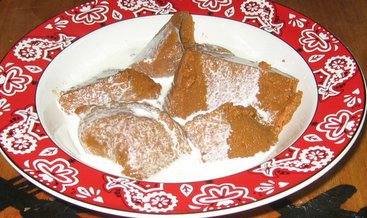
This week I've had a rather nasty sore throat. I've been craving hot oatmeal, scrambled eggs, herb teas - anything hot that will slide on down soothingly. So, for the first time ever, I bought a can of Indian pudding.

My sole experience with Indian pudding came when i was around nine or ten. My family had gone to Durgin Park for dinner, so it must have been some sort of important occasion. Not that Durgin Park is particularly fancy, just that there were four children in my family, so restaurants with non-plastic utensils were reserved for events.

For those of you who don't know, Durgin Park is an old New England institution, renowned for its rude waitresses and its Yankee specialities like clam chowder and Indian pudding.

I was the sort of child who considered everything old-fashioned to be vaguely romantic, so I ordered Indian pudding for dessert. My mother warned me that I might not like it, but I was convinced it had to be good - how bad could dessert be? And it was some sort of pudding, for Pete's sake! Oh, how wrong I was.

Indian pudding is cornmeal mush flavored with molasses and gingerbread spices. I had basically ordered polenta for dessert, and my young suburban tastebuds were in no way prepared for that concept. I was horrified and barely touched my pudding.

I figured enough years had passed that I might have come around on the Indian pudding thing, and I was right. I can't imagine eating it cold, but warmed up, with a little cold cream poured over, it was a nice treat. It was also locally-made, though I doubt that any of the ingredients were locally-grown. All of the ingredients were also recognizable as food - essentially cornmeal, molasses, spices, milk - which is always a plus. Posted by Picasa

Posted by Picasa

Monday, November 28, 2005

Thanksgiving

Chocolate cake with coffee buttercream and marzipan leaves - one of the Thanksgiving dishes that actually came out just fine.

Should I talk about the ones that didn't? Let's face it: the failures are more amusing than the successes. This year, I had a little of both. My little onions, braised in butter and homemade chicken stock, were great. The carrots were cooked to perfections and nicely glazed with brown sugar and butter. No complaints about the roasted sweet potatoes with fresh rosemary. Leaf-shaped butter cookies, flavored with a little orange and coated in cinnamon sugar, were a success. My brother-in-law rated my pear crumble pie a 9, maybe a 10. And the chocolate cake was good, if a little denser than usual. (I make this cake, the epicurious Chocolate Stout Cake recipe, often.)

But I also made a few missteps. The cornbread stuffing was drier than it should have been. Some of the vegetables were a bit cold on serving (I don't know how to handle this without breaking down and buying a food warmer tray). My sweet potato/pecan pie bubbled up and over and made a mess of the floor of the oven, as well as dripping all sorts of stickiness under the crust, making for very messy serving. And then there was the pumpkin cheesecake.

I've made quite a few pumpkin cheesecakes and never had a problem. I made this one last weekend, and it looked just fine. I froze it, then thawed it on Thanksgiving day. And in the thawing lay the problem.

My cheesecake started to give off water.

It was all unmolded on a nice glass cake plate with a lipped edge, and thank goodness for that lip, because otherwise there would have been dripping onto the tablecloth and I had already gotten in trouble by getting chocolate on my mother's tablecloth. I used a paper towel to sop up the liquid, assumed it was just some condensation of some kind, and went about my business.

A half-hour later, there had to have been 1/4 cup of liquid around the base of that cake, making my nice gingersnap crust a soggy mess.

I couldn't understand it, but I had a theory, a theory I hate to admit on a blog devoted to organic, local ingredients. I hadn't used the hallowed One-Pie can of pumpkin. Instead, I had used an organic canned pumpkin. (I knew better than to use real pumpkin, which even when roasted and drained is too watery for most baking). I had noticed upon taking the pumpking frmo the can that it seemed a little lighter in texture and color than I was used to. This morning, I confirmed with a co-worker, whose wife had had the same problem with organic pumpkin in a pie. I am left in the unfortunate position of having to make a recommendation to AVOID organic pumpkin, at least for custards.

What a world. Posted by Picasa

Tuesday, November 22, 2005

Thanksgiving prep


(Note the newly broken whip? Just in time for the holidays. Grr.)

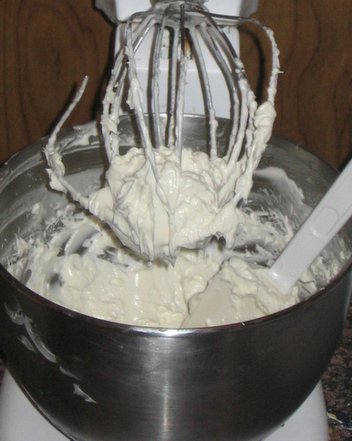
Last night I hauled home piles of groceries from the store, baked cornbread and tore up white bread for stuffing, made cranberry sauce, cooked sweet potatoes for pie, gathered my recipes, and made buttercream for a chocolate cake.

I have vague ideas about a book I would like to write one day called "French Pastries in Ten Recipes." Basically, there aren't that many things you need to know how to do to make most traditional pastries. You just have to learn the basic recipes and then combine and flavor them in different ways. And one of the basics is buttercream.

A lot of people are intimidated by buttercream, and I'm not sure why. There's a common idea that it is fussy and requires a candy thermometer and an advanced degree and possible a sacrifice to St. Honore or something. Not true. Not true at all.

At the bakery where I once worked, we made buttercream by putting all the ingredients in the big mixer, lighting a few Sternos under the bowl to warm it all up, and letting 'er rip. It always came out just fine.

Here's my buttercream recipe:
4 large egg whites (if you use extra large, you might need a touch more butter)
1 cup sugar
3.5 sticks unsalted butter, room temp
Put the egg whites and sugar in a bowl over some simmering water. Whisk until the mixture is warm and the sugar is dissolved. Remove from the heat, and whip (preferably with a machine of some kind) until cool. Add in the butter in chunks, and whip until thoroughly combined. If it seems a little stiff, warm it a bit and whip some more. Medium on a stand mixer is best; high will give you some big air bubbles, which only matters if you're doing smallish piping. If it seems a little melty, put it in the fridge, let it cool a bit, then whip again. Buttercream will always come together eventually, it just has to be the right temperature (just a bit higher that room temp is good.) If you make ahead, you will need to warm it a bit and rewhip for the best texture.

You can flavor this basic buttercream any which way. I'm planning on adding melted bittersweet chocolate and a little instant coffee dissolved in a tablespoon of Kalhua to this batch. (If I were making this for adults only, I would use bitter chocolate, but bittersweet will yield a more child-friendly result.) As long as you stay under two tablespoons of liquid, you're fine. Extracts, purees, concentrates, liqueurs - add what you like. One of my best buttercreams included nearly a cup of dried apricots, made soft with a soak in rum and simple syrup, then pureed.

Tonight I'll make the cake. Posted by Picasa

Monday, November 21, 2005

The Things I Carry

Cooking at someone else's house is a royal pain in the neck. There are always things you assume everyone has, but you're wrong. Like a whisk. Or Saran Wrap. How can a regular suburban American family not have plastic wrap in the house? It seems impossible, but last Thanksgiving, my parents didn't have plastic wrap OR aluminum foil.

So I'm busy making my list of stuff to bring with me to my parents' house for Thanksgiving. Mom and Dad will do most of the shopping, and I'll do most of the cooking there, though I'll bring some things with me on Wednesday. In addition to the finished items I'll drag out there (pumpkin cheesecake, already made and in the freezer, cranberry sauce, two pies, cookies, a chocolate cake and cornbread stuffing), I will bring with me:

  • Butter
  • Lemons
  • A pastry bag fitted with a large star tip, for whipped cream
  • My good chef's knife, even if I do need to get it sharpened
  • A pepper grinder filled to the top with Penzey's Tellicherry peppercorns
  • Good olive oil
  • Garlic
Since it's almost impossible to make even the most basic items with the above, I pretty much always bring them with me anywhere I'm expecting to cook: other people's houses, vacations, etc. (Okay, the pastry bag isn't strictly necessary, but for Thanksgiving it is.) I'm curious as to what other people consider necessities. I wonder how one starts a meme? Can I tag mzn of Haverchuk and Helen of Beyond Salmon? Would that start an internet phenomenon? Or would it simply fizzle sadly in a wave of indifference? We'll see: here goes.....

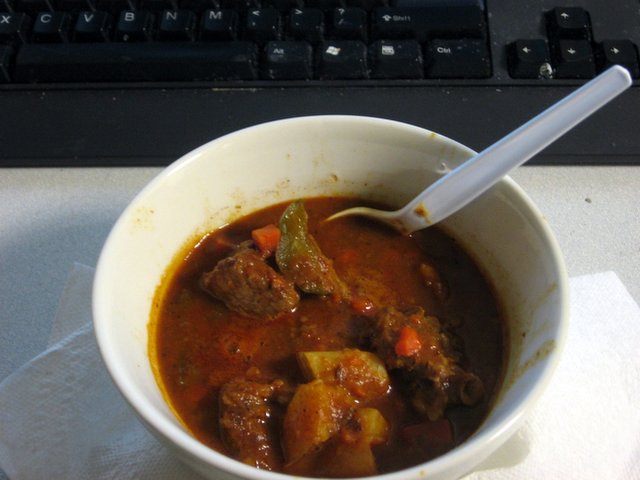
Leftovers lunch - spicy beef stew


Mzn told me to post pictures of leftovers, so here's today's lunch. I made Paul Prudhomme's spicy beef stew this weekend. Only half the cayenne he calls for, but still nicely hot. The unusual thing about this recipe is that there are no onions. Whoever heard of a beef stew without onions? It works, though. As usual with Prudhomme recipes, there are lots of spices. The big double recipe I made used a whole bowlful of spices: ground mustard, cayenne, white and black peppers, caraway, paprika, onion and garlic powders (kept in the house only for Prudhomme recipes) and so on. As is not usual with Prudhomme recipes, there are actually quite a lot of vegetables, though it doesn't look that way in the picture. Half of the vegetables were pureed to thicken the broth. That is a technique that can sometimes result in a vegetal flavor, and I was a bit worried about the effect of the green pepper, but the spices were strong enough to cover any problems. Recommended. (Recipe from Fiery Foods That I Love.) Posted by Picasa

Friday, November 18, 2005

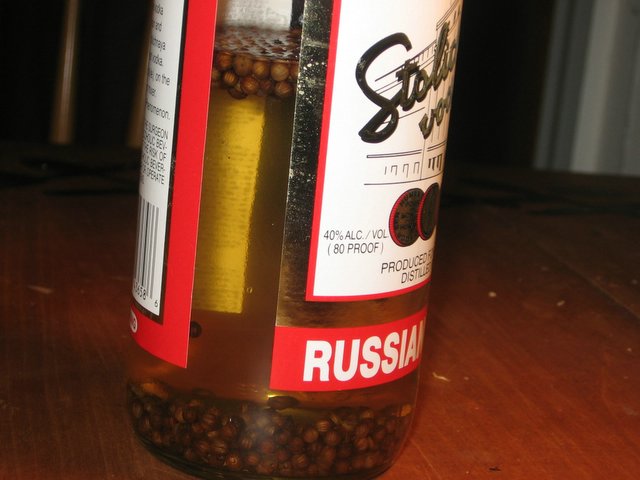
Coriander vodka, getting ready for its close-up

Posted by Picasa
I actually had one more picture. That's it.

Dinner Party Post-Mortem

Okay, take two.

The overall dinner party situation:
Myself, my boyfriend, two of my co-workers and respective significant other/spouse, a high-school friend of mine, a grade school friend of my boyfriend, two Siamese cats and not nearly enough chairs. The kitchen table smooshed up against my painting table, both of which had been dragged into the center of the living room, which had been emptied of whatever furniture I could push into the alcove. I dream of a dining room like some people dream of yachts. I’ve even picked out the paint and had prints framed for this non-existent dining room. I’m not kidding.

The menu:
Caraway and coriander-flavored vodkas (homemade)
Purchased pate and salmon spread, with crackers
Marinated mushrooms

Meatballs in pomegranate sauce

Green salad with mustard vinaigrette

2 roasted chickens rubbed with smoked paprika and caraway seeds
Sauerkraut/cabbage/prune dressing
Roasted potatoes
Red peppers paprikash
Cranberry-horseradish relish
Bread

Cheese/sour cherry strudel
Coffee
Nuts, cheese, pomegranates

The planning:
Vodkas, mushrooms, relish made early in the week. Here’s a picture of the coriander vodka, doing its thing:

The meatballs were mixed and rolled but not cooked the day before. (And a good thing, too – the leftovers were good, but s little squishy.) The dressing was made the day before and just needed cooking off. The red peppers were made the day before and just required heating up. The potatoes were boiled the day before and roasted that day. The strudel was baked the afternoon of the party. The chicken was roasted just before dinner.

The results:
The big winners were the mushrooms, the meatballs and the strudel.

The chickens were good, but I think could have been a bit better. I brined the birds on Thursday, and I think the brining did help keep the flesh moist and flavorful. But I think some of the salt wasn’t properly dissolved, because the tips of the breasts, which were sitting at the bottom of the brining bowl, were too salty. They must have sat in a pool of salt. The rest of the meat was fine, so no worries, just need to make sure all the salt is dissolved next time.

After 24 hours in the salt brine, I rinse and towel-dried the birds, and then I did something I had never done before: I air-dried them. Just put them on a rack in the fridge for 36, bare naked. This was supposed to give a particularly crisp skin, and the skin was very good, but when it came time to rub the chickens with the spices, the spices wouldn’t stick to the dry skin. Which is perfectly logical and follows the basic rules of nature, but never occurred to me. Do people spice first? Or do they just do what I did and cheat with a little oil? At any rate, I got the spices on there: 1 teaspoon of smoked Spanish paprika from Penzey’s, 1 teaspoon of Hungarian sweet paprika, and 1 teaspoon of caraway seeds per bird. The spice coating didn’t look as uniform as it normally would on a moist-skinned chicken. But I was serving the birds carved, so that wasn’t much of an issue. I roasted at 425. I would love to roast at 475 or 500 like all the in-crowd cooks do these days, but that would require a better oven, an exhaust fan that worked, and/or a smoke alarm that didn’t go off even when the air is not smoky. 425 did the job. Overall, I would say that the meat was very good, but I would have liked a touch more heat in the spice rub. Maybe hot paprika instead of sweet.

The red peppers paprikash were solidly good and a nice color. This is an easy recipe that really doesn’t require a recipe – just cook some onions until translucent, add paprika, add red peppers in strips, cook a little more, then add some chicken stock and chopped tomato, maybe a little tomato paste, and cook until tender. Very nice.

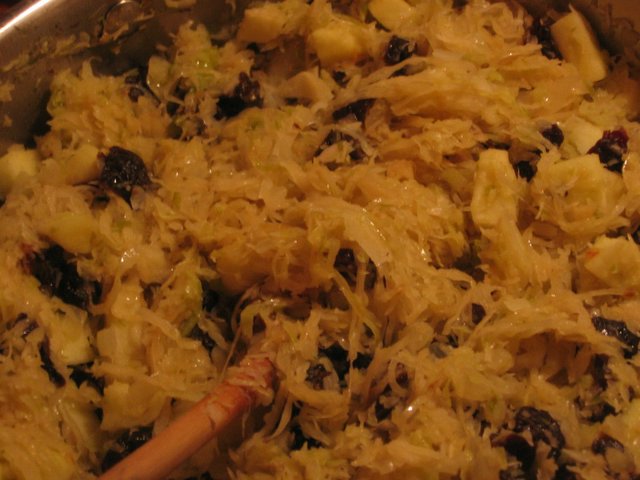
The dressing is one that I love. People weren’t talking about it, but there wasn’t much left, so that’s good. Essentially, you cook shredded cabbage and onions in a bit of oil, add sauerkraut, chopped prunes, chopped apples, a bit of chicken stock, and you’re good. Bake in the bird or out.

Oh, I actually have a picture of the dressing cooking:

Posted by Picasa

I frankly forgot all about picture-taking in the fun and the talk and the wine. This is a general problem between me and the camera.

Okay, the roasted potatoes. I’ve never managed to get my potatoes the way I want them. One pan came out nice and dark on the bottom, but even though they cooked just as long after I turned them, they never browned the same way on the other side. The other pan never really browned properly at all. What am I doing wrong? The outsides were fairly crispy, the interiors were nice, and the flavor was good (I used beef fat), but why can’t I get them to brown? Do I need that exhaust fan?

Finally, the strudel, which I really liked. What’s not to like? Essentially, we’re talking about a cheesecake wrapped in phyllo. Plus sour cherries that I had soaked in Amaretto. (Amaretto also found its way into my after-dinner coffee.)

I think only one or two people actually ate the cranberry relish. It was okay, but just got lost on the table. I suppose I could use the leftovers at Thanksgiving, except that I’m pretty sure no one in my family would eat horseradish.

Oh, and no one ate the afterdinner nuts or pomegranate or cheese or candied ginger. I guess there are people out there who actually stop eating when they get full, which seems mighty strange to me.

Fortunately, the nuts came in handy for tomfoolery.

Posted by Picasa

Thursday, November 17, 2005

Really annoying

I had almost completed a very long post on my dinner party, and now it's gone. Grr....

Tuesday, November 15, 2005

NAIS

Walter Jeffries of Sugar Mountain Farm left an important comment on my last post about NAIS. Basically, the government is trying to implement a mandatory animal identification and tracking system, on the argument that they need to be able to track outbreaks among animals. Which sounds reasonable enough. But the system, as currently proposed, is quite simply insane. Everyone who keeps even a single livestock animal - just one chicken or pig - would be required to register the animal with the government, The animal would then be assigned an ID number and possibly a tracking microchip. All movements of the animal off of the farm would be required to be reported. Veterinarians would be required to report unregistered animals. And it goes on and on.

How is this evil? Let me count the ways. Food prices in general would rise. Small farmers would be put out of business. It would become even more difficult for people to raise their own food. The winners would be the people who have caused a lot of the problems with safety in the food supply to begin with: Big Agriculture and their factory farms.

You really have to read the proposed plan to believe it, because NAIS sounds for all the world like something made up on the internet. So, while I'm getting together my thoughts on my dinner party for posting later, go here: http://animalid.aphis.usda.gov/nais/index.shtml
and be amazed.
(If you would prefer a good review, there's one here: http://www.dailykos.com/tag/NAIS)

There has been almost no media attention to NAIS, which is a good thing for the USDA. This plan has something to offend everyone. Small government conservatives don't like the interference of government in personal property. Nutty-crunchy foodie types don't like the attack on local organic farms. Some religious groups don't like the use of identification numbers or certain technologies. Of course, small farmers have everything to lose. And there's plenty to offend animal-rights activists, libertarians, chefs, 4H Club members, anyone concerned with the future of rural and small town America, and Martha-Stewart readers who want their own blue-egg-laying chickens. A powerful coalition could be developed here, if people get the word out. Do your part.

Tuesday, November 08, 2005

Off until Monday

I'm taking a little vacation. It will include a dinner party, though, so Monday I should have some good pictures to post. Have a good week, everyone.

The mushroom recipe

This recipe is from Please to the Table, with some adjustments. I use it all the time, because the mushrooms are very good and can be made a couple weeks ahead of time, if need be. I love food that can be made ahead. (And I *heart* my deep-freeze, too, but that's another post).

Okay. Anya calls for 1 1/2 pounds of white button mushrooms. I always use crimini (or baby bellas, which I believe are just a silly marketing-department-invented name for the same thing). They have a deeper mushroom flavor. I'm sure you could do this with all sort of exotic mushrooms, if you have access to them. Because more often than not I can only get mushrooms in 10 oz packages, I just use two packages.

Trim the stem ends to get rid of the tough bit at the very tip, then wash the mushrooms. Usually, the rule is that you have to wipe each mushroom individually with a damp towel, so that the mushrooms don't absorb excess water. But these mushrooms are going into a pot of water anyway, so don't worry about it. Just wash them. Halve any that are huge. Now put them in a pot and squeeze the juice of one fresh lemon all over them, then let them sit for about 5 minutes while you putter around. Here's the water part: Anya calls for 3/4 cup or enough water to cover. I don't know what type of mushroom she was sampling when she decided 3/4 cup would cover 1 1/2 pounds of mushrooms, but it doesn't work. You can't "cover" mushrooms with water anyway, because they float. But I usually use about 2 cups so that every mushroom is at least somewhat immersed.

Anya leaves you on your own when it comes to adding the salt. I would say I use about two teaspoons. And here's my personal recipe addition: I throw in 1/2 cup dried mushrooms, quickly rinsed, at this point.

Bring the mushrooms to a boil, reduce heat and simmer for ten minutes uncovered. Then take out the mushrooms. Because I use at least twice the water Anya does, I let the mushroom water keep simmering for a couple minutes here to concentrate it a bit. When you decide you've had enough of that, measure out 1 cup of the mushroom-water. Don't discard the rest; throw it into chicken stock. Return the water to the pot along with 1 cup of tarragon vinegar (Anya says 3/4 cup of each, but she's being stingy.) Add a teaspoon of sugar, about a dozen peppercorns, and three bay leaves. If you wanted these hot, this would be a good place to add some red pepper flakes. Bring to a boil, cover, reduce heat, and simmer five minutes. Take off the heat and allow to cool. I've forgotten to let it cool a bunch of times; the mushrooms come out just fine anyway.

Now, pull out a nice glass jar and layer your mushrooms alternately with roughly chopped dill (Anya says 12 sprigs, I just use a goodly amount) and about 5 or 6 garlic cloves, sliced. Pour the vinegar mixture over the mushrooms, and then pour in enough olive oil to cover. Refrigerate.

You have to wait at least two days before these are ready to eat, and a week is better. Serve within a month. I like to dig out the dill, which won't look very nice, but leave the garlic cloves, which taste pretty good.

Monday, November 07, 2005

Pickled mushrooms, pickling

I'll post the recipe tomorrow. Posted by Picasa

Friday, November 04, 2005

Odds, ends

I corned my own brisket for the first time last weekend and I would give it an A-. I'll reserve the A+ for a slightly more tender result, maybe fom longer brining or lower heat. But, as usual, the grass-fed beef meant a deep, meaty flavor, and home-brining gave me a less salty corned beef than the store-bought version. I'm pretty salt-sensitive, so that was good by me. And it took all of five minutes to mix the brine and throw the brisket in, so there really wasn't much extra work involved. Given how hard it is to find organic corned beef outside of the St. Patrick sale at Whole Foods, I think I'll be doing this in the future.

I also finished the last of the excellent pork chops by browning them in a skillet, then baking them on a bed of sauerkraut mixed with raisins and apple cider, which was great. How did I reach my thirties without knowing how good sauerkraut is? It was just never eaten in my house growing up, and I don't encounter it in restaurants. Maybe if I had liked hotdogs, I would have known, but I didn't.

I also made a very nice roasted pumpkin soup with one of the sugar pumpkins from my farm share. Nothing exotic, just pumpkin, chicken stock, roasted garlic, some spices, onion, and a bit of cream, pureed until smooth. But good, especially with some tart plain yogurt swirled into the center of the bowl for a bit of contrast.

I forgot to take pictures of these things. I never remember to take pictures of dinner at dinnertime, because I'm hungry. Then I have the question: do I take a picture of the leftovers, looking less-than-beautiful despite being tasty, or do I just forget about it? Usually I opt for the latter.

I finally broke down and bought Fergus Henderson's The Whole Beast: Nose to Tail Eating, and was thrilled to find several recipes for pork belly. I have a nice package of pork belly in my freezer that I had no idea how to approach. Of course, I will have to get over my psychological resistance to the idea of sitting down to a dish which is at least as much fat as meat, but I think I can manage it. Mmmm...fat....

I've also been spending a lot of time fantasizing about my place in the country that I am going to buy someday soon,* and the chickens I intend to keep when I get there. I go here: http://www.mcmurrayhatchery.com/
and I spend time choosing breeds, which is a little insane for someone whose apartment doesn't even have a fire escape, but that's okay. It's a difficult choice, after all, because you have to balance the desire for good quality meat or egg production with the yearning for exotic, handsome birds. I find the Golden Polish particularly appealing, but there is something to be said for the charm of the traditional Rhode Island Red. Sigh...


* By "soon", I mean "as soon as I can convince a bank to give me a mortage for the entire cost of a home based on my charm and wit.

Tuesday, November 01, 2005

Blackberry/Wine Sorbet


It's not the greatest picture, but it is a delicious and very quick dessert.

I've been intending to post this for a while. I was going to make this for the wine-pressing night, since it was appropriate and quick and I didn't have much time to cook. But the day got moved up, so I didn't have any time to cook at all. That was okay; I used a little of the bottle of 2003 homemade I received for services rendered (heave-hoing on the press) to make this for myself over the weekend.

I'm not usually crazy about sorbet. It's nice and all, but really I would rather have ice cream. Sorbet is having your dessert and your diet, too. Sorbet is about appreciating the purity of fruit, and appreciation is all very well as it goes, but when was the last time you rolled your eyes in pleasure while appreciating the purity of fruit? I thought not.

But this sorbet, I like. When I was a kid, I assumed wine would taste like blackberry juice, dark and elegant and sweet. Of course, it didn't, though there are blackberry notes in some wines. But it seemed natural to me to pair the two, wine and blackberries, in a sorbet. I went online to see if there were any recipes, and I managed to track down just a few, which I then merged to come up with this:

1 10 oz bag IQF organic blackberries
1/3 cup sugar
2/3 cup fruity wine
1 squeeze lemon juice
Puree fruit. Put 1/3 cup pureed blackberries into a saucepan with 1/3 cup sugar and heat while stirring until sugar is dissolved. Allow to cool, then mix with remaining puree and lemon juice. (If you hate seeds more than you hate cleaning sieves, put through a sieve now). Freeze in ice cream freezer.

The flavor is powerful enough to give this sorbet an oomph most sorbets lack. It tastes like its color, dark and a bit mysterious and seductive. The only negative thing I have to say about it is that it doesn't scoop very smoothly. I think the alcohol content makes for a more sudden melting point, so the sorbet can quickly go from a little too hard to melted. A minor point, probably easily fixed by putting the sorbet in the fridge to thaw gently. I'm never patient enough for that business. The mouthfeel is fine, though, not icy in the least.

I later found out that Trader Joe's sells a Blackberry Merlot sorbet. Very disappointing. Nothing new under the sun and all that... Posted by Picasa